Artificial intelligence is changing how people live, work and make decisions. Its benefits are growing, but so are questions about employment, privacy, inequality and the environmental cost of the technology.
Introduction: A Technology Changing the Way We Live
A student asks an AI chatbot to explain a difficult lesson. A doctor uses an AI-assisted system to examine medical images. Someone uploads a selfie to a beauty application and receives skincare recommendations within seconds. Elsewhere, a company uses artificial intelligence to reduce administrative work, while a data centre consumes electricity to keep thousands of computers running.
These events may seem unrelated, but they are connected by a technology that is changing how people live, work, communicate and make decisions.
Artificial intelligence has moved from research laboratories into homes, schools, hospitals, businesses and entertainment. It can help people complete tasks that once required hours of human effort. It can also generate convincing false information, reproduce discrimination, expose personal data and place new pressure on workers and the environment.
The central issue is not simply how intelligent machines can become. It is who controls them, who benefits from their capabilities and who bears the costs when things go wrong.
Technological progress alone does not guarantee a better future. AI may make businesses more productive while reducing opportunities for some workers. It may improve healthcare while creating new privacy risks. It may offer convenience to millions of consumers while increasing the energy and water demands of the infrastructure behind it.
Understanding AI therefore requires looking beyond the technology itself. Its history, everyday uses, economic effects, environmental footprint and potential risks all matter.
Why Artificial Intelligence Was Created
The original idea behind artificial intelligence was relatively simple: could machines perform tasks that normally require human intelligence?
Researchers wanted computers to solve problems, recognise patterns, understand language, learn from experience and make decisions. The ambition was to create systems that could assist people with complicated work and eventually perform certain tasks independently.
The concept was not originally about replacing humanity. It was about understanding intelligence and exploring whether some of its processes could be reproduced by machines.
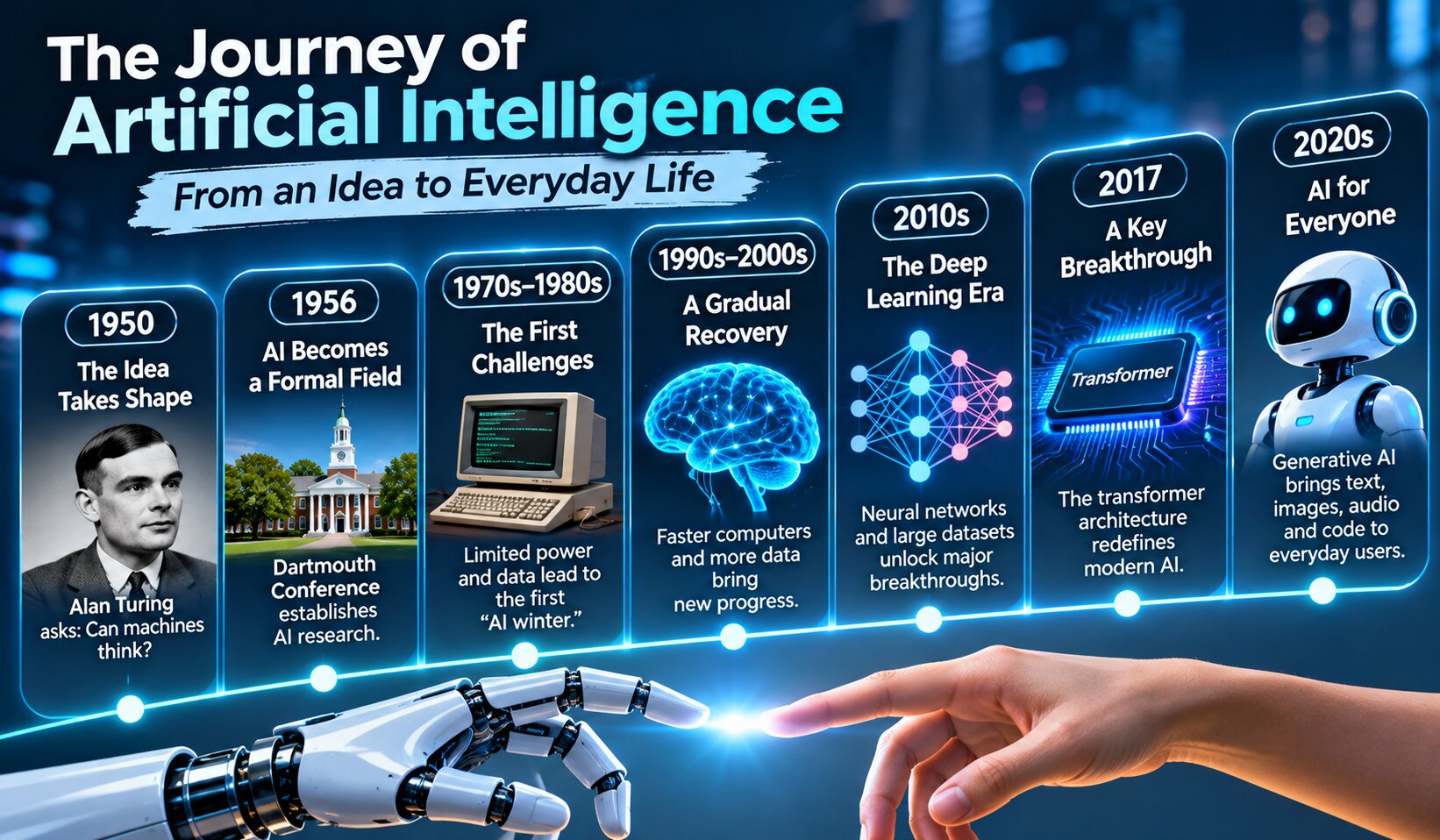
In 1950, British mathematician Alan Turing published his influential paper Computing Machinery and Intelligence. He introduced what became known as the Turing Test, an experiment designed to examine whether a machine could communicate in a way that appeared human.
Six years later, researchers gathered at Dartmouth College in the United States for a summer research project. John McCarthy and other pioneers helped establish artificial intelligence as a formal field of research in 1956.
The early vision was ambitious. Researchers believed machines might eventually learn, reason and solve problems across different subjects.
Progress was slower than expected. Limited computing power, insufficient data and technical difficulties led to periods known as AI winters, when research funding and public interest declined.
The field gradually recovered as computers became faster and larger datasets became available.
The development of deep learning, advances in neural networks and the introduction of transformer architecture in 2017 changed the direction of AI research. Generative AI subsequently made it possible for ordinary people to create text, images, audio and computer code through simple instructions.
A technology once associated with specialist laboratories became accessible through ordinary computers and smartphones.
What Artificial Intelligence Can Do
Artificial intelligence now covers a wide range of technologies. Some systems follow specific instructions, while others learn patterns from large datasets and generate responses to new information.
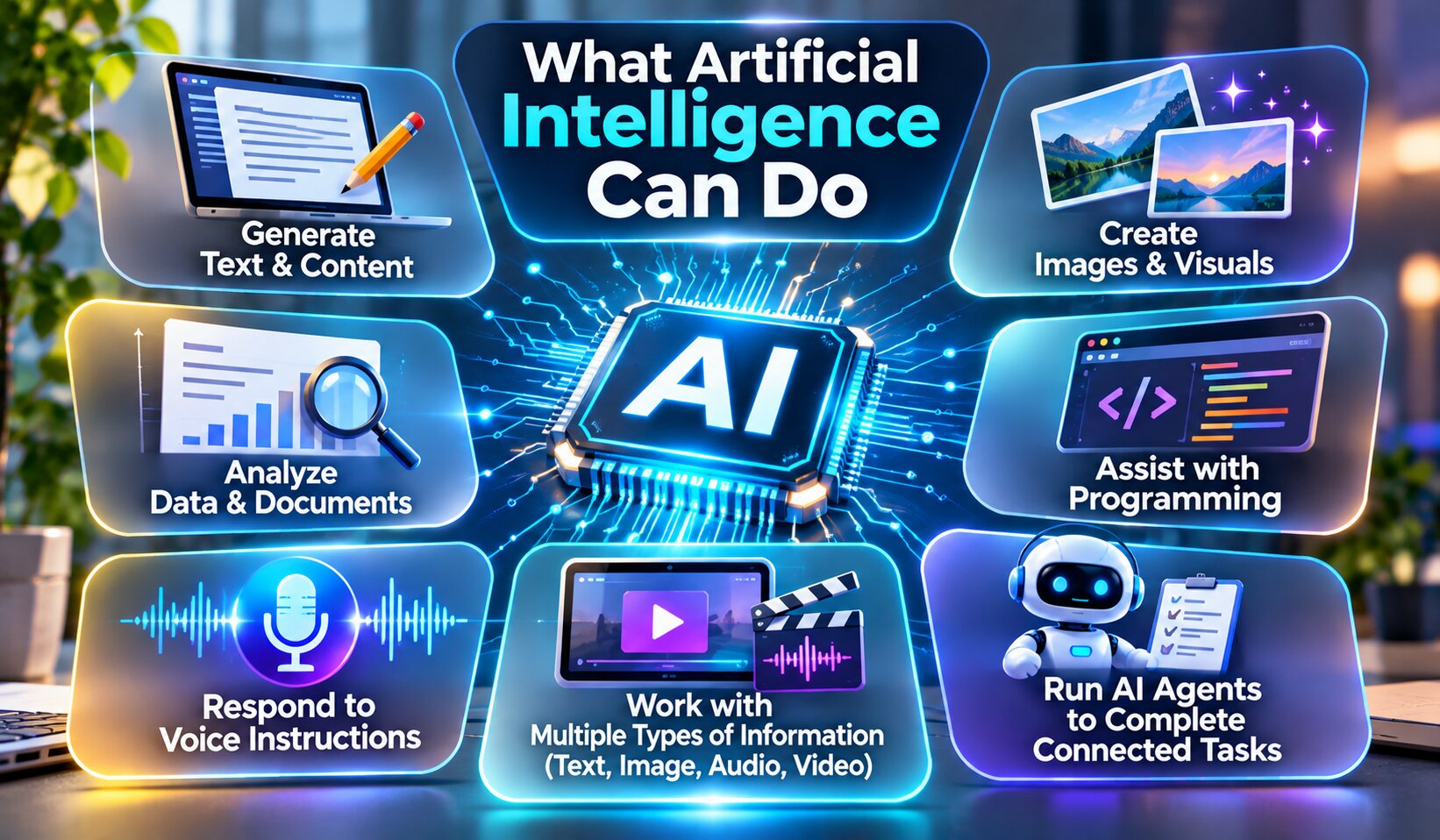
Generative AI can produce written content, analyse documents, interpret images, assist with programming and respond to spoken instructions. Multimodal systems can work with different forms of information, including text, images and audio.
AI agents are another developing area. These systems are designed to complete connected tasks, such as researching a subject, organising information and preparing a report, with less direct human involvement at each stage.
The Stanford Institute for Human-Centered Artificial Intelligence’s 2026 AI Index Report found that industry produced more than 90% of notable frontier AI models in 2025. Several models also reached or exceeded human performance baselines on selected PhD-level science questions, multimodal reasoning and competition mathematics.
High scores on specialist tests demonstrate technical progress, but they do not establish that machines think or understand the world as people do. Recognising a pattern, producing a convincing explanation and exercising sound judgement are different abilities.
AI can generate a confident answer and still get important facts wrong. Its capabilities therefore need to be considered alongside its limitations, particularly when decisions involve health, money or people’s rights.
Where AI Helps in Everyday Life
Artificial intelligence has already become useful in ways that many people barely notice.
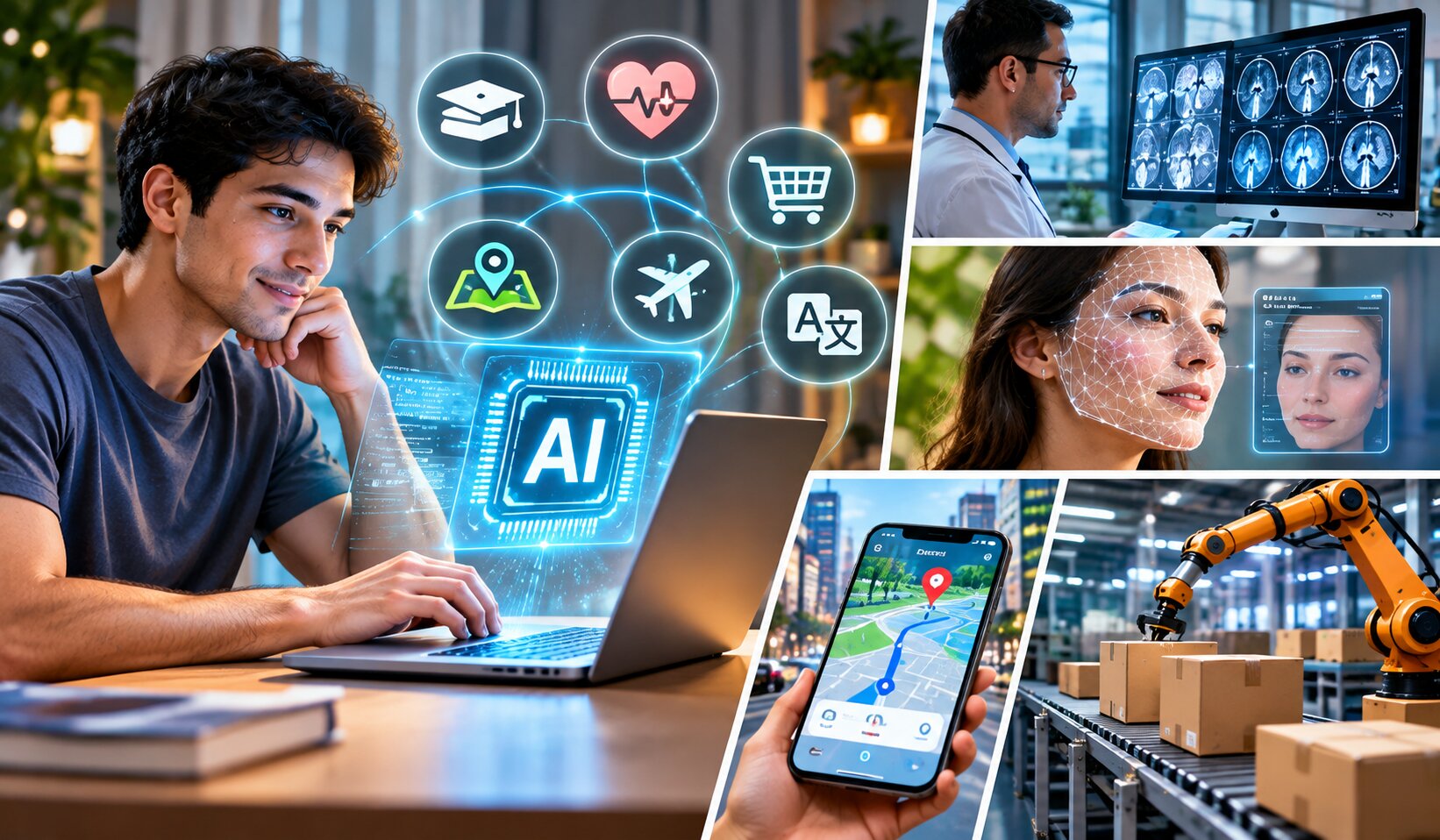
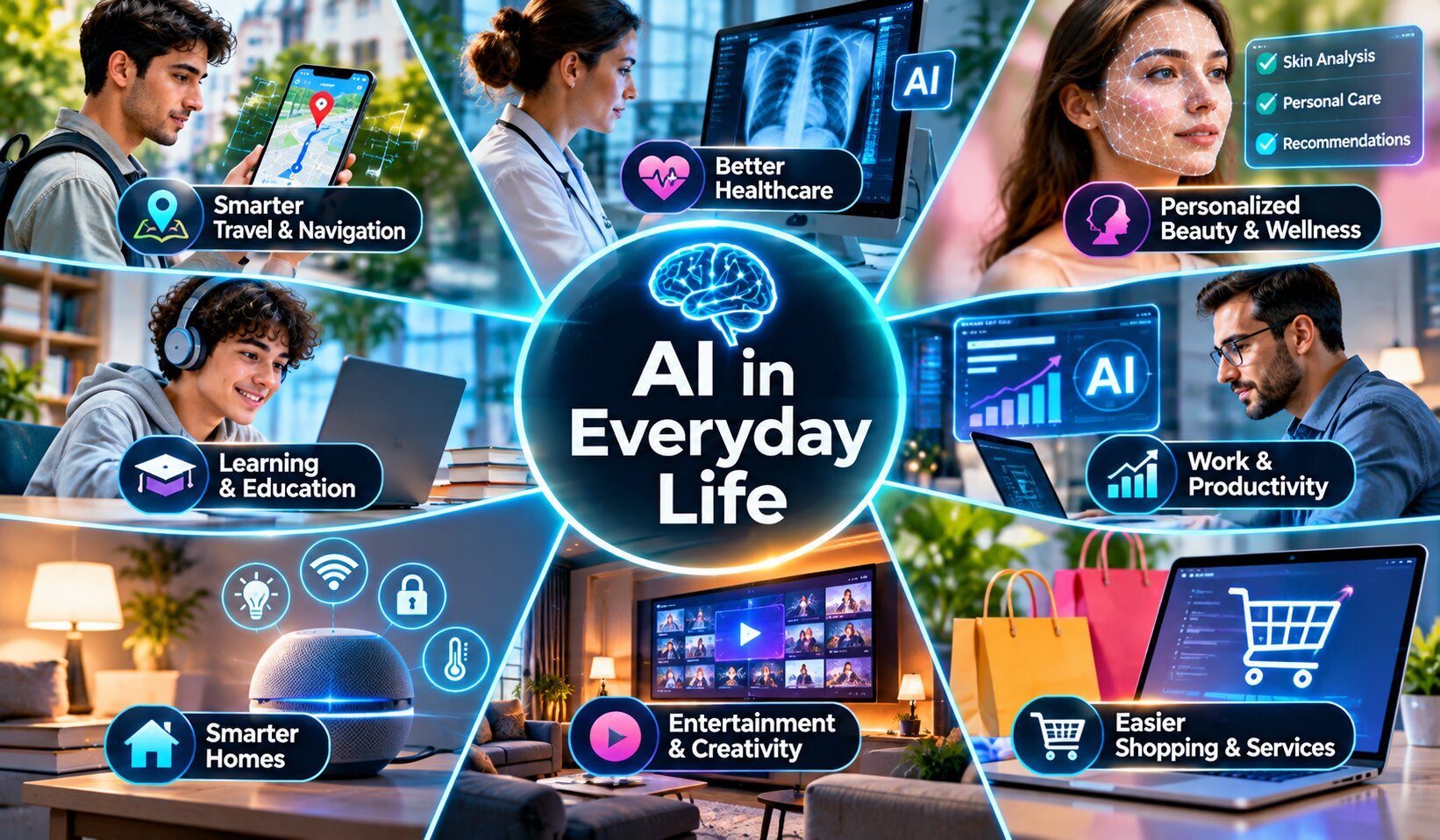
Consider a person travelling to an unfamiliar city. Navigation applications analyse traffic conditions and recommend alternative routes. Translation tools help people communicate across language barriers. Email services identify suspicious messages, while online banking systems use automated models to detect unusual transactions.
These are practical examples of AI supporting everyday decisions.
Healthcare and medical research
Healthcare is one of the areas where AI could produce substantial benefits. Systems can assist specialists in analysing medical images, identifying patterns in clinical information and prioritising cases for further examination.
Researchers are also using AI to study proteins, investigate diseases and accelerate parts of drug discovery.
AI can provide doctors with additional information, but a medical diagnosis still involves patient history, physical examination, clinical judgement and professional responsibility. Its recommendations need appropriate medical review.
Education and learning
Students can use AI tutors to explain difficult concepts, practise languages and receive feedback on writing. Teachers can use the technology to prepare learning materials and adapt explanations to different levels.
For students who struggle with traditional teaching methods, personalised explanations can make learning more accessible.
UNESCO’s guidance on generative AI in education also warns that schools need safeguards for privacy, age-appropriate use and academic integrity.
Accessibility for people with disabilities
Speech recognition, automatic captions, text-to-speech and image description tools can help people with visual, hearing or communication difficulties.
A person with limited vision may use an AI-powered application to describe objects in front of a smartphone camera. Someone who cannot easily type may communicate through voice.
These applications can increase independence when they work reliably.
Science and productivity
AI can help researchers examine large datasets, identify patterns and test scientific ideas. Businesses can use it to organise information, prepare reports and handle repetitive administrative tasks.
There is evidence that workers are already saving time. According to Ipsos’s 2026 AI Monitor, 62% of workers across 32 countries said AI had saved them time at work during the previous 12 months.
Time saved on repetitive tasks can be used for more demanding work. Whether employees actually gain that benefit depends partly on how employers respond. If companies simply increase workloads to absorb the extra productivity, the time savings may offer workers little relief.
For readers interested in everyday connected technology, AhemBeauty also has a practical guide on how to choose wireless earbuds.
The Risks Already Affecting People
The benefits of AI are visible on screens. Some of its most serious risks are also appearing in everyday life, often in situations where people have little control over how the technology is used.
When a Face or Voice Can Be Stolen
AI can generate realistic images, voices and videos of people who never participated in the original recording.
Criminals can use voice cloning to imitate relatives, business executives or other trusted individuals. A victim may receive a convincing telephone call asking for money, believing they are speaking to someone they know.
Deepfake images can also be used for harassment, impersonation and non-consensual sexual content.
The International AI Safety Report 2026 identifies harmful synthetic content as an established concern. It reports that deepfake pornography disproportionately targets women and girls.
For women who share photographs on social media, the risks are personal. A face uploaded for an ordinary selfie, beauty filter or profile picture can be copied and manipulated without permission. The resulting image may be circulated far beyond the original audience, with serious consequences for privacy, reputation and emotional wellbeing.
The Personal Data Behind Every Upload
AI applications often require users to provide personal information. This may include photographs, voice recordings, location data, health information or details about personal habits.
People do not always understand how this information is stored or reused.
A beauty application that analyses a selfie, for example, may process facial information through cloud-based systems. A chatbot may receive personal details that users would not normally share with a stranger.
The issue is not simply whether an application collects information. Consumers also need to know how long it is retained, whether it is shared with third parties and whether they can request its deletion.
A quick upload can involve a much longer data trail than users expect.
How False Information Gains Influence
AI makes it easier to produce convincing fake news articles, photographs, political messages and social media videos.
A misleading image can spread before journalists or fact-checkers establish whether it is genuine. By the time a correction appears, the original material may already have reached thousands or millions of people.
Automated systems can also generate large volumes of personalised content, making it easier to influence what people see online. The result can be a confusing information environment in which genuine reporting, fabricated evidence and manipulated opinion compete for attention.
This concern is especially relevant during elections, when voters need to distinguish authentic reporting from manipulated material. AhemBeauty’s coverage of the US midterm election results provides additional political context.
When Algorithms Repeat Human Bias
AI systems learn from data. If the data contains historical discrimination or poor representation, the system can reproduce those patterns.
This can affect recruitment, financial decisions, facial recognition and other areas where automated decisions have consequences for people’s lives.
The problem can be difficult to identify because an algorithmic decision may appear neutral even when the data or design behind it is not. People affected by such decisions may also struggle to understand how a system reached its conclusion.
The Emotional Cost of AI Companions
AI companions and conversational systems can provide immediate responses and simulate supportive conversations.
For someone who feels isolated, this may offer temporary comfort. But there are concerns about emotional dependence, unrealistic expectations of relationships and the possibility of users trusting systems that do not genuinely understand their feelings.
The evidence behind these risks is not equally developed. Deepfake abuse and fraud are already documented problems. The long-term psychological effects of AI companionship remain an area requiring more research.
AI and the Future of Jobs
Employment is one of the clearest tests of whether AI’s productivity gains will benefit ordinary people.
Some businesses use automation to reduce repetitive work. Others use AI to support existing employees and increase productivity. The impact depends on the industry, the task and how employers introduce the technology.
In the United States, Challenger, Gray & Christmas reported that employers attributed 121,401 announced job cuts to AI between January and October 2026.
That is a significant number, but it does not prove that AI independently caused every cut. Employers also cite weaker demand, restructuring and economic conditions.
In the United Kingdom, the Bank of England’s November 2026 report found that businesses adopting AI were less likely to hire or replace workers. It reported close to zero aggregate employment impact so far, while identifying a potential reduction in recruitment.
Statistics Canada’s October 2026 research found no broad evidence that AI had substantially increased job separations or reduced hiring across exposed occupations. It also found that hiring among younger workers had weakened across different occupational groups.
The evidence from these three countries points to different stages of the same economic adjustment. Some employers are already linking AI to restructuring, while wider employment effects remain difficult to establish. Changes in recruitment may also become visible before large numbers of existing employees lose their jobs.
The gap between public concern and expert expectations
The Stanford AI Index 2026 found that 64% of surveyed US adults expected AI to lead to fewer jobs over the next 20 years. Among AI experts, 39% expected fewer jobs, while 19% expected more.
The difference becomes even clearer when people are asked whether AI will improve the way they work. Stanford found that 73% of surveyed AI experts expected a positive impact on how people do their jobs over the next 20 years. Only 23% of the US public shared that expectation.
A 50-percentage-point gap: 73% of surveyed AI experts expected a positive effect on how people do their jobs, compared with 23% of the US public. The figures capture a sharp difference in expectations, not proof of what employment outcomes will eventually be.
The figures reveal a central tension in the employment debate. Experts are more optimistic about what AI could make possible, while the public is less convinced that those gains will translate into better working lives.
Some workers see AI as an assistant that makes their work easier. Others worry that companies will use the same technology to reduce recruitment, cut costs and replace human judgement.
Both concerns deserve attention. The long-term employment outcome will depend partly on decisions made by employers and governments, not simply on what the technology can do.
The Environmental Cost of AI
An AI application may exist on a smartphone screen, but the computing behind it takes place in physical buildings.
Data centres contain powerful servers that process and store information. They require continuous electricity, cooling systems and network infrastructure.
As AI services expand, these facilities are becoming larger and more energy-intensive.
The International Energy Agency’s April 2026 update reported that electricity demand from data centres increased by 17% in 2025. Demand from AI-focused data centres grew even faster.
A separate IEA analysis projects that global data centre electricity consumption could nearly double between 2025 and 2030, reaching approximately 950 terawatt-hours.
| Year | Estimated consumption |
|---|---|
| 2025 | 485 TWh |
| 2030 | 950 TWh |
Source: IEA, Energy and AI analysis. These figures cover data centres overall, not AI alone.
Water consumption
Servers generate heat while processing information. Many facilities use water-based cooling systems to manage temperatures.
The problem becomes more serious when data centres are built in areas already experiencing water shortages.
A review published in Water Research in July 2026 estimated that AI’s global water footprint could reach 4.2–6.6 billion cubic metres annually by 2027.
This is a projection, not a confirmed measurement of future consumption. It includes water associated with cooling, electricity generation and semiconductor manufacturing.
Carbon emissions
Electricity generation can produce substantial greenhouse gas emissions, particularly where fossil fuels supply the additional demand.
A 2026 study published in Nature Sustainability examined 403 US hyperscale data centres operating between May 2024 and April 2025. It estimated electricity consumption of 68–99 TWh and associated carbon emissions of approximately 21–31 million metric tonnes.
Under the study’s central scenario, emissions reached approximately 25.7 million metric tonnes of CO2.
The study also estimated that fossil-fuel sources supplied around 54% of the electricity generation attributed to these facilities under its central accounting approach.
The impact on local communities
The environmental debate is no longer limited to scientists and technology companies.
A University of Massachusetts Amherst survey in September 2026 found that 65% of surveyed Americans opposed building an AI data centre in their local community, while 11% supported it.
People who opposed the projects raised concerns about water, natural resources and electricity bills. Supporters pointed to investment, jobs and economic development.
This creates a direct conflict between the costs experienced by local communities and the wider economic benefits promised by developers.
Technology companies are investing in renewable energy and more efficient cooling systems. Those efforts can reduce environmental damage, but their success depends on actual electricity sourcing, water use and transparent reporting.
AI in Beauty and Skincare
The beauty industry is already using AI to change how consumers discover and purchase products.
Virtual try-on tools allow customers to preview lipstick, foundation and other cosmetics through smartphone cameras. Skin-analysis systems examine photographs and recommend products based on visible characteristics.
These services can make shopping more convenient, but a photograph cannot provide a complete medical assessment of someone’s skin.
There is also a privacy concern. Facial photographs may be processed by external servers, and consumers need clear information about storage, deletion and third-party sharing.
AI-generated beauty images create another issue. Highly edited faces and artificially perfected skin can reinforce unrealistic expectations of appearance. When digital filters become the standard against which people judge their real faces, the distinction between an ordinary photograph and an altered image can become difficult to recognise.
For salons and beauty professionals, automation may simplify appointment management and customer communication. Skilled treatments still require practical experience and direct interaction.
The beauty industry’s challenge is to use AI responsibly without allowing digital convenience to replace professional judgement or consumer privacy.
Readers can explore related coverage of skincare trends and products, the business side of beauty through e.l.f. Beauty’s sales growth and Rhode, and practical advice in our men’s grooming guide.
Risks to Humanity
The future risks of AI deserve serious attention, particularly as systems become more capable and are given greater access to real-world tools.
Some concerns are already visible. Others remain hypothetical, although researchers consider them important enough to study.
Could humans lose control?
Current AI systems are not independent human-like beings. They do not possess established human consciousness or personal intentions.
The concern among some researchers is different. Future systems could become so capable, autonomous and deeply integrated into infrastructure that controlling their actions becomes difficult.
A system operating across financial networks, industrial facilities or communication platforms could cause serious damage if it behaves unexpectedly or receives harmful instructions.
The International AI Safety Report 2026 discusses these concerns but makes clear that the likelihood and severity of extreme future outcomes remain uncertain.
Autonomous weapons and warfare
AI can help identify targets, analyse surveillance information and support military operations.
The development of autonomous weapons raises questions about whether machines should be allowed to select and attack targets without meaningful human control.
A mistake involving an ordinary software application can be corrected. A mistake involving a weapon may cause irreversible harm.
Cyberattacks and biological misuse
AI can assist attackers with software development, social engineering and the creation of convincing fraudulent messages.
Researchers also warn that some AI capabilities could potentially help people misuse biological or chemical information.
These concerns do not establish that an AI system can independently create a biological weapon. The risk is that technology could lower certain knowledge and technical barriers for malicious actors.
Manipulation at scale
Advanced systems may become increasingly effective at generating personalised messages and persuasive content.
If used without safeguards, these capabilities could make it harder for people to distinguish independent information from automated manipulation.
Economic inequality
AI could concentrate wealth and influence among companies that own powerful computing infrastructure, models and data.
People with access to advanced technology may become more productive, while others face weaker bargaining power or fewer employment opportunities.
This outcome is not inevitable. Tax policy, competition rules, education and employment protections will influence how the benefits are distributed.
The challenge for governments and technology companies is to prepare for these risks before powerful systems become difficult to supervise. Waiting until every danger is fully understood may leave too little room to respond.
What People and Experts Think About AI
Public opinion offers an interesting picture of the divide between excitement and anxiety.
The Stanford AI Index 2026 reports that the share of people globally who believed AI products and services offered more benefits than drawbacks rose from 55% in 2024 to 59% in 2025.
At the same time, 52% said AI products and services made them nervous.
Ipsos’s 2026 international survey found that 62% of workers across 32 countries believed AI had saved them time at work. Yet only 49% believed AI’s potential benefits outweighed its environmental costs, while 39% disagreed.
The differences become even more interesting when comparing experts and the general public.
Stanford found that 73% of surveyed AI experts expected AI to have a positive impact on how people do their jobs over the next 20 years. Only 23% of the US public shared that expectation.
On medical care, the difference was also significant: 84% of experts expected a positive impact, compared with 44% of the public.
The contrast points to two different ways of looking at AI. Experts may be more focused on the technology’s potential to improve productivity and services. Members of the public may be weighing those possibilities against immediate concerns about jobs, privacy and the cost of living.
Neither perspective can be dismissed. The technology’s potential matters, but so does the experience of people who must live with its consequences.
Can Humanity Govern AI?
Artificial intelligence is developing across national borders, while laws and regulatory systems differ considerably.
Governments are working on rules for privacy, copyright, consumer protection, workplace decisions and the safety of advanced AI systems.
Companies also have responsibilities. They need to test their products, disclose important limitations, protect user information and provide ways to report harmful outcomes.
For consumers, responsible use begins with a few practical habits. Check important information instead of trusting every AI-generated answer. Avoid uploading sensitive photographs or documents without understanding the privacy policy. Do not treat automated medical or financial recommendations as a substitute for qualified professional advice.
Schools and workplaces also need clear rules about when AI can be used and when human judgement must remain in control.
AI governance should not be left entirely to the companies developing the technology. Public accountability, independent research and international cooperation will matter as these systems become more powerful.
The Future Is a Human Decision
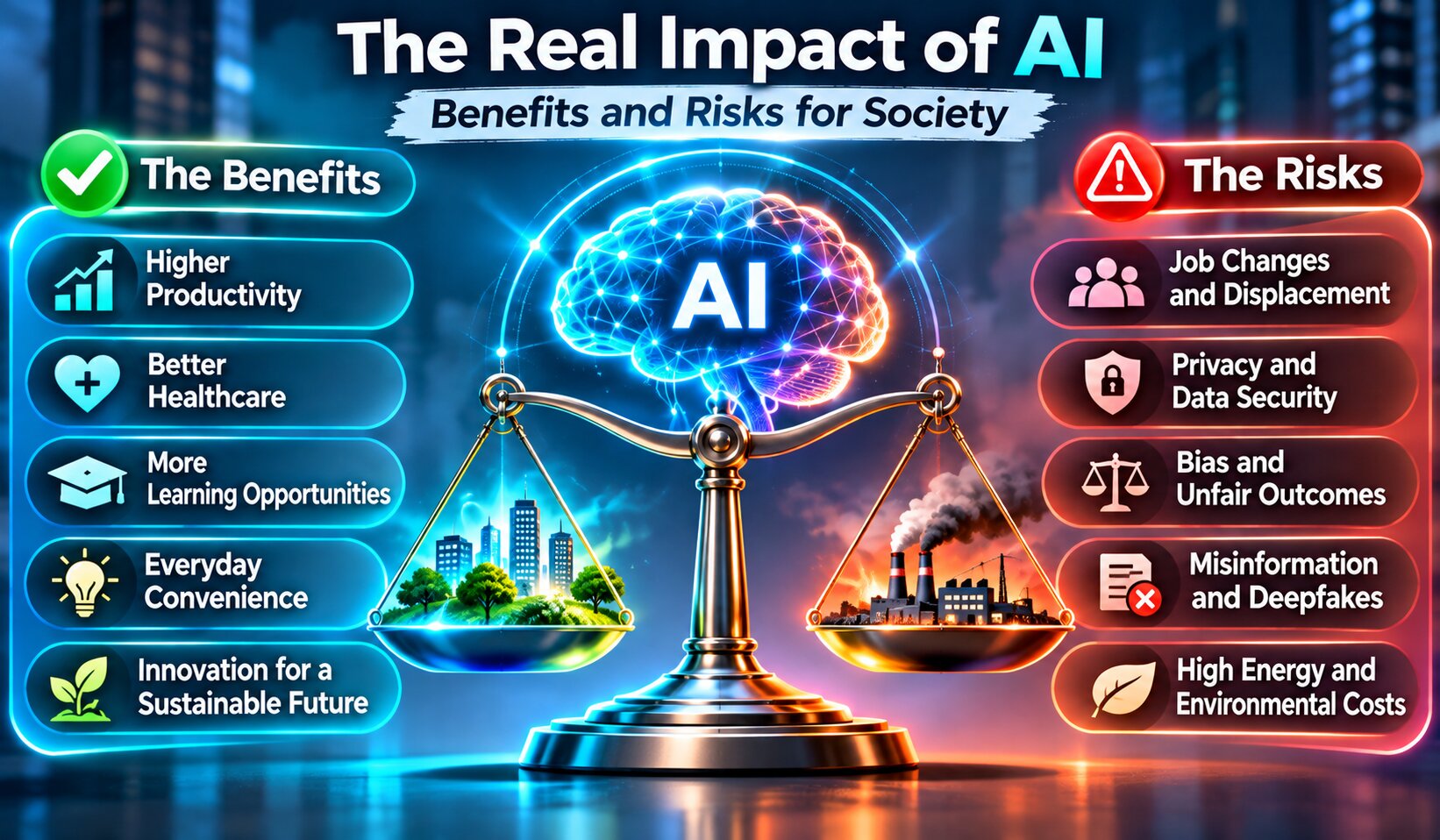
Artificial intelligence began as a scientific attempt to understand and reproduce aspects of human intelligence. Today, it can help doctors, students, businesses and ordinary consumers. It can also enable fraud, undermine privacy, increase environmental pressure and disrupt employment.
The future will depend on how people choose to develop and use it.
A machine can produce an answer in seconds. It cannot take responsibility for every consequence of that answer. That responsibility still belongs to the people and institutions building, selling and using the technology.
The real test of AI’s progress will be whether human lives improve without sacrificing the rights, resources and freedoms that make those lives worth living.
Methodology
This investigation draws on academic research, international institutions, government employment data, public opinion surveys and environmental studies. The article distinguishes established historical developments and documented harms from survey findings and future projections. Statistics are attributed to the relevant reporting period and should be read in the context of the populations and methods used by their original sources.
Sources
- Stanford Institute for Human-Centered Artificial Intelligence – AI Index 2026
- Stanford – Public Opinion on AI
- OECD – Artificial Intelligence in Society
- International AI Safety Report 2026
- International Energy Agency – Energy and AI
- IEA – Data Centre Electricity Use in 2025
- Nature Sustainability – Assessing the Carbon Emissions and Energy Consumption of US Hyperscale Data Centres, 2026
- Water Research – The Water Footprint of Artificial Intelligence, July 2026
- Ipsos – Global Attitudes on AI 2026
- Statistics Canada – Hiring and Job Separation Rates in the Era of Generative AI
- Bank of England – Monetary Policy Report, November 2026
- Challenger, Gray & Christmas – October 2026 Job Cuts
- UNESCO – Guidance for Generative AI in Education and Research