Published: November 16, 2026 Author: Itim Kibkae Category: Kitchen & Dining
Stainless Steel Cutting Boards Are Getting Attention in 2026. Are They Worth It?
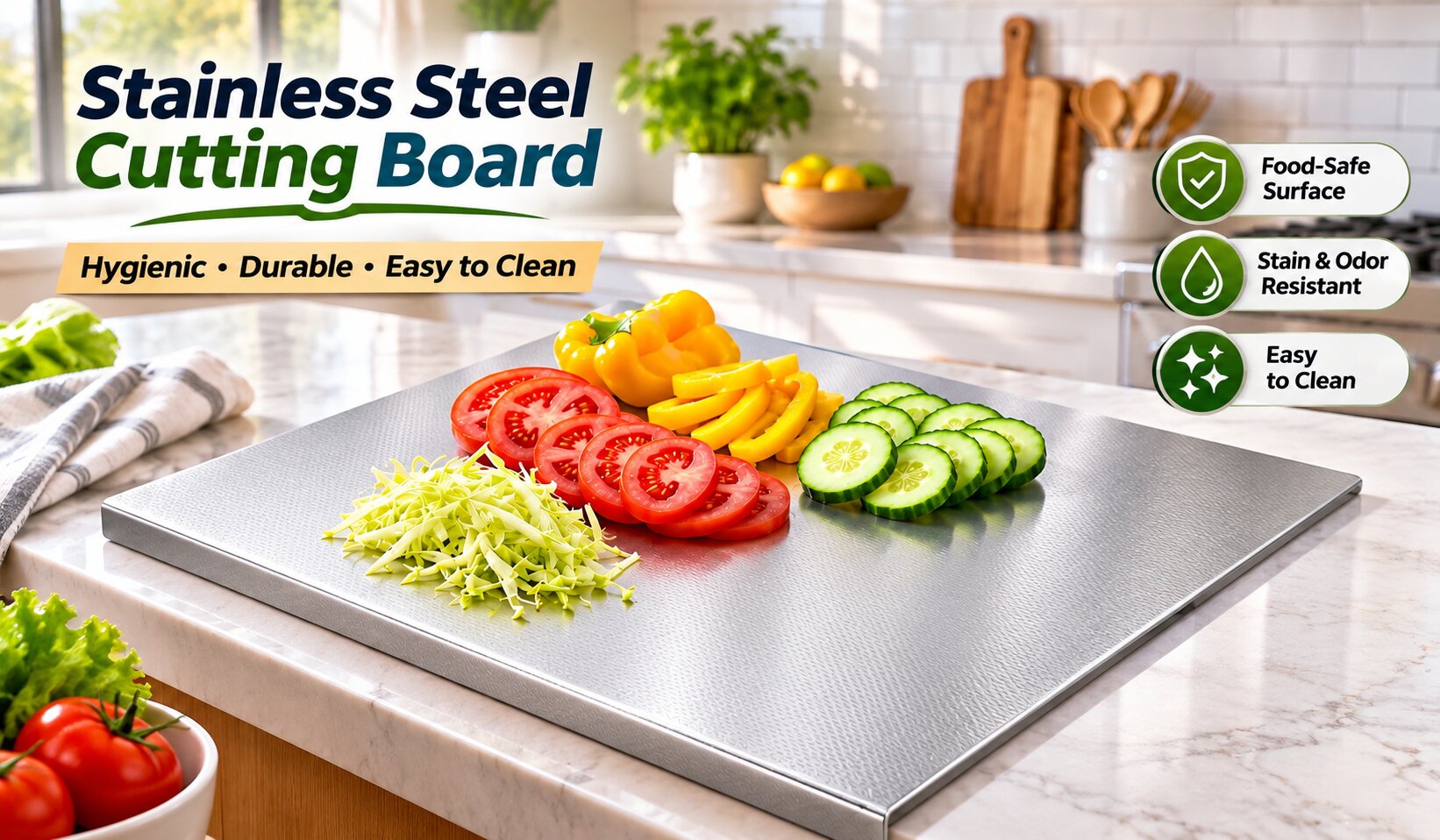
Stainless steel cutting boards are attracting attention from home cooks looking for alternatives to traditional wooden and plastic chopping boards. Their smooth metal surfaces, modern appearance and resistance to deep knife marks make them an interesting option for people who want a different approach to food preparation.
The interest is part of a wider conversation about kitchen materials. Consumers are asking questions about plastic, food-contact surfaces, cleaning routines and the long-term condition of everyday kitchen equipment. Stainless steel has entered that conversation because it is already widely used in food preparation equipment and commercial kitchens.
But a cutting board has a different job from a storage container or kitchen worktop. It must provide a stable surface for chopping while protecting the sharp edge of a knife. A material that is easy to clean may still be uncomfortable to use every day.
That is the central question behind the search for the best stainless steel cutting board in 2026. Is the convenience of a metal surface worth the potential drawbacks?
A published knife-sharpness test suggests that buyers should think carefully before replacing every board in their kitchen. Stainless steel can be useful for selected tasks, but it may not be the best everyday surface for someone who regularly uses quality kitchen knives.
Here is what the available research, product specifications and current product listings tell us.
Why Are People Considering Stainless Steel Cutting Boards?
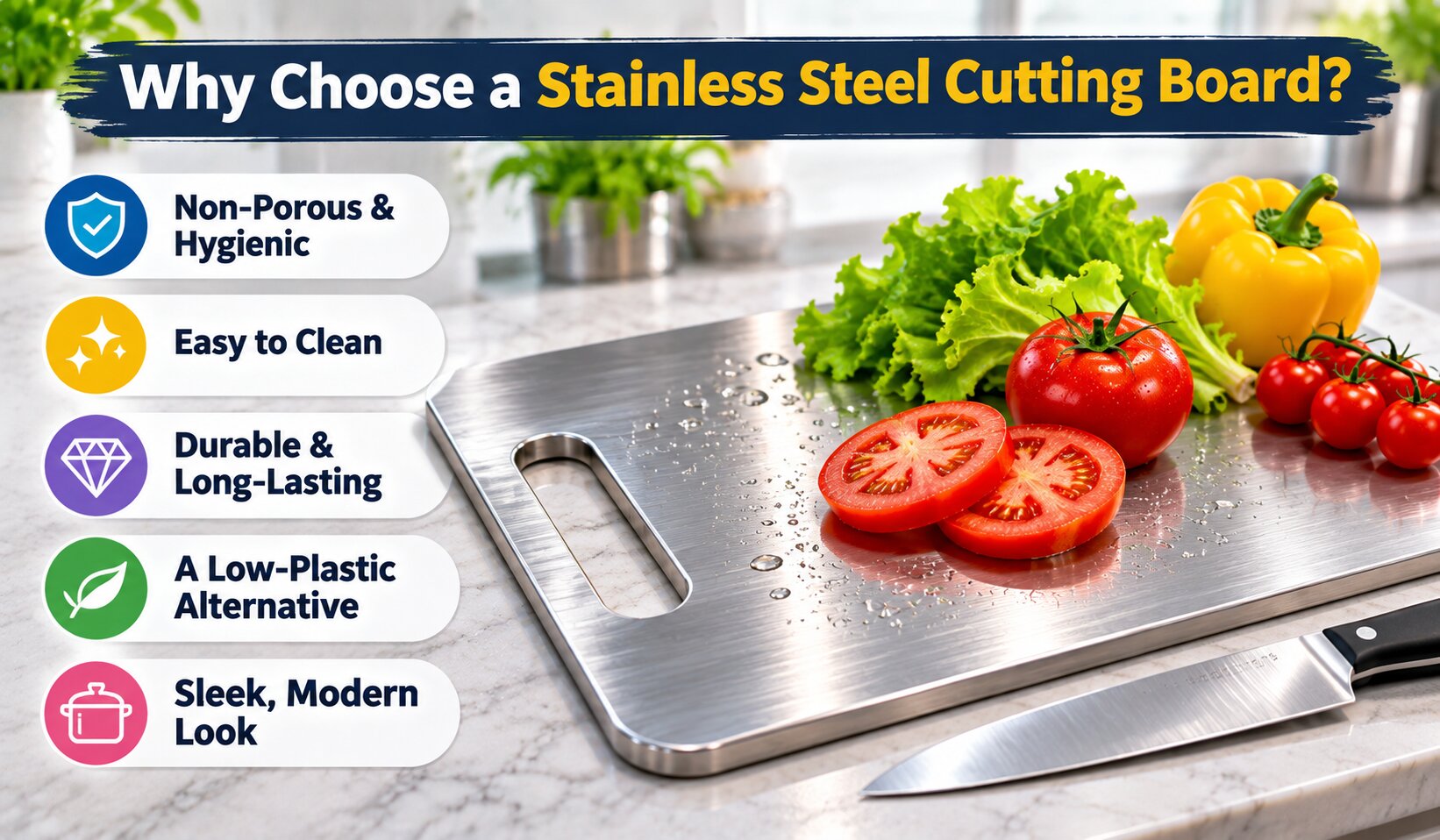
One reason is their smooth, non-porous surface. Unlike a wooden board, stainless steel does not absorb moisture in the same way. It is also less likely to develop deep visible knife grooves than many plastic boards.
This can make cleaning more straightforward. Food residue, strong smells and stains are generally easier to remove from a smooth metal surface, provided the board is properly designed and maintained.
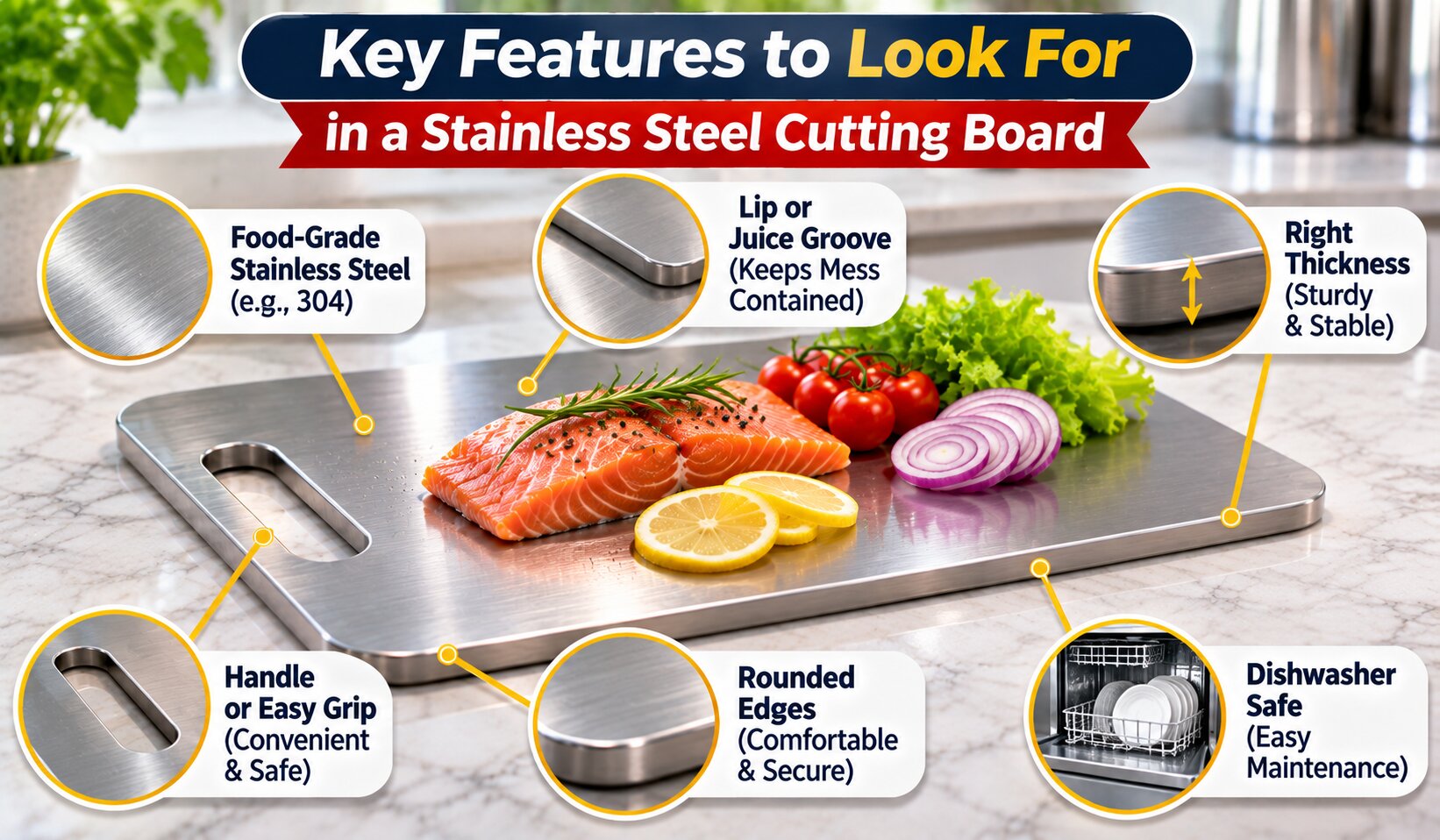
Appearance is another factor. Stainless steel has a clean, minimalist look that fits modern kitchens. Some models include handles, juice grooves or a second food-preparation surface, making them more versatile than a plain metal sheet.
There is also interest from people trying to reduce the amount of plastic in their kitchens. A stainless steel surface can offer an alternative for certain food-preparation tasks. However, buyers should check the full construction of a product. Several boards marketed as stainless steel are actually hybrid products with a metal side and a plastic or wheat-straw polypropylene side.
The distinction matters. A hybrid board is not a completely metal or plastic-free product, even if one side is made from stainless steel.
The Knife Problem: A Hard Surface Has Less Give
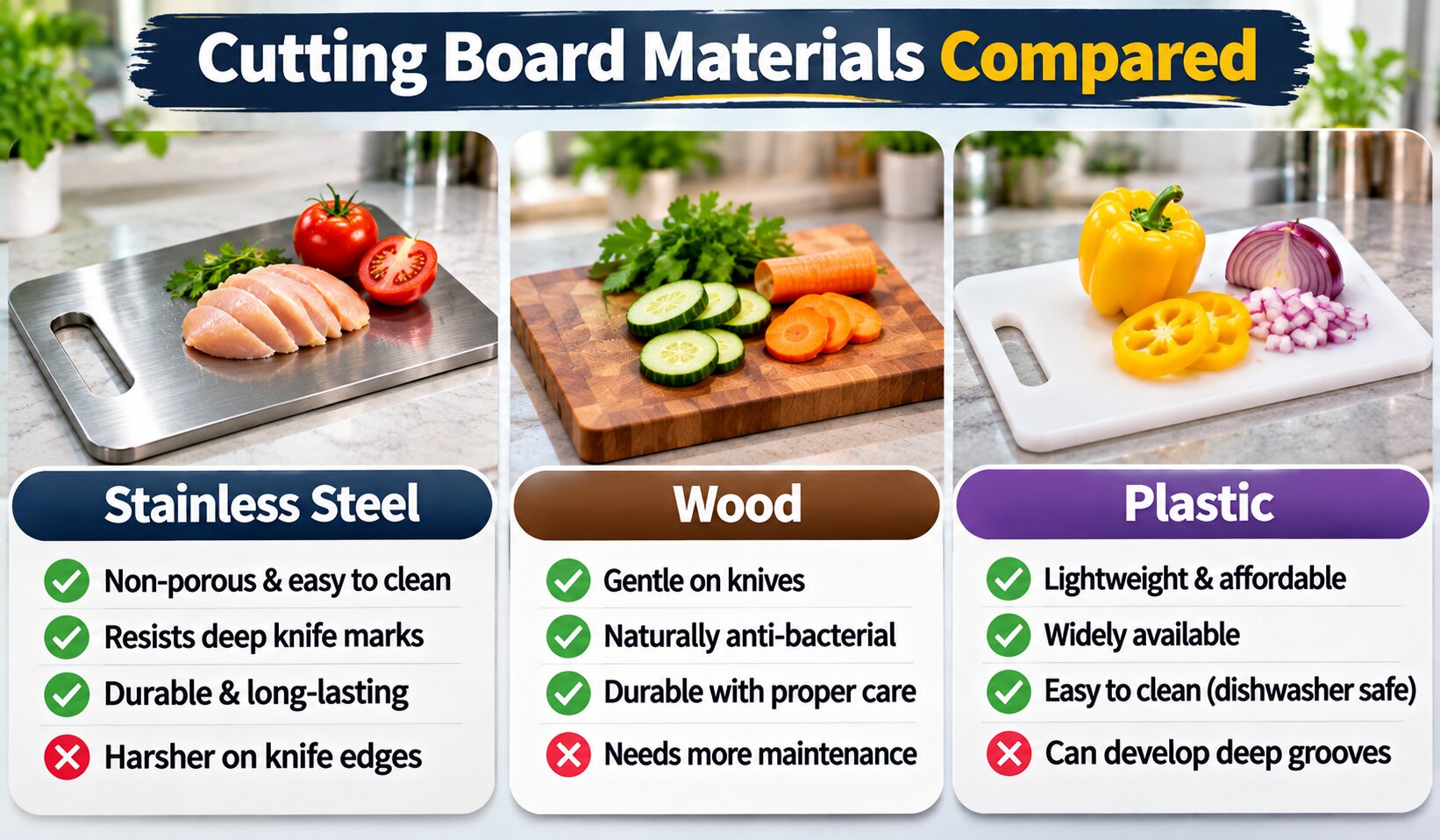
The biggest concern with stainless steel cutting boards is their effect on knife edges. Steel is much harder than wood, rubber and many plastic cutting-board materials. When a knife repeatedly strikes a hard surface, its fine cutting edge can wear more quickly.
Prudent Reviews published a cutting-board comparison in September 2026 that examined knife sharpness after repeated use. The test used 300 rocking cuts and 300 straight chops on each surface, then measured sharpness with a BESS tester.
In that test, stainless steel caused more knife-edge wear than wood, rubber and plastic. The result is a useful warning for people who want to protect expensive kitchen knives. It should still be read as one published test under specific conditions, rather than a guarantee of how every knife will perform on every stainless steel board.
For everyday chopping, many cooks may prefer wood or rubber because these materials provide more give. Stainless steel may be better treated as a secondary surface for selected preparation jobs rather than a complete replacement for a traditional board.
Quick Picks: Which Stainless Steel Board Suits Which Kitchen?
| Product | Construction | Best suited to | What to check |
|---|---|---|---|
| Stron-Dura | Advertised 304 stainless steel | Compact preparation tasks | Exact size and board stability |
| SNOWCLAD | Stainless steel and wheat-straw PP | Two-sided everyday prep | Care instructions and materials |
| GUANCI | Advertised 304 steel and wheat-straw PP | Extra features such as a juice groove | Which side is dishwasher-safe |
| Matiks | Advertised 316 steel surface and hybrid second side | Buyers checking a 316 claim | Material documentation |
| KORVOS | Advertised 304 stainless steel | Large preparation area | Dimensions, weight and storage |
Five Products Worth Considering
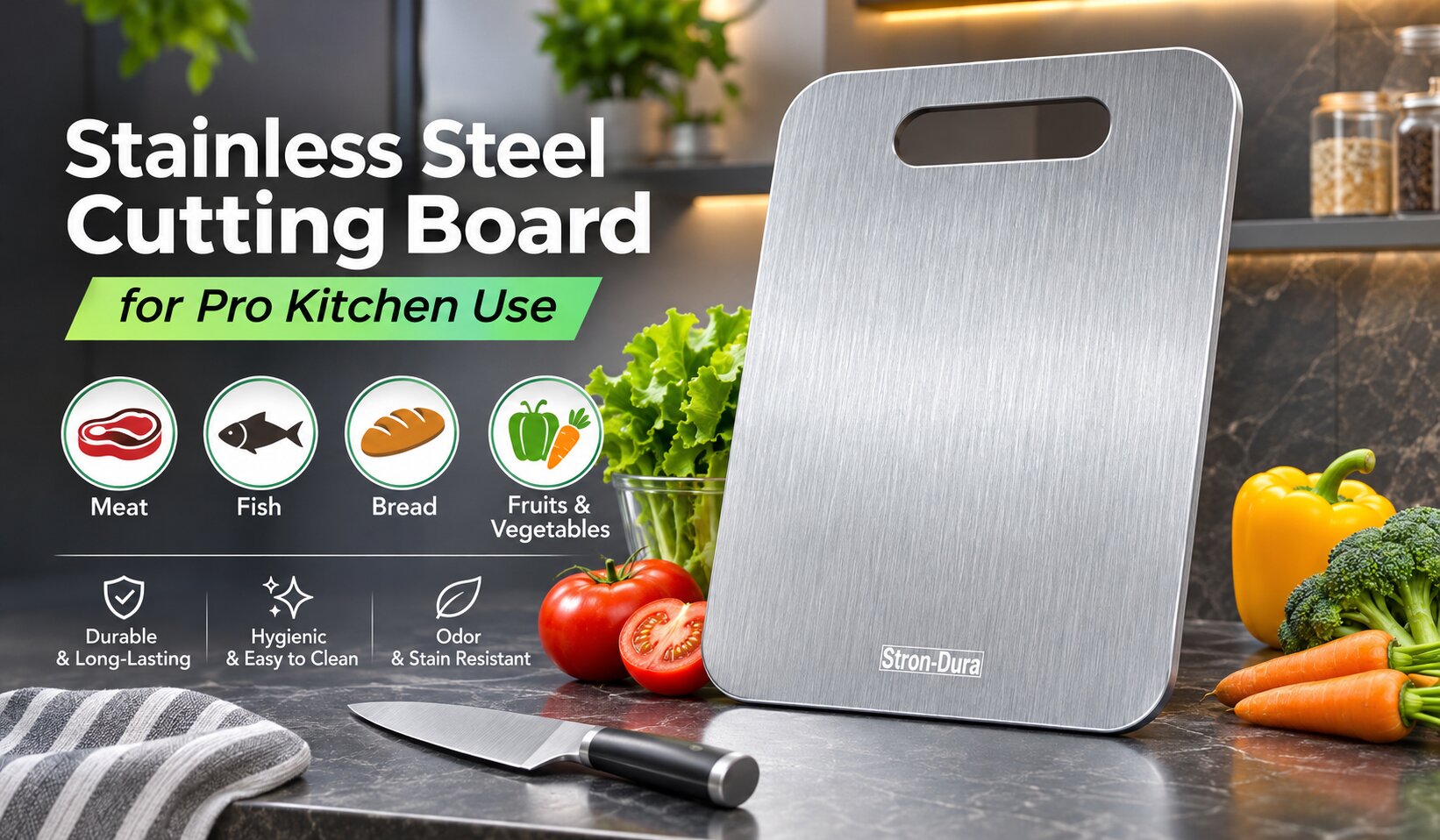
1. Stron-Dura 304 Stainless Steel Cutting Board
A compact option for smaller preparation jobs
The Stron-Dura board is listed as a 304 stainless steel model, with a compact version measuring approximately 11.5 × 8 inches. Its smaller footprint may suit kitchens where counter space is limited or where a metal surface is needed only for occasional tasks.
304 stainless steel is commonly used in food-processing equipment because it offers useful corrosion resistance and is widely available. However, buyers should still confirm the material specification on the current product listing rather than relying only on a product title.
The compact size is convenient for slicing a small quantity of ingredients, preparing garnishes or keeping a separate surface for particular foods. It is less suitable when you need room to chop several ingredients at once.
As with other metal boards, the main drawback is the hard cutting surface. It may be less forgiving on knife edges than wood or rubber. Check whether the board has non-slip feet or another feature that keeps it stable during use.
Consider it if: You want a smaller stainless steel surface for occasional food preparation and understand the trade-off for knife care.
2. SNOWCLAD Stainless Steel and Wheat Straw Cutting Board
A two-sided option for flexible food preparation
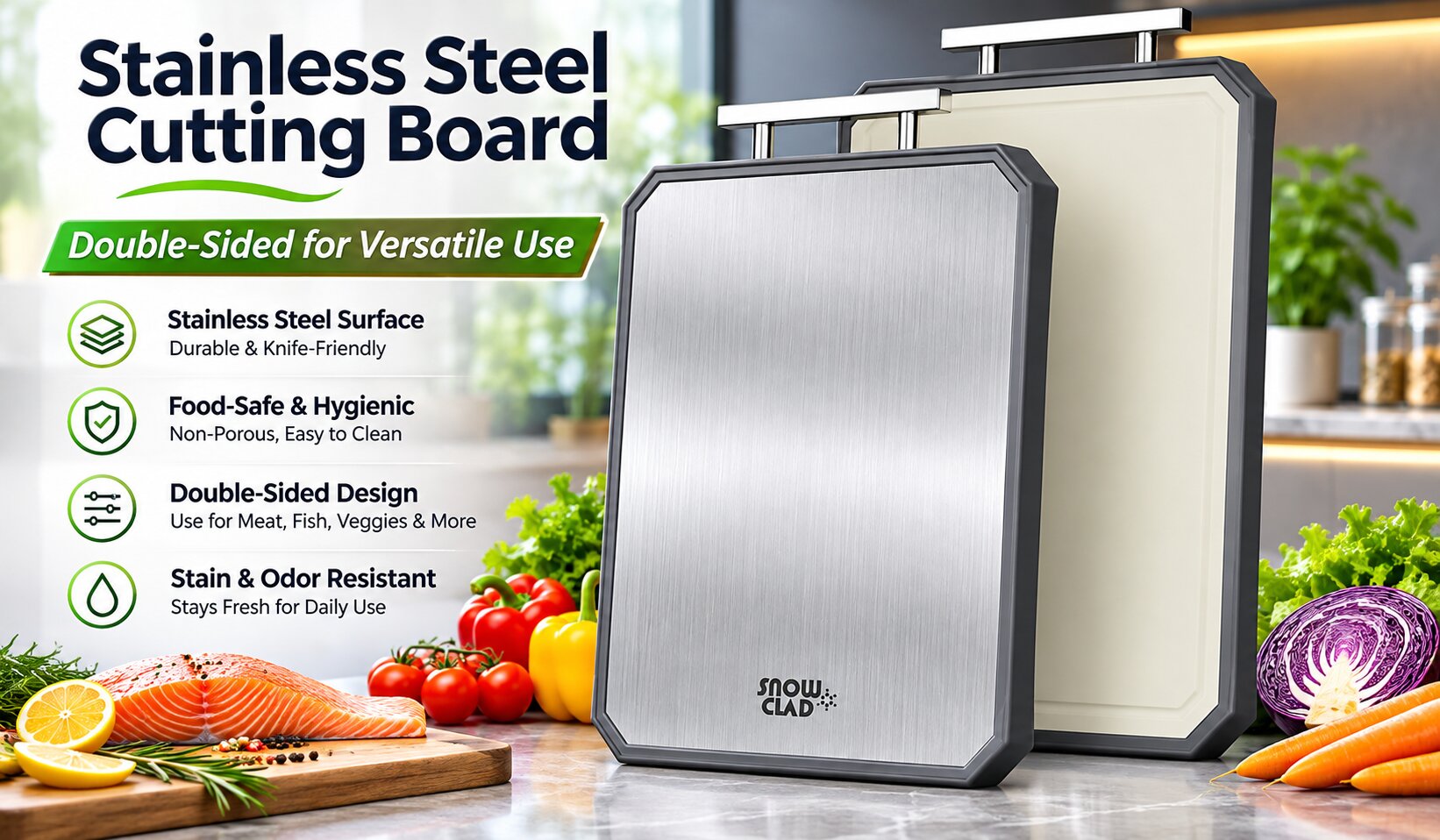
SNOWCLAD combines a stainless steel surface with a wheat-straw polypropylene side. A commonly listed version measures approximately 16 × 11 inches, giving users more room than a compact board.
The two-sided design is its main selling point. You can use the metal side for selected preparation tasks and the other side for jobs where a different surface is preferred. This may be useful in kitchens where one board needs to handle several types of food preparation.
It is important to understand what wheat straw means in this context. The second side is generally a polypropylene-based material that incorporates wheat-straw content. It should not be described as a completely natural, plastic-free surface.
Before ordering, check the seller’s current care instructions, including whether the exact model is dishwasher-safe. Also check the board’s thickness and whether it has a non-slip base.
Consider it if: You want a two-sided board with a metal surface and a separate polypropylene-based preparation side.
3. GUANCI Double-Sided 304 Stainless Steel Cutting Board
A practical choice for buyers who want extra features
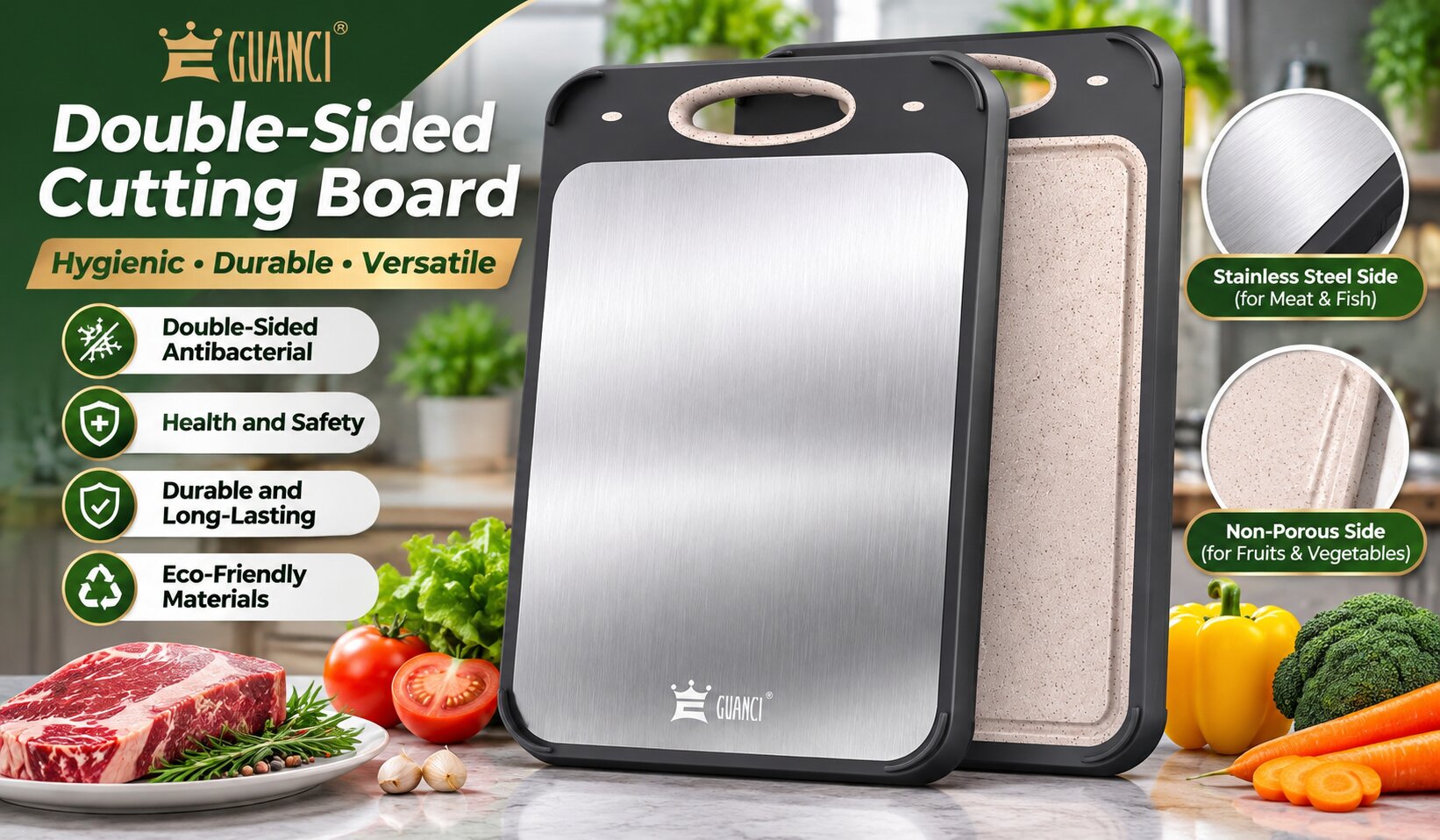
GUANCI offers more than a plain metal surface. Its double-sided design combines an advertised 304 stainless steel side with a wheat-straw polypropylene side.
A commonly listed model measures approximately 16 × 11 inches.
One of its more useful features is the juice groove on the second side. A juice groove is a channel around the edge of a cutting surface that catches liquid released while cutting meat, fruit or other moist ingredients. It can help reduce spills across the countertop.
The board also includes a textured area designed for crushing or grinding garlic and ginger. This may appeal to people who want a preparation surface with several built-in functions.
However, the hybrid construction is important. The product is not entirely stainless steel, and some listings specify hand washing rather than dishwasher cleaning. Follow the care instructions for the exact version.
Price reference: A product-tracking listing showed the 16 × 11-inch GUANCI model at approximately $23.99. This is a reference price and may differ from the live Amazon listing.
Consider it if: You value the juice groove, garlic-grinding area and two-sided design more than having an all-metal board.
4. Matiks Stainless Steel Cutting Board
For buyers interested in a board advertised with 316 steel
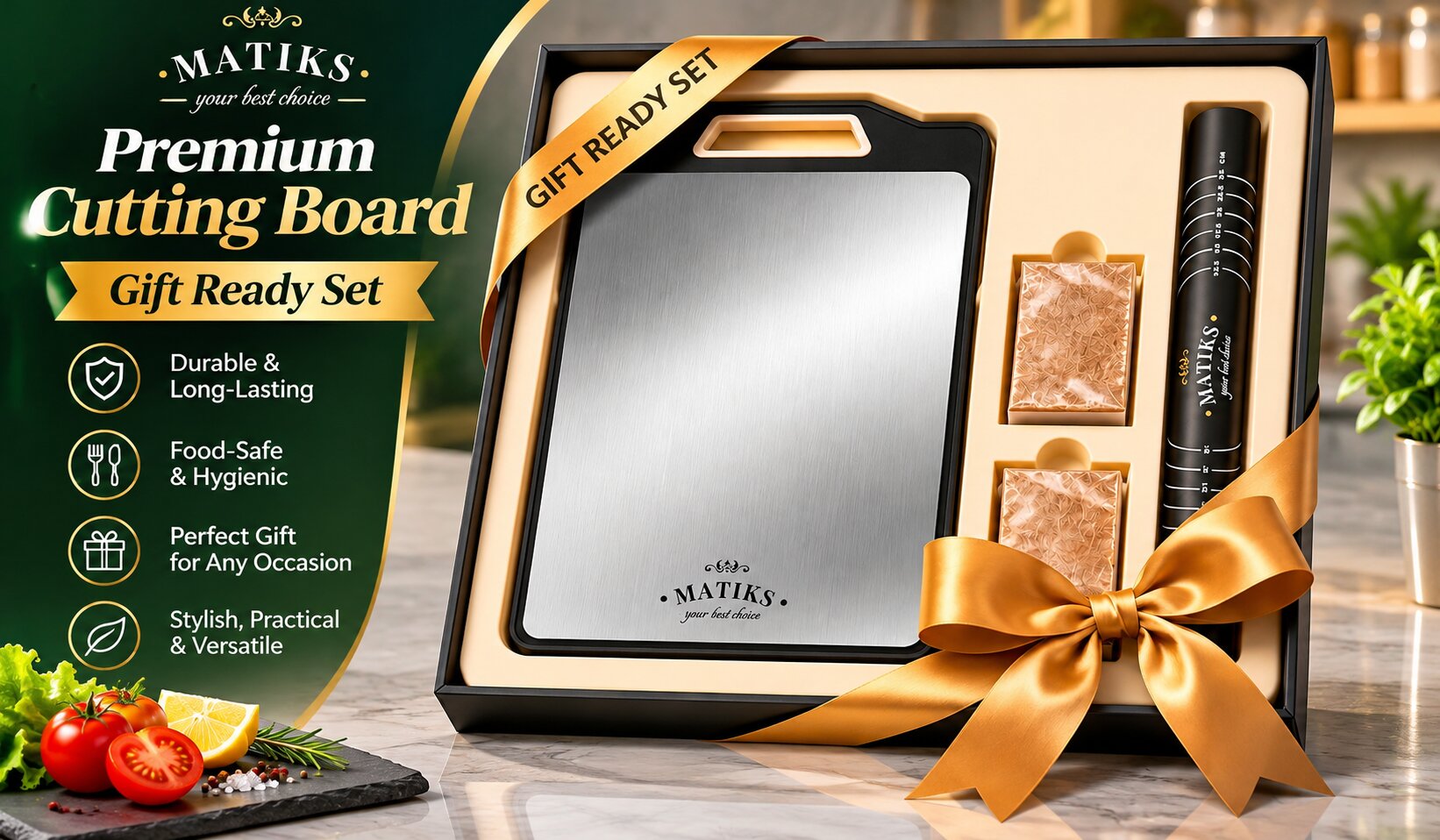
Matiks appears in online product roundups as a stainless steel cutting board advertised with a 316 steel surface and a wheat-straw-style second surface.
Grade 316 is worth understanding because it contains molybdenum, which improves resistance to certain corrosive environments compared with 304 stainless steel.
However, a product title or affiliate roundup is not the same as a material certificate. Buyers should verify the 316 claim against the current manufacturer’s or seller’s listing before paying extra for it.
The hybrid design also means the overall product depends on more than the metal surface. Its second-side material, edge construction, stability and cleaning requirements matter too.
A confirmed current Amazon price was not available during this review, so no price range is assigned here.
Consider it if: You specifically want to investigate a product advertised as 316 stainless steel and can verify its material documentation.
5. KORVOS 304 Stainless Steel Cutting Board
A large-format option for spacious kitchens
KORVOS is listed in online product sources as a large 304 stainless steel cutting board measuring approximately 23.62 × 19.68 inches.
That is substantially larger than the compact Stron-Dura model and may provide more room for preparing several ingredients at once.
A larger surface can be useful for people who regularly prepare substantial meals or want more space to organise ingredients before cooking. It may also be convenient for selected dough-preparation tasks, although marble and granite remain more traditional choices for pastry work.
Before buying, check the exact product dimensions, weight, edge finish, handles and whether the board has non-slip support. A large metal board needs to remain stable on the countertop.
A confirmed current Amazon price was not available during this review, so no price range is assigned.
Consider it if: You have enough counter and storage space and want a larger metal preparation surface.
What to Skip: Three Situations Where Stainless Steel May Be the Wrong Choice
Stainless steel is not a universal replacement for wood, rubber or plastic cutting boards. There are several situations where another material may be more practical.
- Skip it as your only board if you regularly use sharp knives. The hard surface may contribute to faster edge wear than more forgiving materials.
- Skip hybrid boards if you expect a completely plastic-free product. Wheat-straw polypropylene is still a plastic-based material.
- Skip oversized models if your kitchen has limited counter or storage space. A large metal board can be awkward to move, clean and store.
For many households, a traditional wood or rubber board remains a better everyday choice. A stainless steel board can still have a place as a secondary surface when its particular features are useful.
Does Stainless Steel Rust?
Stainless steel is corrosion-resistant, but it is not completely rust-proof. Its resistance comes from a thin protective chromium-rich oxide layer that forms on the surface.
That protective layer can be affected by certain conditions. Prolonged exposure to salt, harsh cleaning chemicals, trapped moisture or surface contamination can increase the risk of corrosion.
For normal kitchen care, wash the board according to the manufacturer’s instructions, rinse away food and salt residue, and dry it thoroughly before storage. Avoid using harsh chlorine-based cleaners unless the product instructions specifically allow them.
Also check the board for scratches, rough edges, damaged coatings or signs of corrosion. If the surface becomes badly damaged, contact the manufacturer or replace the board rather than continuing to use it without checking its condition.
304 vs 316: Does the More Expensive Grade Matter?
304 and 316 are two common grades of stainless steel. Both are used in applications where corrosion resistance is important.
Grade 316 contains molybdenum, which generally gives it better resistance to certain corrosive environments, including exposure to some salts and chemicals. This can be useful in more demanding conditions.
That does not mean every 316 cutting board is automatically better than every 304 model. Construction quality, thickness, surface finish, stability and accurate material claims all matter. A well-made 304 board may be a more sensible purchase than a product with an unverified 316 claim.
Before paying extra, look for clear material information from the manufacturer. If the listing simply uses a grade number without supporting details, treat the claim with caution.
Are Stainless Steel Cutting Boards Non-Toxic? What About Nickel?
Stainless steel is widely used in food-contact equipment, but the phrase “non-toxic” should not be treated as a complete safety certification. Buyers should look for the stated material grade, food-contact information and manufacturer details.
Some stainless steel grades contain nickel. People with a known nickel allergy should consider their own sensitivity and seek reliable product information before choosing a board. The presence of nickel in an alloy does not, by itself, establish how much nickel might transfer during normal use.
For any cutting board, safe food handling still matters. Clean the surface after use, keep raw meat separate from ready-to-eat foods and follow recognised food-safety guidance.
Choosing the Right Size: A Simple Cutting Board Size Guide
The right size depends on how much food you prepare, the available counter space and where you plan to store the board.
| Approximate size | Best for | Things to consider |
|---|---|---|
| 11.5 × 8 inches | Small portions, garnishes and occasional preparation | Limited room for several ingredients |
| 16 × 11 inches | General kitchen preparation | Needs a moderate amount of counter and storage space |
| 23.62 × 19.68 inches | Large preparation jobs and spacious kitchens | Can be heavy and difficult to store |
Measure your available counter space before ordering. If you plan to store the board in a cupboard, check its dimensions against the cupboard opening as well. A large board may look useful in a product photograph but become inconvenient in a small kitchen.
How to Clean a Stainless Steel Cutting Board
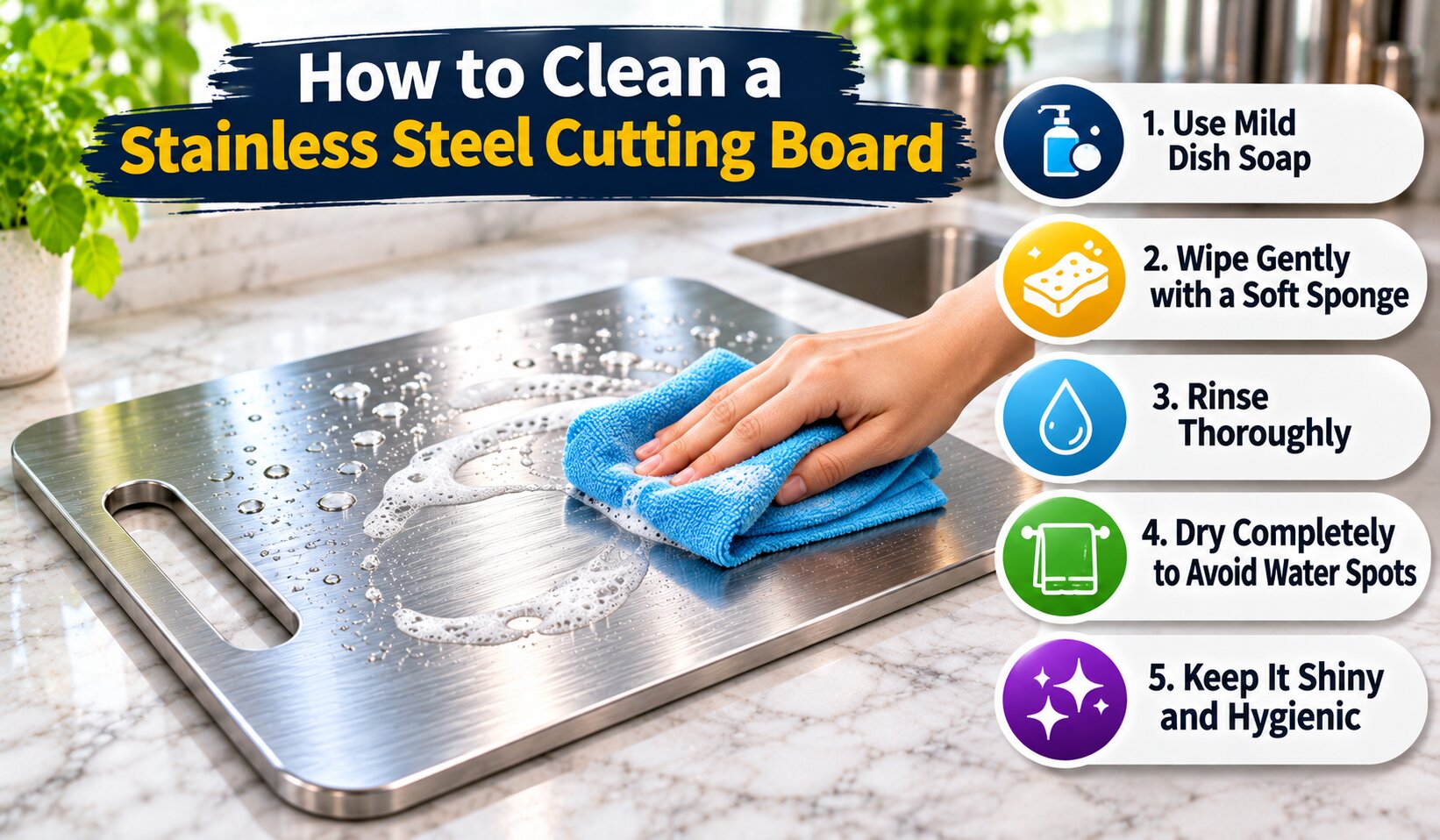
Cleaning is one of the main reasons people consider stainless steel. Its smooth surface can make it easier to remove food residue, but good hygiene still depends on proper washing and handling.
- Remove food scraps. Clear away leftover ingredients and rinse the surface after use.
- Wash with dish soap. Use warm water and a suitable dishwashing liquid. Follow the manufacturer’s care instructions.
- Use a non-abrasive sponge. Avoid rough cleaning materials that may damage the finish.
- Rinse thoroughly. Remove soap, salt and food residue from the entire surface.
- Dry the board. Use a clean towel or allow it to dry fully before storage.
- Clean both sides of hybrid boards. Follow the care instructions for each material, especially if the second side is polypropylene-based.
Do not assume every stainless steel cutting board is dishwasher-safe. Some product listings advertise dishwasher compatibility, while others recommend hand washing. The manufacturer’s instructions for the exact model should take priority.
For food safety, use separate boards for raw meat, poultry and seafood and for ready-to-eat foods when possible. Wash and sanitise kitchen surfaces and utensils after contact with raw animal products, following recognised food-safety guidance.
Stainless Steel vs Wood, Plastic and Bamboo
| Material | Main advantages | Possible drawbacks | Best use |
|---|---|---|---|
| Stainless steel | Smooth surface, resists many stains and deep grooves, easy to wipe clean | Hard on knife edges, can be noisy and slippery | Selected preparation tasks and secondary use |
| Wood | More forgiving on knives, stable feel and traditional appearance | Needs suitable washing and drying; may require maintenance | Everyday chopping |
| Plastic | Lightweight, affordable and often dishwasher-safe | Can develop deep knife grooves over time | Separate food-preparation tasks, depending on care instructions |
| Bamboo | Lightweight, firm and often affordable | Can be harder on knife edges than some wood boards; may need careful drying | General preparation when properly maintained |
There is no single material that suits every kitchen. Wood and rubber are often more comfortable for regular knife work. Plastic can be practical when separate boards are needed for different food groups. Bamboo is a firm, lightweight option. Stainless steel offers a smooth metal surface, but its hardness is a meaningful trade-off.
For most home cooks, choosing more than one board material makes sense. You can use a wood or rubber board for everyday chopping and keep a stainless steel board for tasks where its surface is useful.
Countertop Styling and Kitchen Gift Ideas
Stainless steel cutting boards have a modern appearance that can fit kitchens with stainless steel appliances, metal fixtures and simple countertop accessories. A compact model may be easier to display or store than a large board.
If you are buying one as a gift, check the recipient’s kitchen size and cooking habits first. Someone who enjoys using sharp knives may prefer a quality wooden or rubber board. A person who wants a smooth metal preparation surface may appreciate a stainless steel model.
Practical details matter more than appearance. Look for a stable base, smooth edges, clear material information and care instructions that suit the recipient’s routine.
Final Verdict: Which One Should You Choose?
Stainless steel cutting boards have some useful qualities. Their smooth surfaces are easy to wipe clean, they resist many stains and deep grooves, and some models offer two-sided designs with extra preparation features.
However, the knife-sharpness concern should not be ignored. The published Prudent Reviews test found more knife-edge wear on stainless steel than on wood, rubber and plastic under its test conditions. That makes stainless steel a less obvious choice as the only cutting board in a kitchen.
Among the five products discussed, Stron-Dura is the compact option for occasional use. SNOWCLAD and GUANCI offer hybrid two-sided designs. Matiks is worth considering only after checking its advertised 316 material claim. KORVOS may suit buyers who need a much larger preparation surface and have enough room to store it.
For most households, the sensible approach is to keep a wood or rubber board for regular chopping and consider stainless steel as a secondary surface. Before ordering, verify the current product dimensions, material claims, cleaning instructions and Amazon listing details.
Frequently Asked Questions
These answers address common consumer questions about stainless steel cutting boards, materials, cleaning and everyday use.
1. Are stainless steel cutting boards safe for food?
Stainless steel is widely used in food-contact equipment. A properly made and maintained board can be used for food preparation, but safe handling and thorough cleaning are still necessary. Check the product’s material and food-contact information before buying.
2. Does a stainless steel cutting board dull knives?
It can contribute to faster knife-edge wear. A published 2026 test by Prudent Reviews found considerably more sharpness loss on stainless steel than on wood, rubber and plastic in its test conditions. The exact result can vary with the knife, cutting technique and board construction.
3. Does stainless steel rust?
It is corrosion-resistant, not completely rust-proof. Salt residue, harsh chemicals, surface damage and prolonged moisture can contribute to corrosion. Wash and dry the board according to its care instructions.
4. Is 304 stainless steel good for cutting boards?
304 is a commonly used stainless steel grade in food-processing equipment. Buyers should still confirm the material and manufacturing details of the specific product.
5. Is 316 stainless steel better than 304?
316 generally offers better resistance to certain corrosive environments because it contains molybdenum. That does not automatically make every 316 cutting board a better everyday choice. Construction quality and verified material claims also matter.
6. What is a juice groove on a cutting board?
A juice groove is a channel around the cutting surface designed to catch liquid released while cutting food. It can help reduce spills on the countertop.
7. Can stainless steel cutting boards go in the dishwasher?
Some products are advertised as dishwasher-safe, while others specify hand washing. Follow the care instructions for the exact model, particularly when the board has a second surface made from another material.
8. Are stainless steel cutting boards non-toxic?
The phrase non-toxic alone is not enough to establish product safety. Check the material grade, food-contact information and manufacturer details. Some stainless steel grades also contain nickel, which may matter to people with a known nickel allergy.
9. Are stainless steel cutting boards better than plastic?
They have different strengths. Stainless steel resists many stains and deep grooves, while plastic is generally lighter and more forgiving on knife edges. The better choice depends on how you prepare food and how you maintain the board.
10. What size stainless steel cutting board should I buy?
An 11.5 × 8-inch board may suit smaller kitchens, while a 16 × 11-inch model provides more room for general preparation. Larger boards need sufficient counter and storage space.
11. Can I use a stainless steel cutting board for pastry?
You can use a suitable flat metal surface for some preparation tasks, but marble and granite are more traditional choices for certain pastry work. Check that the surface is stable and appropriate for the task.
12. Should a stainless steel cutting board be my only cutting board?
For most households, probably not. A wood or rubber board is a more forgiving everyday surface for kitchen knives, while stainless steel can serve as a secondary preparation surface.

Sources and Further Reading
- Prudent Reviews — published cutting-board and knife-sharpness testing referenced in this article. See the September 2026 comparison for the specific test method and results.
- USDA Food Safety and Inspection Service — food-safety guidance on cleaning, handling and preventing cross-contamination.
- U.S. Food and Drug Administration — general food-contact material and food-safety information.