Democrats Win Congress in 2026 Midterms: What Happens Next?
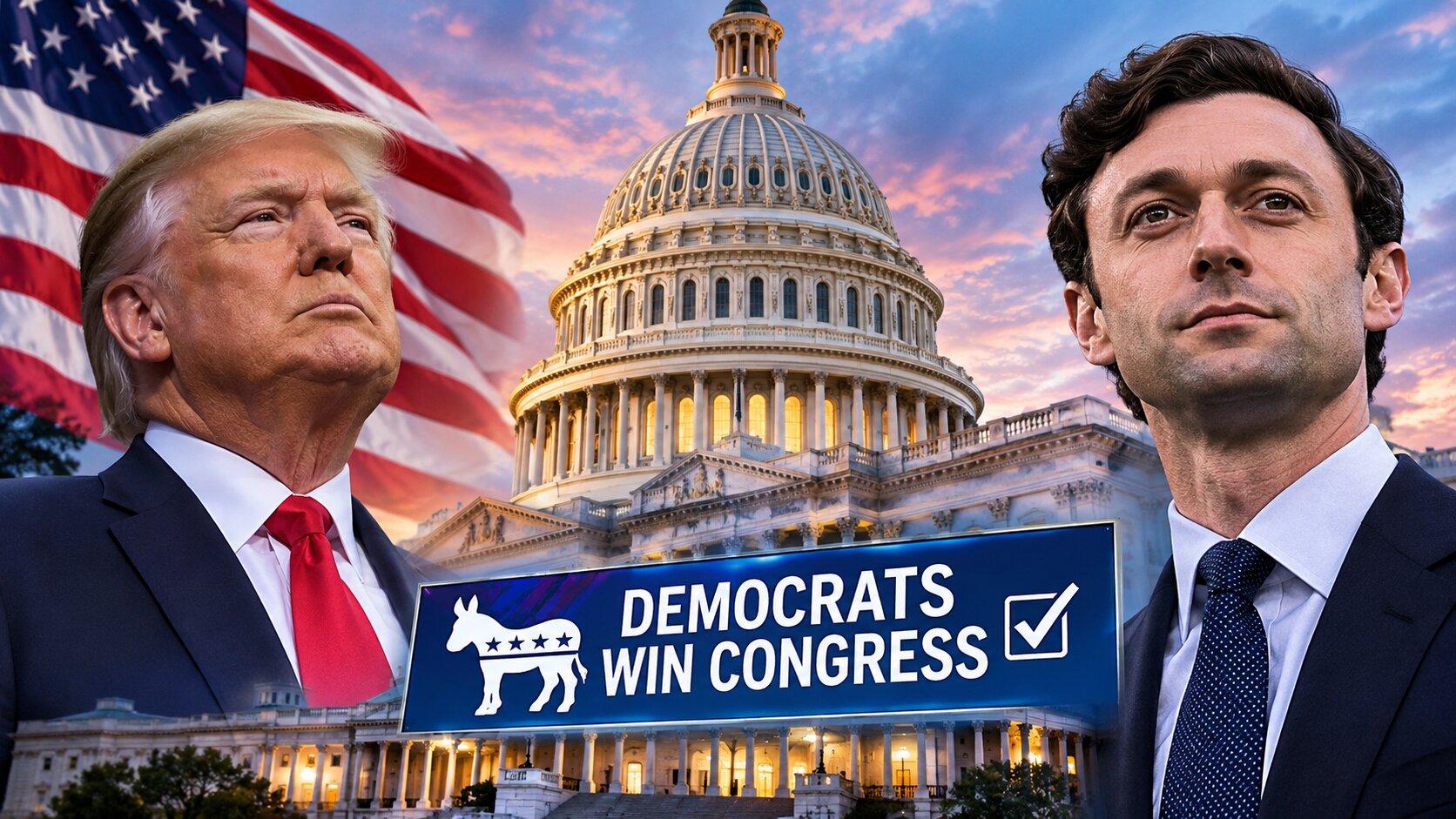
Democrats have secured control of both the House and Senate in a major midterm victory. The result changes the political balance in Washington, creates new challenges for Donald Trump and puts Georgia Senator Jon Ossoff in the national spotlight as attention turns towards 2028.
The 2026 US Midterm Election Results have changed the balance of power in Washington. Democrats have won control of both chambers of Congress, the House of Representatives and the Senate, ending the Republican Party’s control of the federal legislature. The outcome gives Democrats a stronger position to challenge President Donald Trump’s agenda during the final two years of his current term.
The result is a major development for American politics. For the first half of Trump’s second presidency, Republicans controlled both chambers of Congress, giving the administration a clearer path to advance its legislative priorities. That political arrangement is now set to change when the new Congress takes office in January 2027.
Among the Democrats receiving national attention is Georgia Senator Jon Ossoff, who won re-election after a closely watched campaign. His victory has renewed discussion about his political future and whether he could become a contender in the 2028 Democratic presidential race. Ossoff, however, has said he is not interested in running for president.
2026 Midterm Election: Key Facts
- Election date: November 3, 2026
- House: Democrats have won control of the chamber.
- Senate: Democrats have won control of the chamber.
- President: Donald Trump remains in office.
- New Congress: Scheduled to begin on January 3, 2027.
- Georgia Senate race: Jon Ossoff won re-election.
- Next presidential election: Scheduled for 2028.
1. What Happened in the 2026 US Midterm Elections?
Americans voted on November 3 to elect members of Congress, along with governors, state legislators and local officials in several parts of the country. All 435 seats in the House of Representatives were on the ballot, as were 35 Senate seats, including regular and special elections.
The central result was a Democratic victory in both chambers of Congress. Democrats gained Republican-held seats in several states and secured the numbers needed to take control of the legislature. The outcome means that the next two years of federal lawmaking will take place under divided government: a Democratic-controlled Congress and a Republican president.
The election also produced notable results in states that have been central to recent national political contests. Georgia was particularly important because Democrats needed to defend Jon Ossoff’s Senate seat. Ossoff defeated Republican Congressman Mike Collins, according to election projections reported by Reuters and other outlets.
Some individual races were still being counted or finalised in the immediate aftermath of election day. Final certified totals can differ from early projections, so the official state election records remain the definitive source for each contest.
2. Why the Result Matters for American Politics
Midterm elections take place halfway through a president’s four-year term. They do not decide who becomes president, but they can change which party controls Congress. That matters because Congress writes federal laws, approves spending and conducts oversight of the executive branch.
When the president’s party controls both chambers, passing legislation can be easier, particularly when party members agree on the administration’s priorities. When the opposing party controls Congress, negotiations become more difficult and the president may face stronger scrutiny.
The 2026 result therefore changes the political environment for Trump’s administration. Democrats will have committee leadership, greater influence over the legislative calendar and the ability to hold hearings on issues involving federal agencies and government policy.
3. What Happens When Democrats Control Both the House and Senate?
The US Congress has two chambers, and both play different roles in the federal lawmaking process. Democratic control of the House and Senate gives the party significant influence, but it does not mean that every Democratic proposal will automatically become law.
The House of Representatives
The House has 435 voting members. It plays a major role in introducing and passing legislation, approving federal spending measures and beginning impeachment proceedings.
With a Democratic majority, the party can elect the Speaker of the House and take control of committee leadership. House committees can investigate government departments, request documents, hold public hearings and issue subpoenas within their legal authority.
The House also has an important role in budget and tax legislation. Revenue bills must originate in the House, although the Senate also has to approve legislation before it can become law.
The Senate
The Senate has 100 members and performs several functions that the House does not. It considers presidential nominations for federal judges, senior government officials and ambassadors. It also has the constitutional responsibility to provide advice and consent on treaties.
Senate control gives Democrats the power to lead committees and shape the schedule for considering nominations and legislation. It can also affect how quickly presidential appointments move through the confirmation process.
However, the Senate has its own rules. Many ordinary bills need 60 votes to overcome a filibuster, unless a specific exception or procedural route applies. A simple majority therefore does not guarantee that every bill will pass.
Can Democrats pass laws without Trump’s support?
Congress can pass a bill through both chambers and send it to the president. Trump can sign it into law or veto it. If he vetoes a bill, Congress can override that veto with a two-thirds vote in both the House and Senate.
That threshold is difficult to reach. As a result, a Democratic Congress may be able to pass bills that express its priorities, but many could face a presidential veto unless there is enough bipartisan support.
4. What Does the Midterm Result Mean for Donald Trump?
The election creates a more difficult legislative environment for President Trump. During the first part of his second term, Republican control of Congress gave his administration a degree of political alignment between the White House and the legislature. That alignment will end when the new Congress begins its work.
Trump will remain commander-in-chief and retain the powers of the presidency. He can continue directing executive departments, conducting foreign policy within his constitutional authority and using presidential veto powers. The election does not automatically cancel executive orders or remove policies already in effect.
However, a Democratic Congress can make it harder for the administration to secure new legislation. It can also examine the implementation of existing policies and demand explanations from government officials.
More congressional investigations
Committee investigations are likely to become a major part of the political relationship between Congress and the White House. Lawmakers may hold hearings on federal spending, immigration enforcement, government contracts, foreign policy and decisions made by executive agencies.
Congressional investigations can generate public scrutiny and produce documents or testimony. They do not automatically establish wrongdoing, and the findings of an investigation may be disputed.
Government funding could become a major issue
Congress must approve federal funding measures. When the two chambers and the White House are controlled by different parties, budget negotiations can become more difficult.
If lawmakers fail to pass the necessary spending legislation or temporary funding measures, parts of the federal government can face a shutdown. Both parties would have to negotiate to avoid or resolve such a situation.
5. Who Is Jon Ossoff and Why Is He Getting So Much Attention?
Jon Ossoff is a Democratic US senator from Georgia. He first entered the Senate in 2021 after defeating Republican incumbent David Perdue in a closely watched runoff election. His victory helped Democrats secure control of the Senate at the beginning of Joe Biden’s presidency.
Ossoff became one of the younger members of the Senate and gained national attention through his questioning of government officials, committee work and political communication. His public image has often been associated with a calm speaking style and an emphasis on government accountability.
Jon Ossoff: At a Glance
- Full name: Thomas Jonathan Ossoff
- Born: February 16, 1987
- Political party: Democratic Party
- State: Georgia
- First elected to the Senate: 2021
- 2026 election: Won re-election against Mike Collins, according to media projections
His 2026 re-election victory
Ossoff’s 2026 campaign was one of the closely watched Senate contests. He faced Republican Congressman Mike Collins in Georgia, a state that has become highly competitive in recent presidential and Senate elections.
Reuters reported that Ossoff won re-election, defeating Collins, who had received Trump’s endorsement. His victory allowed Democrats to retain an important Georgia Senate seat as the party pursued control of the chamber.
The campaign focused on issues including the cost of living, healthcare, government accountability and the Trump administration’s policies. Ossoff also criticised the administration’s approach to foreign policy and tariffs.
His victory gave him another six-year Senate term and increased his visibility within the national Democratic Party. It also added to discussion about whether he could play a larger role in national politics.
6. Could Jon Ossoff Run for President in 2028?
One of the questions emerging after the midterm election is whether Jon Ossoff could become a Democratic candidate for president in 2028. His re-election victory, national profile and position in a competitive state have placed him in conversations about the party’s future leadership.
The 2028 presidential election will take place after Trump’s current term. Democrats will need to choose a nominee through their primary and caucus process before the general election. The party has not yet selected a candidate, and the field could change considerably over the next two years.
Why his name is being discussed
There are several reasons political observers have started discussing Ossoff’s national prospects.
- A competitive-state victory: Georgia is an important battleground state. Winning a Senate race there can give a politician national visibility.
- Campaign fundraising: Reuters reported that Ossoff raised substantially more campaign money than his Republican opponent during the 2026 contest.
- National media attention: His campaign and re-election victory have brought him greater exposure beyond Georgia.
- Senate experience: His work in the Senate gives him a record on federal policy, oversight and government accountability.
- Age and political generation: Born in 1987, Ossoff belongs to a younger generation of national Democratic politicians.
Has Ossoff said he wants to become president?
No. Reports from Georgia Public Broadcasting and FOX 5 Atlanta say Ossoff has rejected the idea of a presidential campaign and indicated that he is focused on his Senate role. FOX 5 reported that he had said he had “zero interest” in the job.
That statement matters. Media discussion about a politician’s possible future is not the same as an announcement by the politician. At this stage, there is no basis to describe Ossoff as an officially declared 2028 presidential candidate.
Who else could be part of the 2028 discussion?
The Democratic Party has several nationally recognised figures who may attract attention as the next presidential cycle approaches. Potential names discussed in political coverage include California Governor Gavin Newsom, former Vice President Kamala Harris, Pennsylvania Governor Josh Shapiro and Georgia Senator Raphael Warnock, among others.
That does not mean any of them will run or secure the nomination. Their decisions, political records, public support and performance in the coming years will shape the field.
7. Could Trump Face Impeachment After the Democratic Victory?
The Democratic victory has renewed discussion about whether the House could pursue impeachment proceedings against President Trump. Control of the House gives Democrats the ability to initiate impeachment proceedings if party leaders and members decide there are grounds to do so.
Impeachment is a constitutional process, not an automatic consequence of losing an election. The House can approve articles of impeachment by a simple majority. If that happens, the Senate holds a trial and decides whether to convict and remove the president.
What is needed to remove a president?
A two-thirds vote of senators present is required to convict a president in an impeachment trial. That is a much higher threshold than the simple majority needed for the House to impeach.
Even if the House votes to impeach Trump, removal from office would not be automatic. The Senate would have to conduct the trial and reach the constitutional threshold for conviction.
The new Congress could also choose to focus on investigations, oversight hearings and legislation rather than impeachment. The election result gives Democrats greater procedural power, but it does not predetermine how they will use it.
8. What Could Change for the Economy, Healthcare and Foreign Policy?
The policy consequences of the election will depend on which proposals Democrats prioritise and how the White House responds. Control of Congress gives the party more influence, but the president’s veto power and Senate procedures remain important limits.
Cost of living and the economy
The cost of living was an important issue during the election campaign. Democrats have indicated that they want to focus on household expenses, healthcare costs and economic concerns.
Congress can debate tax policy, federal spending, housing measures and other proposals that affect households and businesses. However, economic changes are not immediate. Inflation, interest rates, employment and energy prices are influenced by many factors beyond congressional control.
Healthcare
Healthcare policy could become a major point of disagreement. Democrats have said they want to address Republican changes to health programmes and examine the impact of federal policy on access to care.
Any major legislative changes would still need to pass both chambers and be signed by the president, or survive a veto override. This makes bipartisan negotiations important.
Immigration
Immigration enforcement and border policy are likely to remain politically contested. A Democratic-controlled Congress can hold hearings, examine agency practices and introduce legislation. The administration, however, retains significant authority over how federal immigration laws are enforced.
Foreign policy
The president has substantial authority in foreign affairs, but Congress influences foreign policy through funding, legislation, oversight and its constitutional role in areas such as treaties and war powers.
A Democratic Congress could question the administration’s decisions, request briefings and debate the funding of overseas operations. The extent of any policy change will depend on the specific issue and whether lawmakers can secure enough votes.
9. What Happens Next? The Road to January 2027
The immediate next step is the transition to the new Congress. Members elected in November will take office on January 3, 2027, when the 120th Congress is scheduled to begin.
Before that date, lawmakers will complete the remaining stages of the election process, including state certification where required. Party leaders will also prepare for the new legislative session and decide committee assignments.
Key developments to watch
- Leadership elections: Democrats will choose their leaders in the House and Senate, including the next House Speaker.
- Committee control: The new majorities will organise committees and decide which issues receive hearings and investigations.
- Federal budget negotiations: Funding deadlines could create early negotiations between Congress and the White House.
- Legislative priorities: Democrats will decide which campaign promises they want to pursue first.
- Presidential response: Trump will have to decide how to work with a Congress controlled by the opposition party.
The first months of 2027 will offer a clearer picture of whether the two sides can reach agreements or whether Washington will enter a period of extended political confrontation.
10. Key Takeaways from the 2026 Midterms
| Question | What the result means |
|---|---|
| Who controls Congress? | Democrats have won control of both the House and Senate. |
| Is Trump still president? | Yes. The midterms do not change the presidential term. |
| Can Democrats pass laws? | They can pass legislation through Congress, but presidential vetoes and Senate rules still matter. |
| Can Trump be impeached? | The House can initiate impeachment, but Senate conviction requires a two-thirds vote of senators present. |
| Did Jon Ossoff win? | Yes. Media projections reported his re-election victory in Georgia. |
| Will Ossoff run in 2028? | There is speculation, but he has said he is not interested in a presidential campaign. |
Final Thoughts
The 2026 US midterm elections have created a new political balance in Washington. Democrats now control both chambers of Congress, giving them greater influence over legislation, government oversight and federal spending. President Donald Trump remains in office, but his administration will face a Congress with a different political majority from January 2027.
Jon Ossoff’s re-election in Georgia is another important part of the story. His victory has raised his national profile and brought fresh attention to the Democratic Party’s future leadership. Although some observers have discussed him as a possible 2028 presidential contender, Ossoff has publicly indicated that he is not interested in running.
The real test will come when the new Congress begins its work. Its decisions on the economy, healthcare, federal spending and oversight will help determine how much the election changes the direction of US politics.
Sources and Further Reading
- Associated Press – Democratic victory in the 2026 midterm elections
- Reuters – Senator Jon Ossoff wins re-election, holding Georgia for Democrats
- Ballotpedia – Democrats win US House and Senate majorities
- Al Jazeera – Democrats win control of House and Senate
- Georgia Public Broadcasting – Jon Ossoff wins re-election
- FOX 5 Atlanta – Ossoff’s victory fuels 2028 presidential speculation
Last updated: November 5, 2026