Most people buy headphones the way they buy a mattress: once every few years, after a bad night. The old pair starts crackling, the ear pads flake, or a colleague turns up with something that makes the open-plan office disappear, and suddenly you are scrolling through forty tabs of “best headphones” lists that all say the same thing.
This guide is meant to be the tab you keep. Whether you are comparing the best wireless headphones, the best Bluetooth headphones or a cabled pair for home, it covers where headphones came from, why they are useful well beyond music, what actually changed in 2026, and how the technical specs (noise cancelling, microphone quality, Bluetooth codecs) translate into a normal week. Price examples are shown mainly in US dollars, with selected UK references; availability can differ across the US, UK and Canada.
A quick note on method. I have not lab-tested every pair mentioned here and I will not pretend otherwise. This is a buying guide built on published measurements and reviews from RTINGS, SoundGuys, What Hi-Fi? and others, plus owner discussions in community threads. It is not a first-hand test of every model. Where those sources disagree, I say so, because they often do. Rankings are attributed to the publication that made them; they are not presented as a universal consensus. The right pair depends on your ears, your commute and your budget, and no single ranking settles that.
By the end you should know what matters, what is marketing, and which kind of pair fits your day.
Where headphones came from, and who really built the first pair
The honest answer to “who invented headphones” is: a few people, in stages.
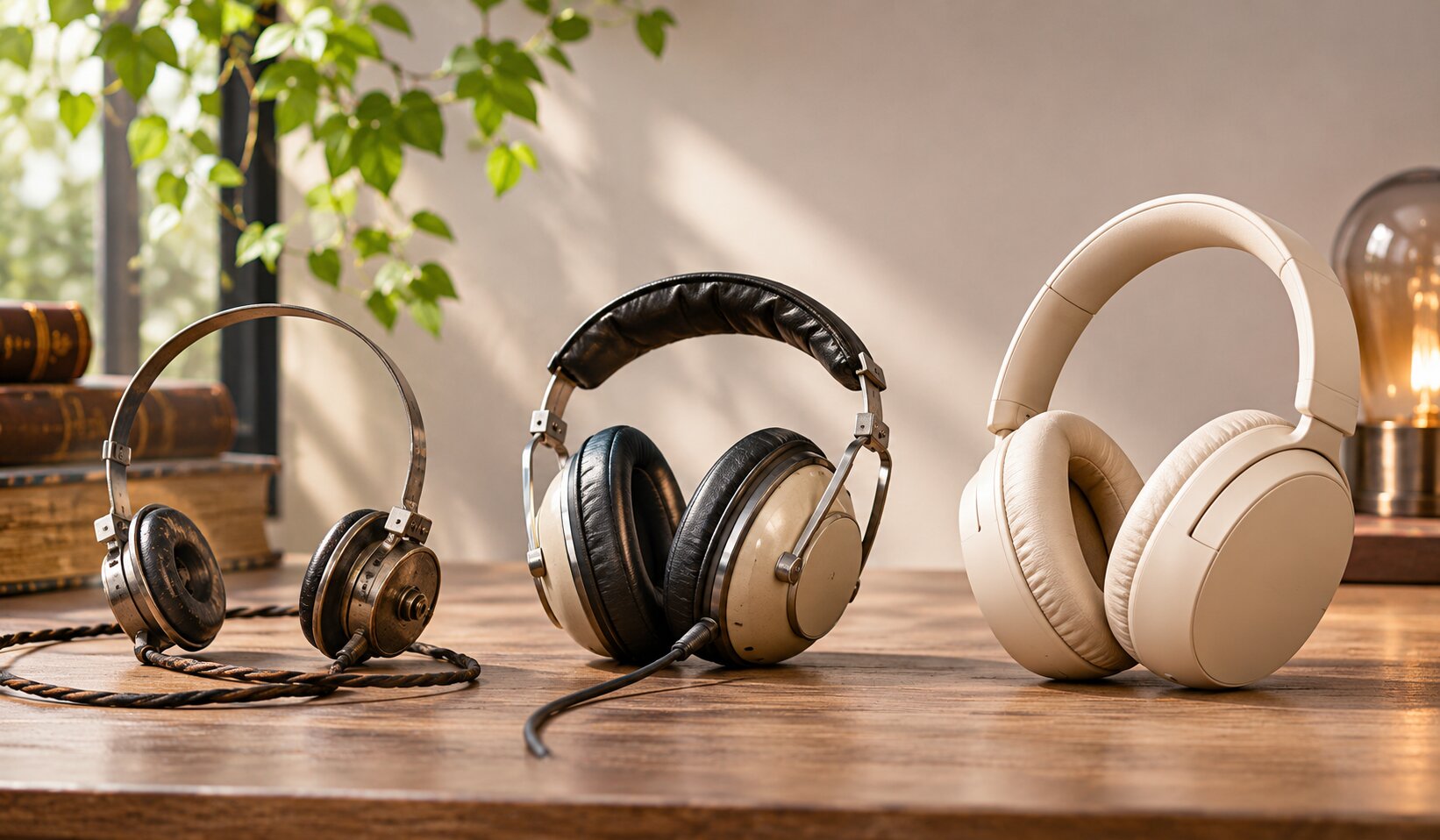
Telephone operators wore clunky headsets in the 1890s, and London’s Electrophone service piped live theatre and opera into subscribers’ homes through handheld listening devices. A French engineer, Ernest Mercadier, patented in-ear telephone receivers in 1891, according to the Smithsonian’s history of headphones. Those were ancestors, not the headphones we recognise.
The person most often credited with the modern design is Nathaniel Baldwin. In 1910 the Utah engineer mailed prototype headsets to the US Navy, which tested them and ordered more, even after learning he was hand-building them in his kitchen, roughly ten at a time. Two padded cups joined by a headband, no hands required: that is still the layout of any over ear pair you own.
The next jumps came from companies. SSENSE’s design history notes that John Koss’s hi-fi stereo headphones sold faster than the portable phonograph they were built to demonstrate. Sennheiser’s HD 414 opened the cups to let outside sound in, an early sign that headphones would leave the living room. Sony’s Walkman in 1979 then turned them into a way to carry a private world through public space.
After that the timeline reads like a tech diary: Bose’s first noise cancelling headphones in 1989, smaller earbuds and bone conduction through the 1990s (Headphonesty’s timeline), Bluetooth cutting the cable, and Beats making headphones a fashion object in 2008.
One pattern is worth noticing. Almost every era’s headphone began as work gear (switchboards, Navy radio rooms) before it became personal. Today’s noise cancelling over-ears have quietly closed that loop: the most popular use for a premium pair in 2026 is getting through a workday.
Why headphones are worth more than a music accessory
Think about what a good pair does across an ordinary week, and it is rarely just about music.
Start with noise. Active noise cancelling works best on steady, low-pitched sound such as aircon hum, train rumble or a laptop fan. One Louder review of the Sony WH-1000XM6 describes a desktop PC hum disappearing at home and traffic noise dropping sharply on a busy street. That is the real payoff: lower stress and better focus, not just louder bass.
It is also quietly a hearing-health tool. The World Health Organization’s current safe-listening guidance uses weekly exposure limits: up to 12 hours 30 minutes at 85 dB, four hours at 90 dB and 20 minutes at 100 dB. The exact risk depends on both volume and listening time. Well-fitted noise-cancelling headphones can help you avoid turning the volume up to compete with background noise. See the WHO safe-listening guidance. Which? adds that in ear designs can sound up to 9 dB louder than over ear at the same volume setting (Which?), worth remembering if you are shopping for the best in ear headphones.
Calls are the other half of daily use for hybrid workers, which is why the microphone gets its own section below. Headphones are also becoming accessibility tools: Bluetooth Auracast lets one source broadcast to many headphones at once, which could mean airport announcements or lecture-hall audio straight to your ears (RouteNote explainer).
Finally, there is the routine itself. A morning run, a ninety-minute focus block, an evening wind-down with a podcast: for many people the pair they reach for is part of how they look after themselves. That is why comfort deserves as much attention as any spec.
What changed in 2026: the news that matters
2026 at a glance: The market has a crowded top tier rather than one universally accepted winner. The dated updates below separate confirmed launches from rumours and scheduled releases.
If you read only one thing about the best headphones 2026 has produced, make it this: 2026 did not produce one new champion, it produced a crowded top shelf. Here is the dated log, newest first.
| Date (2026) | Release or news | Why it matters |
|---|---|---|
| Nov 19 (scheduled) | Technics EAH-A1000 launches in Japan | Panasonic announced the new flagship wireless model for Nov 19; it had not gone on sale when this article was published. Panasonic’s announcement |
| Nov 17 | Xiaomi Clip global launch; Samsung Galaxy Studio leak | Xiaomi introduced its clip-on open-ear earbuds globally. Samsung’s rumoured over-ear model remains unconfirmed and has no confirmed launch date. Xiaomi launch coverage · Samsung leak report |
| Nov 6 | Audio-Technica ATH-AWX7000 | $3,799 closed-back wired flagship; proof the wired world is alive |
| Oct | What Hi-Fi? names Sennheiser HDB 630 “best overall” in its October update | Sony no longer tops every list |
| Sep 8 | Bose adds Bluetooth LE Audio and Auracast (beta) to QC Ultra (2nd Gen) | Audio sharing arrives by firmware |
| Aug 7 | Bose QuietComfort Headphones (2nd Gen), $359 | Ultra features, lower price |
| Mar | AirPods Max 2 with the H2 chip | First real update since 2020 |
| Mar 12 | JBL Live 780NC enables Auracast on iPhone via its app | A workaround around Apple’s silence |
Sony remains a leading noise-cancelling option. The WH-1000XM6 launched in 2025 and uses Sony’s QN3 processor with 12 microphones, according to Sony’s launch announcement. RTINGS names the XM6 its best overall headphone in its October 19, 2026 update. What Hi-Fi? takes a different view: its October update puts the Sennheiser HDB 630 at the top, largely for sound quality. These are publication-specific rankings based on different testing priorities, not a single industry-wide verdict. RTINGS · What Hi-Fi? TechGearLab also favours the Bose QuietComfort Ultra (2nd Gen) in its own testing. Sony also marked the 10th anniversary of its 1000X line with a limited “The ColleXion” edition.
Bose has had a busy year. The QuietComfort Headphones (2nd Gen) launched in August 2026, and Bose later added Bluetooth LE Audio and Auracast support in a firmware update for compatible Android and Windows devices. Check the Bose firmware notes before relying on feature availability. The standard model and Ultra version should be compared at their current sale prices, since discounts change frequently.
Apple introduced the AirPods Max 2 in March 2026 at a US starting price of $549. They weigh 386.2 g and offer up to 20 hours of listening with ANC enabled. The weight is a practical consideration for long sessions; check Apple’s official announcement and technical specifications for the full feature list.
Sennheiser and Nothing are the outliers worth noticing. The Momentum 5 Wireless has a user-replaceable battery, confirmed by Sennheiser, and the Nothing Headphone (1) offers a rare IP52 rating at $299.
The bigger trend is a wired comeback (Sony’s $59.99 MDR-3R) alongside the open-ear boom.
The technical side
Sound quality and the speakers inside
Driver size is the spec people love to compare and the one that predicts least. The WH-1000XM6 uses a 30 mm dynamic driver (TechRadar) and still wins sound comparisons, because tuning and software matter more than millimetres. If you want the best headphones for music, SoundGuys names the XM6 its best all-rounder, with tuning close to its preferred curve and an app to adjust it. Loud and Wireless hears the Sony as fuller and heavier than the AirPods Max, which sound crisper and cleaner. Neither is “right”; it is a taste call. What is not a taste call is EQ: a pair you can adjust (the Sennheiser HDB 630 even offers a parametric EQ) beats a pair you cannot.
Noise cancelling
ANC listens with outward microphones and plays an inverse wave. It excels on steady low frequencies and struggles with sharp, variable sounds like voices and keyboard clatter, which is why even the best noise canceling headphones let some chatter through. The XM6’s 12-microphone array is a notable part of its noise-cancelling system, but one Pickr review cautions it will not isolate you from everything. Bose and Apple get close with different algorithms, though they attenuate high frequencies a little less.
Microphone quality
This is where specs mislead. Expert Reviews found XM6 call quality struggles in loud settings, and RTINGS notes voices can lose intelligibility in harsh conditions. A cloudmagazin comparison finds Bose more consistent on Windows and says the AirPods Max lose mic quality on non-Apple devices. One tip: when the headset mic switches on, Bluetooth drops to a narrower call profile, so music sounds worse mid-call. On a Mac, choose the laptop mic as input to keep sound quality high.
Bluetooth, codecs and battery
When you shop for the best Bluetooth headphones, the version number tells you little. Codecs decide quality: SBC and AAC are the basics, LDAC is Sony’s high-bitrate option (Sony says the XM6 also supports LC3), and Expert Reviews notes that iPhone owners cannot use LDAC, so the XM6’s highest-bitrate Bluetooth option is unavailable on iOS. LE Audio brings lower power use, multi-stream audio and Auracast, but compatibility is uneven (Avantree’s guide). Multipoint (two devices at once) works on Sony and Bose, not on the AirPods Max. For gaming, classic Bluetooth latency typically sits around 100 to 200 ms, so a 2.4 GHz dongle is the better route.
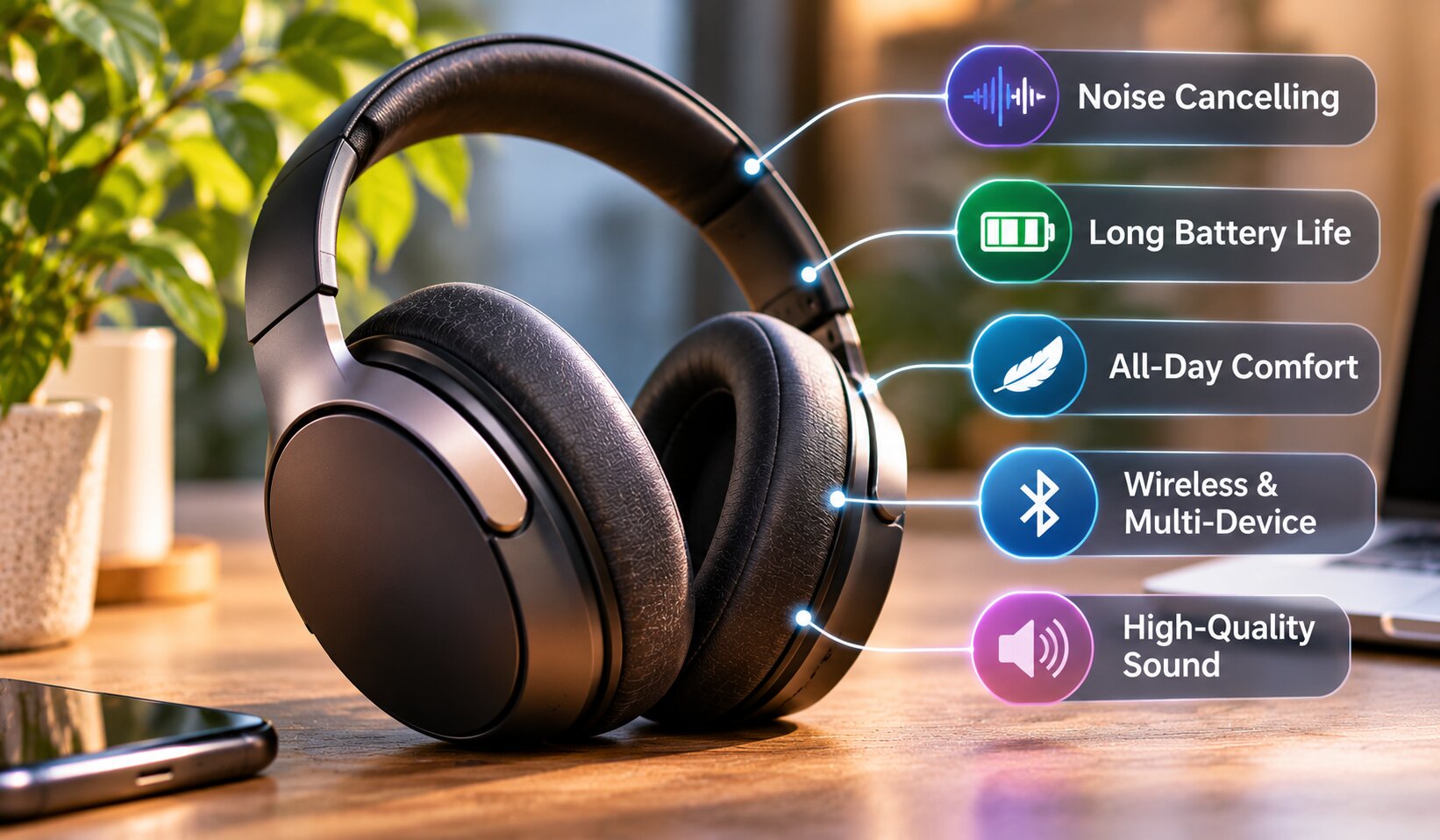
Battery: Sony rates the XM6 for up to 30 hours with ANC on and 40 hours with it off. Battery life varies with settings and use; see Sony’s official specifications.
Which type fits your life
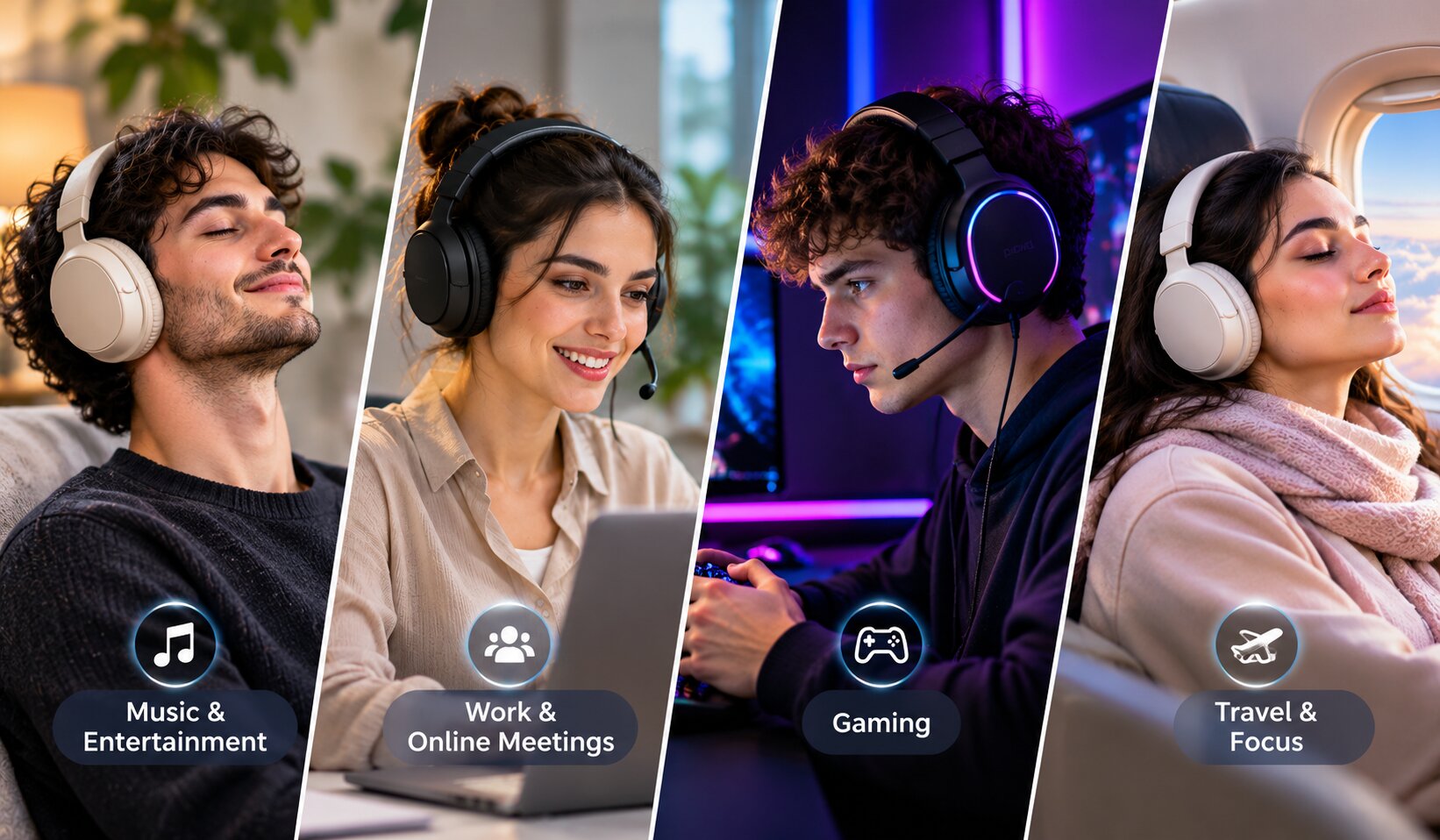
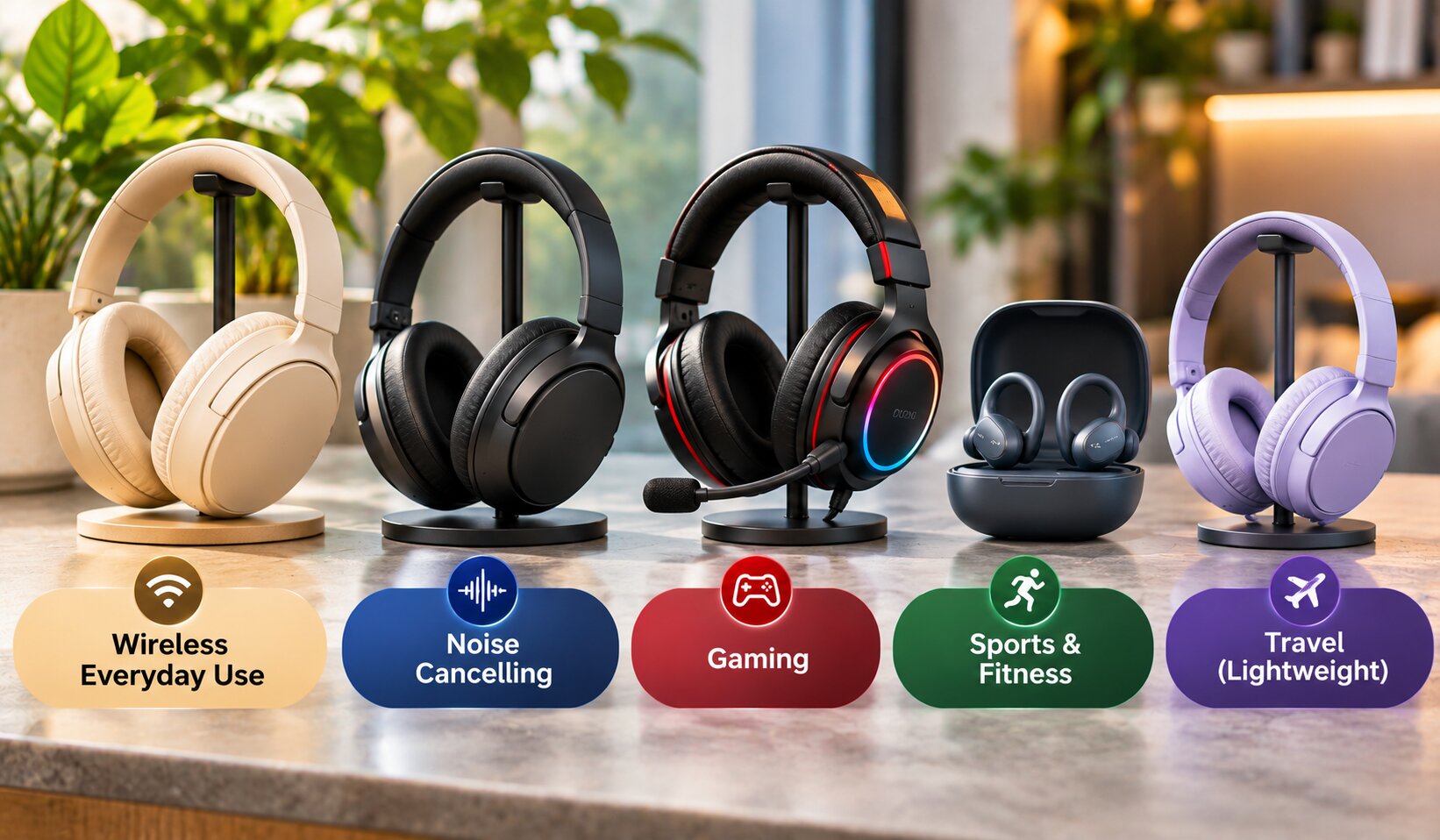
Best over ear headphones for noise canceling
If you want the best over ear headphones for flights and offices, this is the category. You get the strongest noise cancelling and the longest battery, and you pay in bulk. The XM6 weighs about 254 g; Apple lists the AirPods Max 2 at 386.2 g. The difference is noticeable if you wear headphones for several hours. Sony specifications · Apple specifications
Best in ear headphones for commutes
Earbuds win on portability. The Sony WF-1000XM6 uses Sony’s QN3e noise-cancelling processor and four microphones on each earbud. Sony says this setup reduces noise by 25% compared with the previous model; that is a manufacturer claim. Sony’s February 2026 announcement. Remember the loudness caveat from earlier: a sealed ear canal makes the same volume setting sound louder.
Best wired headphones
No battery, no codec limit, no pairing. For music at home, the Sennheiser HD 560S is Crutchfield’s budget audiophile pick, and Sony’s revived MDR-3R costs $59.99. Even wireless models now offer a wired fallback: the Bose QuietComfort (2nd Gen) supports USB-C audio up to 24-bit/48 kHz (audioXpress).
Best headphones for gaming
Look for a 2.4 GHz dongle, a detachable boom mic and a long battery. RTINGS lists the Audeze Maxwell 2, Razer BlackShark V3 Pro and SteelSeries Arctis Nova 7 among its top sets, and warns that some budget sets have only an okay mic in noisy rooms (RTINGS).
Best headphones for running, working out and the gym
The best headphones for working out are the ones that stay put: fit and sweat resistance matter more than sound here. If you are after the best running headphones, RTINGS names the Beats Powerbeats Pro 2 its pick and added the Nothing Headphone (a), which carries an IP52 rating, as a gym option. Most over-ear flagships have no official water rating, so treat them as gym-capable for light sweat only.
Best bone conduction headphones
Open-ear designs keep your ears free for traffic. The Shokz OpenRun Pro 2 leads Tom’s Guide and Live Science: 12 hours, IP55, and a hybrid of bone and air conduction for more bass. The cheaper OpenRun (under $130) uses only bone conduction, so it sounds thinner. The trade-off is always bass and privacy.
Comfort, hair, skin and glasses: the part reviews skip
Spec sheets ignore what you notice by week two. Pads sit on your skin for hours, so heat, sweat and pressure matter as much as drivers. Expert Reviews found that wearing glasses with the XM6 did not noticeably hurt comfort or noise cancelling (Expert Reviews), the kind of detail worth checking for any pair if you wear frames.
Hair and earrings are mostly a clamp-force question, and clamp force is one of the most common complaints in community threads. If a pair gives you a headache at hour two, it will not get better.
A few habits are common sense rather than lab findings: wipe pads with a slightly damp cloth and let them dry, keep foundation and skincare from building up on the cushions, and clean in ear tips regularly. For workouts, a pair with removable, washable earcups, like the one Engadget highlights, saves a lot of fuss. Replaceable pads and batteries, as on Sennheiser’s Momentum 5, make a pair last longer and look better.
What owners and communities actually say
Reviews tell you what a lab measured. Community threads tell you what a pair is like after a year. I looked at Reddit-derived summaries (via tools such as GummySearch), so treat them as anecdotes rather than a poll.
The first thing you notice is that nobody agrees. A 2026 write-up of Reddit ANC threads found no clear champion: the Sony WH-1000XM6 and Bose QuietComfort Ultra (2nd Gen) come up most, with comfort, sound preference, mic quality, portability and price deciding the rest. That matches the split among professional reviewers above. Bose fans are especially loyal about noise cancelling; one commenter’s whole recommendation was “Bose for anc all day,” while Sony owners counter with the app, the mic and the sound.
The complaints are more practical than the praise. A Discury analysis of budget-ANC threads lists muddy, bass-heavy default tuning and clamping force that causes headaches as the top gripes. People also ask for budget noise cancelling for sensory needs, where the Soundcore Space One (around $99.99) is a frequent suggestion (Reddit mentions).
The lesson I take from this: buy from a retailer with an easy return window and wear the pair for a full workday before deciding. Comfort and clamp force never show up on a spec sheet.
The ideal pair for a hybrid worker in the US, UK or Canada
Forget “best” in the abstract. For someone who splits the week between a home desk, a train or bus, and the occasional flight, this is the profile I would shop against:
- Strong ANC on low frequencies, with a transparency mode that sounds natural for quick chats.
- A mic that handles wind and room noise, since calls are half of daily use.
- Multipoint Bluetooth, so a laptop and phone stay connected at once.
- At least 30 hours of battery and fast charging.
- Weight near 250 g and pads that suit glasses, hair and earrings; ideally replaceable pads you can wipe clean.
- USB-C audio for a wired fallback, and LE Audio for the future.
Here is how the main contenders line up against it.
| Model | Price | Best for | Catch |
|---|---|---|---|
| Sony WH-1000XM6 Check price on Amazon | About $449 (£399 at launch) | ANC, sound, 30 h battery | USB-C is charge only; calls dip in loud places |
| Bose QuietComfort Ultra (2nd Gen) Check price on Amazon | $449 list, often about $379 | Comfort, calls, USB-C lossless | Sound rated decent rather than standout |
| Bose QuietComfort Headphones (2nd Gen) Check price on Amazon | $359 | Ultra features for less | SBC and AAC codecs only |
| Sennheiser Momentum 5 Wireless Check price on Amazon | $399.95 | Replaceable battery | ANC rated decent, not class-leading |
| Nothing Headphone (1) Check price on Amazon | $299 | Design, IP52, USB-C audio | Newer brand, so long-term support is unproven |
| AirPods Max 2 Check price on Amazon | About $549 | Apple users | 385 g, no multipoint, no EQ |
My read: if you use mixed devices, the Sony or the Bose pairs are the safest bets, and the call-heavy among you should lean Bose. Apple users with a MacBook and iPhone get a smoother experience from the AirPods Max 2 but pay for it. On a tighter budget, SoundGuys recommends the JLab JBuds Lux ANC under $100, and CNN Underscored picks the EarFun Tune Pro in that band.
Timing helps, too: RTINGS has already published its Black Friday 2026 guide, and flagships like the Bose Ultra have been discounted in recent months, so check current prices at US, UK and Canadian retailers before paying list.
Where headphones are heading
A few shifts look likely over the next year or two, and I will flag which are reported fact and which are my reading.
Audio sharing is the clearest shift, and it is reported fact rather than speculation. Bose’s Auracast beta, JBL’s app-based version on iPhone and Sennheiser’s Auracast TV headset (Digitec) all point the same way. One Spanish-language explainer notes that, as of October 2026, Apple does not document Auracast support, while the Bluetooth SIG says five major hearing-aid makers now ship Auracast-capable devices.
Longevity is the second theme. Sennheiser’s replaceable battery and the open-ear models from Xiaomi, Bose and Shokz show buyers want gear that lasts and keeps them aware of their surroundings. On the sound side, Noble’s FoKus Artemis is described as the first wireless ANC pair to combine dynamic and planar magnetic drivers (Gear Patrol). More flagship rivals are rumoured too: Samsung’s Galaxy Studio is a leak with no confirmed date or price.
My own reading, and it is only that, is that noise cancelling is reaching parity. Top models already sit close together, so the next fight will be mic quality, software, comfort and repair. If that holds, the sensible approach is to buy for the next three years of how you work, not for a spec sheet.
Final thoughts
The best headphones are the ones you forget you are wearing. For most people that means a lightweight noise cancelling over-ear pair with a trustworthy mic and a battery that outlasts the week; for runners it means open-ear or secure earbuds; for music lovers at home it can still mean a cabled pair.
If you are ready to buy, start with how you spend your day, set your budget, then try two finalists for a full workday. Keep volume modest, take listening breaks, and let noise cancelling do the work instead of the volume knob. Your ears do not come with a warranty.
Sources
Reviews and testing
- RTINGS: best headphones (October 2026) and Sony WH-1000XM6 review
- SoundGuys: best headphones
- What Hi-Fi?: best headphones and best wireless headphones
- Sony: WH-1000XM6 launch details · Sony: official specifications
- TechGearLab: best headphones
- Expert Reviews: Sony WH-1000XM6
- Apple: AirPods Max 2 announcement · Apple: technical specifications
- GSMArena: Sony WF-1000XM6
News and releases
- Panasonic: Technics EAH-A1000 announcement · Sennheiser: Momentum 5 announcement
- Tech Times: Autumn Headphone Festival 2026
- Bose: QuietComfort Ultra 2nd Gen firmware notes · Bose: QuietComfort 2nd Gen firmware notes
- Trusted Reviews on Samsung Galaxy Studio leak
History and hearing health
- Smithsonian Magazine: A Partial History of Headphones · Smithsonian National Museum of American History: Nathaniel Baldwin headset
- WHO: safe-listening guidance
Community discussion (aggregated, anecdotal)
- GummySearch, Discury
Also referenced in the text: Louder, Sonova on WHO guidance, Loud and Wireless, Pickr, cloudmagazin, Avantree, RouteNote on the XM6, Crutchfield, audioXpress, RTINGS on gaming and sport headphones, Tom’s Guide, Live Science, Engadget, SlashGear, The Gadgeteer, CNN Underscored, Digitec, iwantek.
Prices and availability were checked on November 18, 2026. They vary by country, retailer and promotion; confirm the final price and local availability before buying. Manufacturer pages are used for product specifications and launch dates; independent review rankings are attributed to the publications that produced them.

Affiliate disclosure: AhemBeauty may earn a commission if you buy through links in this article, at no additional cost to you. As an Amazon Associate, we earn from qualifying purchases.