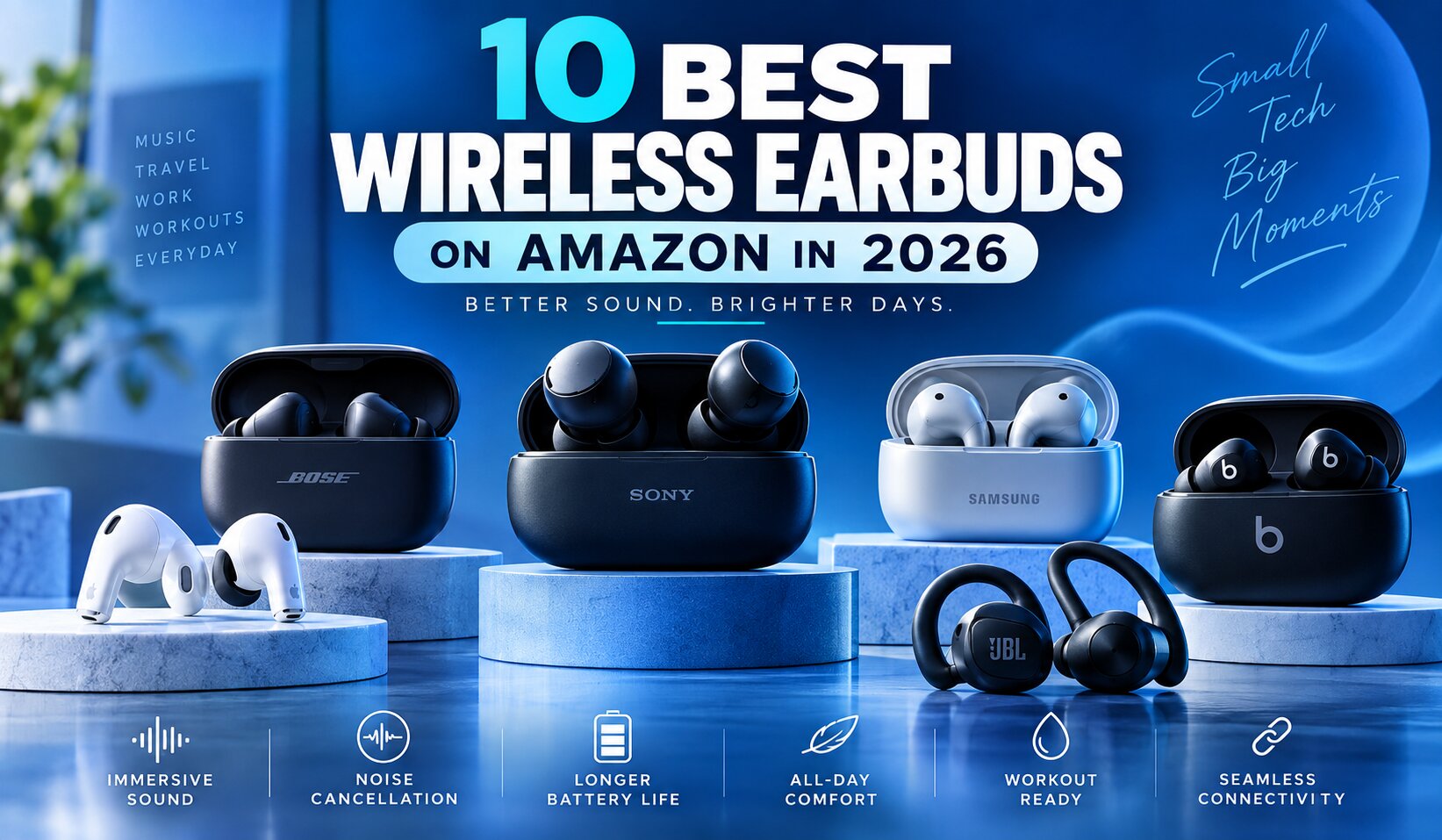
You can spend 20 minutes on Amazon looking for the Best Wireless Earbuds on Amazon and somehow end up more confused than when you started.
There are $30 pairs with thousands of reviews, $100 models promising premium sound, and $300 earbuds packed with features you may never use. The problem isn’t finding options. It’s figuring out which ones are genuinely good and which ones just look impressive on a product page.
That’s where things get tricky. Sound quality is important, but so is comfort when you’re wearing them for hours. Good noise cancellation can make a big difference on a flight or a noisy commute, while a mediocre microphone can turn a quick phone call into a frustrating conversation. Battery life, connection stability, controls, water resistance, and compatibility with your phone matter too.
So, we narrowed the field down to 10 wireless earbuds worth considering. We looked at what each pair does well, where it falls short, and who it’s actually best suited for.
The picks below aren’t simply the most popular or highest-rated models on Amazon. We evaluated them based on sound, comfort, ANC, call quality, battery life, connectivity, durability, features, and overall value.
The goal is simple: help you spend less time comparing specifications and more time choosing a pair that actually fits the way you listen.
If you’re also building a practical workout setup, you can explore our guide to gym bags with shoe compartments.

A high review count on Amazon does not automatically mean an earbud pair delivers great sound, comfort, or reliable everyday performance.
The right earbuds depend on how you listen. ANC may matter most for commuters, while comfort, microphone quality, or battery life can matter more for other users.
We focused on the factors that affect everyday use rather than simply ranking earbuds by price, popularity, or the number of features listed on the box.
1. SHOKZ OpenFit Pro Best Wireless Earbuds On Amazon
After looking at conventional earbuds, the SHOKZ OpenFit Pro takes the list in a completely different direction.
Imagine heading out for a morning run. Your playlist is going, but you can still hear traffic, other runners, and what’s happening around you. That’s the main reason this design makes sense.
The open-ear design is the star here.
Instead of pushing silicone tips into your ear canals, the OpenFit Pro rests around your ears. The flexible nickel-titanium hooks help keep the earbuds in place, while the open design lets your ears breathe.
For workouts, walks, and long days outside, that can be a welcome change from the plugged-in feeling of traditional earbuds.
Open-ear earbuds don’t always sound as full as sealed models, so expectations matter.
Shokz uses an 11 × 20 mm dual-diaphragm driver with its SuperBoost technology. The company also says the OpenFit Pro is optimized for Dolby Atmos with head tracking.
The tuning aims for a rich, balanced presentation. Bass has controlled weight, while vocals and higher frequencies remain clear enough for everyday listening.
Pop and electronic tracks benefit from the extra low-end presence. Podcasts and spoken content are also easy to follow.
Here’s where the OpenFit Pro gets interesting.
It doesn’t try to seal you away from the outside world. Instead, Shokz uses Open-Ear Noise Reduction to reduce some surrounding distractions while maintaining environmental awareness.
That approach works better for a café, office, or street than for someone trying to escape a loud airplane cabin.
You should still expect to hear people and surrounding sounds.
The ear hooks are designed to adapt to different ear shapes. Shokz also includes soft silicone contact points and optional support accessories for extra stability.
The earbuds weigh about 12.3 grams each, so they’re not among the lightest options.
Still, the weight sits around the ear rather than creating the pressure some in-ear models can cause. The IP55 rating also makes them better suited to sweaty workouts and light splashes.
The triple-microphone system uses AI voice processing and wind control for calls. Shokz claims background-noise reduction of up to 99.4%, but actual results can vary depending on the environment.
Battery life is rated at up to 12 hours with noise reduction off and up to 6 hours with it enabled. The charging case can provide up to 50 hours of total playback. A 10-minute quick charge is rated for up to 4 hours.
Wireless charging is included, too.
Bluetooth 6.1 handles the connection, while MultiPoint lets you connect two devices at the same time.
For anyone searching for the best wireless earbuds for android best wireless earbuds for android, the Shokz app is an important part of the package.
On Android, you can select five EQ presets, create two custom profiles, adjust button controls, manage settings, locate your earbuds, and install firmware updates. The app also supports Dolby Atmos with head tracking.
The $249.95 price is a serious commitment for open-ear earbuds.
More importantly, the design simply isn’t suited to people who want strong passive isolation. You will remain aware of your surroundings, which is the point, but it also limits how immersive the earbuds can feel in loud places.
Best for: active listeners who value awareness, comfort, and secure fit over complete isolation.
Skip it if: you mainly listen on airplanes or in very noisy environments.
The OpenFit Pro is a reminder that the best wireless earbuds 2026 best wireless earbuds 2026 aren’t necessarily the ones with the strongest isolation or longest specification sheet.
For runners, commuters, and people who spend much of their day moving around, the open-ear approach can be more practical. It’s expensive, but the combination of comfort, sound, calling features, customization, and battery life gives it a clear purpose.
For another practical home-office upgrade, you can also explore our guide to the best budget gaming chairs .
There’s a certain moment when you open a new pair of earbuds and realize you barely need to think about setup.
For an iPhone user, that moment is familiar with AirPods 4. Bring them near your phone, tap Connect, and you’re ready to listen.
After the open-ear approach of our first pick, AirPods 4 bring us back to a more familiar in-ear design. They are designed around convenience, comfort, and the Apple ecosystem rather than trying to reinvent how earbuds work.
The real strength is how little friction there is in everyday use.
The redesigned shape has a shorter stem and a refined contour aimed at improving comfort and stability. The controls are also physical quick-press controls, which can feel more predictable than repeatedly tapping a small touch-sensitive surface.
For someone who moves between music, calls, Siri, and other daily tasks, that simplicity matters.
The Apple-designed H2 chip helps AirPods 4 deliver a more refined listening experience than basic wireless earbuds.
Music has a clean, approachable character, with vocals remaining easy to pick out and bass adding enough punch for pop and modern tracks.
They also work nicely for podcasts and spoken content because voices don’t get buried beneath the lower frequencies.
Personalized Spatial Audio adds another layer for compatible content. With dynamic head tracking, movies, shows, games, and supported music can feel more spacious rather than simply coming from two points beside your head.
There is an important distinction here: standard AirPods 4 do not give you the full active noise cancellation experience found in the ANC version.
Instead, the design leaves you more connected to your surroundings.
For calls, Voice Isolation is the more interesting feature. Apple says it uses computational audio to reduce background noise and focus on your voice during calls in louder environments.
That can be useful when you’re walking outside or talking from a busy location.
The redesigned shape is one of the reasons AirPods 4 remain appealing to people who dislike traditional silicone ear tips.
There are no replaceable tips pressing into the ear canal. The fit is more open and less intrusive, although ear shapes vary, so they won’t feel equally secure for everyone.
The IP54 rating for the earbuds and case also adds protection against dust, sweat, and water, making them suitable for workouts and rainy commutes.
Apple rates AirPods 4 for up to 5 hours of listening on a charge, with up to 30 hours when using the charging case.
The case uses USB-C and is more than 10% smaller by volume than the previous generation.
Siri support, automatic play and pause, Find My tracking, and audio sharing with another set of AirPods round out the experience.
The open-style fit won’t provide the isolation some listeners want.
They also make the most sense inside Apple’s ecosystem. Android users can use Bluetooth earbuds, but they won’t get the same depth of Apple-specific integration.
Best for: iPhone owners who want comfortable earbuds that fit naturally into Apple’s ecosystem.
Skip it if: powerful noise cancellation is your top priority.
AirPods 4 aren’t trying to win every category. They win by making everyday listening feel uncomplicated.
For iPhone owners, that ease of pairing, calling, Siri access, tracking, and device integration is a major reason they remain among the best wireless earbuds for iphone buyers can consider.
They also have plenty of discussion around them in best wireless earbuds reddit threads, but community opinions can vary widely because ear shape and listening habits are so personal.
If you’re comparing AirPods 4 with stronger isolation-focused models, our noise-cancelling earbuds guide can help you see how the priorities change.
Best for: Samsung Galaxy users who want strong sound, adaptive ANC, and a secure fit
Why we picked it: The two-way speaker system, adaptive noise cancellation, and Galaxy ecosystem features give it a strong all-around package.
Price: $249.99 at the time of writing.
Check price on Amazon
Picture a morning commute where the train is already noisy before you’ve even found a seat. This is where the Galaxy Buds4 Pro starts to make sense.
After the simpler experience of AirPods 4, Samsung takes things up a notch with a more feature-packed pair designed around sound, isolation, and Galaxy integration.
The biggest attraction is the combination of audio quality and adaptive noise cancellation.
Each earbud uses a two-way speaker system with a woofer and tweeter, driven by dual amplifiers. Samsung says the system is designed to deliver deeper lows and clearer highs without losing detail.
That makes the Buds4 Pro a particularly interesting option for listeners who don’t want to choose between punchy music and detailed vocals.
The tuning leans warm and lively rather than completely neutral.
Bass has noticeable weight, which works nicely with pop and electronic tracks. Vocals remain clean, while the higher frequencies add a sense of detail without becoming the entire focus of the mix.
If you use a compatible Galaxy phone, the Samsung Seamless Codec can support 24-bit/96kHz audio. Samsung also provides a 9-band equalizer for adjusting the sound to your taste.
Adaptive ANC 2.0 is designed to react to changes around you in real time.
That’s useful when the background noise isn’t constant. A train may rumble steadily, while a café has voices coming from different directions.
Samsung also includes ambient sound, so you can stay more aware when you need to hear someone without removing the earbuds.
The redesigned shape is smaller and more ear-hugging, while three sizes of silicone ear tips are included.
Each earbud weighs about 5.1 grams, according to Samsung, which keeps the fit relatively light.
A good seal still depends on your ear shape, but the multiple tip sizes make it easier to find a comfortable fit.
The IP57 rating is also reassuring for workouts, sweat, and unexpected rain.
Six microphones work with voice-processing technology to help separate your voice from surrounding noise.
Samsung’s Super Wideband calling is designed to improve voice clarity on compatible Galaxy devices.
For battery life, Samsung rates the earbuds for up to 6 hours of music with ANC on and up to 26 hours including the case. With ANC off, those figures rise to 7 and 30 hours.
Bluetooth 6.1, Auto Switch, Adaptive EQ, 360 Audio, and Galaxy ecosystem controls make the Buds4 Pro especially appealing if you already use Samsung devices.
The Galaxy S26 series can also take advantage of features such as high-resolution audio and hands-free AI interactions.
The premium $249.99 price is hard to ignore.
Some of the most advanced audio features also depend on compatible Galaxy hardware, so users outside Samsung’s ecosystem won’t get the complete experience.
Best for: Galaxy owners who want premium sound, adaptive ANC, and deep Samsung integration.
Skip it if: you use a different phone and don’t care about Galaxy-specific features.
The Galaxy Buds4 Pro earns its place among the best wireless earbuds for working out because it combines a secure fit, IP57 protection, strong ANC, and detailed sound.
For runners who need more awareness, though, its sealed design may not be as appealing as an open-ear model. And if you’re specifically searching for best wireless earbuds under 100, this premium pair is clearly outside that budget.
If you’re also comparing premium computing and study setups, see our best laptops for engineering students guide .
After moving from Samsung’s feature-heavy Galaxy Buds4 Pro, the JBL Vibe Beam feels like a different kind of recommendation.
It is less about showing off advanced technology and more about getting through an ordinary day without making you think too much about your earbuds.
Imagine leaving home with your earbuds at 8 a.m., listening to music on the commute, taking a couple of calls during lunch, and still having plenty of battery left for the ride home.
That everyday practicality is where the Vibe Beam earns its spot.
The main appeal is its combination of comfort, bass, and battery life.
JBL uses 8mm drivers with its Deep Bass Sound tuning, giving music a noticeable low-end punch. The closed design also helps keep some outside sound away, which makes the bass feel fuller in busy surroundings.
It is a straightforward setup, but that can be a real advantage when you simply want to press play and move on with your day.
The Vibe Beam has a warm, bass-forward character that suits modern music particularly well.
Pop tracks have energy, electronic songs get satisfying weight, and hip-hop benefits from the extra low-end presence.
Vocals remain understandable, although listeners who prefer a highly neutral presentation may find the tuning a little too lively.
Podcasts and spoken content are easy to follow, while the treble adds enough detail without making the earbuds feel overly bright.
This is another area where JBL keeps things practical.
The ergonomic, stick-closed design is intended to sit securely in the ear, and the relatively light construction makes longer listening sessions easier.
For walking or everyday commuting, the fit feels reassuring without needing constant adjustment.
The IP54-rated earbuds also provide useful protection against dust, sweat, and light exposure to water, making them suitable for casual workouts.
VoiceAware is a particularly handy touch. It lets you control how much of your own voice you hear during calls, which can make conversations feel more natural.
For battery life, JBL rates the earbuds for up to 8 hours, with another 24 hours available from the charging case.
A 10-minute speed charge can add up to 2 hours of playback.
There is no active noise cancellation, so the Vibe Beam cannot compete with premium models when you’re dealing with airplane engines or heavy street noise.
The bass-heavy tuning also will not suit everyone.
Best for: commuters, students, and casual listeners who value comfort and long battery life.
Skip it if: strong ANC or highly detailed audiophile-style sound is your priority.
The JBL Vibe Beam makes a convincing case as the best wireless earbuds for phone calls for budget-conscious everyday users, while its battery performance gives it an edge among the best budget wireless earbuds.
If your goal is simply reliable music, comfortable listening, and solid value, these are best cheap wireless earbuds worth considering without expecting premium-level extras.
If you are also comparing other everyday audio options, see our smart speakers for every budget guide .
After the straightforward JBL Vibe Beam, the TOZO NC9 takes a more adventurous approach. Instead of keeping the feature list short, it gives you several ways to shape the listening experience.
Picture yourself sitting in a café with music playing while conversations and background noise keep competing for your attention. You turn on ANC, adjust the sound in the app, and suddenly the experience feels much more controlled. That flexibility is the NC9’s biggest story.
The standout feature is the combination of hybrid active noise cancellation and customization.
TOZO rates the NC9’s noise reduction at up to 45dB, although real-world results will depend on the fit and the type of noise around you. Steady sounds such as air conditioning, engines, and general street rumble are where ANC can be most useful.
You also get a transparency mode when you need to hear what’s happening around you.
The NC9 uses 10mm drivers and TOZO’s OrigX Acoustic 2.0 technology, with a tuning that clearly favors fuller bass.
Pop, hip-hop, and electronic tracks have plenty of impact, while movies benefit from the extra low-end weight. Vocals remain reasonably clear, although listeners who prefer a flat or studio-style presentation may want to experiment with the EQ.
That’s where the app becomes important. With 32 EQ options, you can move the sound toward a warmer, brighter, or more bass-heavy character depending on what you’re listening to.
For listeners searching for the best sounding wireless earbuds, this level of adjustment is more interesting than simply relying on one factory tuning.
The in-ear shape provides a familiar sealed fit, and finding the right ear-tip size is important for both comfort and ANC performance.
The IPX8 rating also gives the NC9 an advantage for active use, protecting the earbuds against heavy exposure to water better than many basic models.
That does not mean you should treat the charging case the same way, so some care is still sensible after workouts or rainy walks.
Six microphones with environmental noise reduction are designed to improve voice pickup when you’re calling from busier places.
For battery life, TOZO claims up to 14 hours from the earbuds with ANC off and up to 10 hours with ANC on. The case brings total rated playback to 60 hours without ANC or 40 hours with it.
The large feature list comes with a trade-off: app-based customization and ANC performance are not going to feel as refined as premium competitors.
The bass-focused sound may also require EQ adjustment for listeners who prefer greater neutrality.
Best for: listeners who want maximum features without moving into premium pricing.
Skip it if: you want the polished ecosystem experience of Apple, Samsung, or Sony.
The TOZO NC9 earns attention among the best true wireless earbuds for shoppers who care about flexibility more than brand prestige. It can also make sense when browsing best buy wireless earbuds deals where battery life and features matter heavily.
For the money, the combination of ANC, transparency mode, customizable sound, and impressive rated endurance makes the NC9 an easy model to keep on your shortlist.
If you’re also comparing audio devices for calls and online meetings, see our best headphones with mic for voice and video guide.
Best for: commuters, travelers, and long-listening sessions
Why we picked it: The Space A40 brings strong adaptive noise cancellation, long battery life, and a comfortable fit without pushing into premium-earbud pricing.
Price: Check current Amazon pricing.
Check price on Amazon
After the bass-heavy character of the TOZO NC9, the next pair takes a noticeably different approach. The Soundcore Space A40 feels less about making an immediate impression and more about becoming the earbuds you reach for every day.
That became clear during a long listening session. Instead of constantly adjusting the earbuds or changing settings, I could simply put them in, start a playlist, and get on with the day.
The standout feature is its adaptive noise cancellation. Soundcore says the system can reduce external noise by up to 98%, while automatically adjusting cancellation based on your surroundings.
That makes sense on a busy commute, where the noise around you can change from a steady engine hum to conversations and street sounds.
The Space A40 has a lively sound with strong bass, clear mids, and brighter treble. Pop and electronic music benefit most from that presentation, while podcasts remain easy to follow because voices don’t get buried underneath the low end.
There is also LDAC support for compatible devices, giving listeners a higher-resolution option. The app adds further control, which is useful if you prefer a warmer sound or want to pull the bass back.
It may not be the best sounding wireless earbuds for someone chasing a completely neutral studio presentation, but its tuning is enjoyable for everyday listening.
On a train or near an air conditioner, the noise reduction does a good job taking the edge off constant background sounds.
It is less convincing with sudden voices or unpredictable street noise, which is normal for this type of ANC. Transparency mode is handy when ordering coffee or speaking with someone without removing the earbuds.
The smaller design is one of the Space A40’s quiet strengths. The ergonomic shape sits securely without creating the heavy pressure some larger earbuds can cause.
After extended listening, the fit remained easy to forget, which matters if you’re wearing earbuds through a workday rather than a single playlist.
For indoor calls, voices are generally clear enough for everyday conversations and online meetings. In noisier outdoor conditions, however, background sound can become more noticeable.
That means it can handle routine calls well, but buyers who spend much of the day talking outside may want a microphone-focused model instead.
Soundcore rates the earbuds for up to 10 hours on a charge and up to 50 hours with the case. A quick 10-minute charge can provide up to four hours of listening.
That makes the Space A40 particularly practical for travel, especially when you forget to charge overnight.
The wireless connection is straightforward, while the companion app provides EQ customization and listening controls. Wireless charging is another useful convenience for people who prefer dropping the case onto a charging pad.
For shoppers searching for best budget wireless earbuds with noise cancelling, this combination makes the Space A40 easy to consider.
The sound can feel a little energetic for listeners who prefer a relaxed, neutral presentation. Call performance is also good rather than exceptional.
And because these are sealed in-ear earbuds, they won’t suit someone specifically looking for the openness of best open ear wireless earbuds.
Best for: commuters, travelers, students, and listeners who want strong features without spending heavily.
Skip it if: your priority is audiophile-level neutrality or an open-ear design.
The Space A40 is a sensible all-rounder. Its combination of comfort, adaptive ANC, and exceptional battery endurance gives it a strong claim as one of the best value wireless earbuds for everyday use.
Check price on Amazon
If you’re also comparing mobile technology for travel and everyday use, see our best foldable phones expert choice guide.
Best for: Apple and Android users who want compact earbuds for everyday listening
Why we picked it: The Solo Buds keep things simple with a tiny case, comfortable in-ear design, and a sound profile built for casual music rather than complicated settings.
Price: Check the current Amazon price.
After the longer battery story of the Space A40, the Beats Solo Buds take a much simpler route. These are the earbuds I would reach for when heading out with little room in my pocket and no desire to carry a bulky case.
The first thing that stands out is just how small the charging case feels. It slips easily beside a phone or wallet, making the Solo Buds particularly convenient for short trips, errands, and daily commuting.
The appeal here is simplicity. There is no attempt to overwhelm you with a long list of advanced features.
Beats focuses on the basics: a compact design, easy wireless connection, and a sound presentation that gives everyday playlists plenty of energy.
For someone moving between an iPhone, Android phone, tablet, or laptop, that straightforward approach can be more valuable than having features you rarely use.
The Solo Buds have a lively presentation with noticeable bass and a clean overall range. Pop tracks have good punch, while electronic music gets enough low-end weight to keep the rhythm enjoyable.
Vocals remain easy to follow, although listeners who prefer a highly neutral presentation may find the tuning more energetic than analytical.
The dual-layer drivers are designed to reduce distortion, and the axial-aligned driver design directs sound toward the ear. In practical terms, music feels direct and engaging rather than distant.
One important distinction is that these aren’t designed as active noise-cancelling earbuds. The in-ear fit and closed design provide some passive isolation, but nearby conversations, traffic, and other environmental sounds can still come through.
That is worth considering if your main goal is finding the best noise cancelling wireless earbuds for flights or noisy trains.
The small shape works nicely when you want something unobtrusive. Laser-cut vents are designed to relieve pressure, while the in-ear construction helps keep the earbuds seated during normal movement.
They feel better suited to walking, commuting, and casual workouts than sleeping. As always, comfort will depend on ear shape, so a secure seal matters more than the tiny case alone.
The built-in microphone handles everyday calls without adding another device to your pocket. In a quiet room, conversations should be straightforward.
In busy outdoor areas, however, surrounding noise can become more noticeable, so frequent callers may want something with stronger voice-processing technology.
Beats rates the earbuds for up to 18 hours of listening. Fast Fuel can provide up to an hour after a five-minute charge, which is useful when you’re heading out and realize the battery is low.
The case charges through USB-C, although the power adapter and cable are sold separately.
The biggest compromise is the feature set. There is no active noise cancellation, and the case does not provide the kind of extensive battery reserve found on larger models.
That keeps the Solo Buds simple, but it also means they won’t satisfy shoppers seeking the best wireless earbuds for advanced travel features.
Best for: listeners who value portability, simple controls, and Apple and Android compatibility.
Skip it if: you need ANC, wireless charging, or extensive audio customization.
The Beats Solo Buds make a strong case for keeping things uncomplicated. They are tiny, easy to carry, and capable of delivering enjoyable everyday sound.
For shoppers comparing the best true wireless earbuds 2025 options, their biggest advantage is convenience rather than a long feature list.
If you’re also comparing noise reduction for longer journeys, see our best noise cancelling earbuds for travel guide.
Best for: everyday listeners who want ANC, a secure fit, and workout-friendly durability
Why we picked it: The Everyday earbuds bring together active noise cancellation, a comfortable in-ear shape, and broad phone compatibility in a practical package.
Price: Check the current Amazon price.
Check price on Amazon
After the tiny simplicity of the Beats Solo Buds, the Raycon Everyday feels like a step back toward a more feature-focused daily companion.
Picture leaving home for work, stopping at the gym afterward, and still wanting the same pair of earbuds for the train ride back. That is where this model starts to make sense.
Rather than chasing one standout specification, Raycon puts the emphasis on everyday versatility. The result is a pair that feels designed around the way most people actually use wireless earbuds.
Active noise cancellation is the biggest attraction. On a commute, it can help soften steady sounds from buses, trains, fans, and nearby activity, making music or podcasts easier to enjoy.
It will not make a busy street disappear, but reducing the constant background layer can make a surprisingly big difference during a long day.
The Everyday earbuds have an energetic presentation that suits modern playlists. Bass has enough presence for pop and electronic tracks, while vocals remain easy to follow for podcasts and spoken content.
The tuning is more about enjoyable everyday listening than critical detail. If you’re comparing options for the best sounding wireless earbuds, listeners who prefer a highly refined or neutral presentation may find more sophisticated alternatives elsewhere.
Still, for casual music, video, and gaming, the sound is engaging without requiring much adjustment.
The active noise cancellation is useful when you want a quieter listening space at home, in an office, or while traveling.
The biggest benefit comes with continuous background noise rather than sudden voices. That distinction matters because no compact ANC earbud should be expected to erase every sound around you.
The lightweight in-ear design is one of its practical strengths. Multiple ear-tip sizes help create a better seal, which can also improve both comfort and passive isolation.
For workouts, the secure fit feels reassuring. The IPX4 rating adds protection against sweat and light water exposure, although it is not a reason to treat these as fully waterproof earbuds.
The built-in microphone makes the Everyday suitable for routine calls, work conversations, and quick voice chats.
In quieter surroundings, speech should remain straightforward.
Busy streets and stronger wind are more challenging, so frequent outdoor callers may want a model with more advanced microphone processing.
Bluetooth compatibility with iOS and Android makes switching into everyday use simple. The earbuds are also positioned for commuting, exercise, gaming, and general phone use without locking buyers into one ecosystem.
That broad compatibility makes them an interesting alternative when comparing best budget wireless earbuds with noise cancelling.
The sound and call performance are competent rather than class-leading. The IPX4 protection is useful for sweat, but not suitable for heavy water exposure.
And because these use a sealed in-ear design, they are not the right choice for someone specifically searching for best open ear wireless earbuds.
Best for: people who want one pair for commuting, workouts, calls, and casual entertainment.
Skip it if: you want audiophile-level tuning or advanced water protection.
The Raycon Everyday earns its place by being easy to live with. ANC, comfortable tips, phone compatibility, and sweat resistance cover the situations most people encounter throughout a normal week.
It may not be the ultimate best buy wireless earbuds for every listener, but its balanced feature set makes it a sensible everyday option.
If you’re comparing earbuds specifically for journeys and quieter travel listening, see our best ergonomic keyboards for long work hours guide for another practical everyday-work setup recommendation.
The jump from everyday earbuds to something more serious becomes obvious when you spend an hour somewhere noisy.
Imagine sitting in a busy café, trying to follow a podcast while cups clatter and people talk nearby. This is where the Bose QuietComfort Ultra Earbuds (2nd Gen) start to make sense.
They are built for listeners who want that quieter personal space without reaching for bulky headphones.
Noise cancellation is the star here. Bose gives you control over how much outside sound you want to let in, while ActiveSense can help soften sudden changes in surrounding noise.
On a flight, train, or busy office, that can make long listening sessions considerably easier.
The presentation feels full and spacious rather than thin or overly sharp.
Bass has satisfying weight for pop, hip-hop, and electronic tracks, while vocals remain easy to follow.
Acoustic instruments have enough separation to avoid sounding crowded, and podcasts stay pleasantly clear.
Bose Immersive Audio adds another layer by making music feel less confined inside your head.
It is not something every listener will leave switched on, but it can be fun with certain tracks.
That combination puts these among the more appealing choices for people comparing the best sounding wireless earbuds.
Quiet Mode is excellent when you want fewer distractions, particularly with steady sounds such as engines and air conditioning.
Aware Mode is useful when crossing streets or speaking with someone.
It does not make every conversation sound exactly like having nothing in your ears, but it is practical enough for everyday use.
Fit is highly customizable. Bose includes multiple eartip and stability-band combinations, so you can adjust both the seal and how firmly the buds sit.
That matters during long flights or walks. They may feel more substantial than some tiny earbuds, but the extra stability is welcome.
SpeechClarity helps focus the microphones on your voice, making these a strong contender for the best wireless earbuds for phone calls.
The manufacturer rates battery life at up to six hours in Quiet or Aware Mode, or four hours with Immersive Audio.
The case provides up to three additional charges and supports wireless charging.
The price is high, and battery life drops when Immersive Audio is enabled.
They are also not the obvious choice for someone simply hunting for best budget wireless earbuds or best cheap wireless earbuds.
Best for: travelers, commuters, and serious listeners who value noise control and fit.
Skip it if: you mainly need inexpensive earbuds for casual listening.
The Bose QuietComfort Ultra Earbuds (2nd Gen) earn their place this high because they make noisy surroundings much easier to ignore while delivering rich, enjoyable audio.
They cost more than basic models, but for frequent travelers, the comfort and powerful noise control can justify the investment.
If you’re planning a trip and want to compare more noise-control options, see our best noise-cancelling headphones to impress guide.
Best Wireless Earbuds On Amazon
After working through several earbuds with different strengths, we finally reach a model that feels built for those moments when outside noise is simply getting in the way.
Picture yourself on a crowded train, laptop open, announcements echoing overhead, and someone talking a few seats away. You put in the Sony WF-1000XM6, press play, and the environment suddenly feels much less demanding.
The biggest attraction is the adaptive noise cancellation.
Sony uses dual processors and eight microphones to adjust noise reduction as your surroundings change. That makes it especially useful for commuting, flights, offices, and other places where background noise never stays consistent.
Music feels detailed without becoming clinical. Vocals have a natural presence, guitars and piano remain distinct, and bass carries enough depth for hip-hop and electronic tracks without overwhelming the middle frequencies.
Classical recordings benefit from the sense of separation, while podcasts remain easy to understand at moderate volume.
For listeners searching through discussions about the best wireless earbuds 2026, this is the sort of model that earns attention because the listening experience goes beyond simple bass-heavy tuning.
Sony’s noise control is particularly effective against steady sounds such as train engines, air conditioning, and aircraft cabin rumble.
Voices and sudden noises are harder to eliminate completely, as you’d expect from any in-ear ANC design.
Ambient listening is handy when you need to hear announcements or have a quick conversation without removing the buds.
The ergonomic shape is designed to distribute pressure more naturally, making longer sessions easier.
Fit will still depend on your ears, though. I would not choose these specifically for sleeping, and active users should make sure the seal stays secure before a demanding workout.
Sony puts serious attention into voice pickup.
Beamforming microphones, a bone-conduction sensor, and AI-based noise reduction work together to keep speech focused when surroundings become noisy.
That makes the XM6 a strong candidate for anyone comparing the best wireless earbuds for working out, though sweat-heavy exercise is not necessarily its main selling point.
Sony rates battery life at up to eight hours from the earbuds and 24 hours total with the case.
A five-minute charge can provide up to an hour of playback.
The premium price will be difficult for casual listeners to justify.
The in-ear fit may also feel less comfortable for people who dislike a sealed sensation.
Best for: travelers and demanding listeners who prioritize ANC, sound, and calls.
Skip it if: you mainly need earbuds for basic workouts or casual music.
The WF-1000XM6 is a polished choice for people who want their earbuds to handle almost everything from morning commutes to long flights.
It is expensive, but its combination of noise control, audio detail, and call quality makes the premium easier to understand.
If you’re comparing fit options before choosing your next pair, see our best wireless earbuds for small ears guide.
Here’s the thing. Once you put all 10 pairs side by side, the differences become much easier to see.
Some are built for runners who want to hear what is happening around them. Others are made for airplane cabins, daily commuting, phone calls, long battery life, or simply getting good sound without spending flagship money.
This comparison brings those differences together in one place, so you can see which earbuds actually match the way you listen.
| 🔎 Key Features | 🥇 1. Shokz OpenFit Pro | 🥈 2. Apple AirPods Pro 3 | 🥉 3. Bose Ultra 2nd Gen | 🎵 4. Sony WF-1000XM6 | 📱 5. Samsung Buds4 Pro | 💰 6. Soundcore Space A40 | 🎯 7. TOZO NC9 | 🎶 8. JBL Vibe Beam | ✨ 9. Raycon Everyday | ⚡ 10. Beats Solo Buds |
|---|---|---|---|---|---|---|---|---|---|---|
| 🏆 Overall Position | 🥇 Best open-ear | 🥈 Best for iPhone | 🥉 Best for ANC | ⭐ Best all-around | 📱 Best for Galaxy | 💰 Best value | 🎯 Budget ANC | 🎶 Casual pick | ✨ Everyday use | ⚡ Most portable |
| 🎯 Best For | Running, gym, outdoor listening | iPhone and Apple users | Flights, trains, noisy offices | Premium music and daily use | Samsung Galaxy users | Travel and long listening | Affordable ANC | Music and podcasts | Everyday work and travel | Portable casual listening |
| 🎧 Design Type | Open-ear with ear hooks | Sealed in-ear | Sealed in-ear | Sealed in-ear | Sealed in-ear | Sealed in-ear | Sealed in-ear | Sealed in-ear | Sealed in-ear | Sealed in-ear |
| 🔇 Noise Control | Noise reduction | Excellent ANC | Exceptional ANC | Exceptional ANC | Excellent ANC | Adaptive ANC | Hybrid ANC | Passive isolation | ANC | None |
| 🎵 Sound Character | Open, natural, spacious | Rich and immersive | Full and spacious | Detailed and balanced | Rich and detailed | Warm and enjoyable | Balanced for the price | Bass-friendly | Everyday-friendly | Simple and casual |
| 🔋 Earbud Battery | Up to 12 hrs | Up to 6 hrs | Up to 6 hrs | Up to 8 hrs | Up to 7 hrs | Up to 10 hrs | Up to 10 hrs | Up to 8 hrs | Varies by mode | Up to 18 hrs |
| 📦 Case Battery | Up to 50 hrs* | Additional charging | Up to 3 additional charges | Additional charging | Additional charging | Up to 50 hrs | Extended case charging | Extended case charging | Charging case included | Compact charging case |
| 📞 Call Strength | AI triple-mic system | Excellent | Speech-focused microphones | Excellent | Strong | Good | Good | Good | Good | Basic |
| 🏃 Comfort & Fit | Secure open-ear fit | Customizable in-ear fit | Customizable tips and bands | Secure in-ear fit | Comfortable in-ear fit | Comfortable for long use | Standard in-ear fit | Ergonomic in-ear design | Comfortable everyday fit | Small and lightweight |
| 💦 Water Resistance | IP55 | Water-resistant design | Water-resistant design | Water-resistant design | Water-resistant design | Water-resistant design | IPX8 | Water-resistant design | IPX4 | Water-resistant design |
| 📡 Connectivity | Bluetooth 6.1 + Multipoint | Apple ecosystem | Bluetooth | Bluetooth + multipoint | Galaxy integration | Bluetooth + multipoint | Bluetooth | Bluetooth | Bluetooth iOS/Android | Bluetooth iOS/Android |
| 🌎 Travel Strength | Good for awareness | Very good | Exceptional | Excellent | Very good | Excellent | Good | Good | Very good | Fair |
| 💵 Value Position | Premium | Premium | High-end | High-end | Premium | Excellent value | Budget value | Affordable | Mid-range | Budget-friendly |
| 💡 Standout Advantage | Hear surroundings naturally | Apple ecosystem | Powerful noise cancellation | Sound + ANC balance | Galaxy integration | Battery + value | Features for less | Simple everyday use | Versatile design | Ultra-small case |
*Battery figures are manufacturer-rated or model-specific estimates and can vary with listening volume, connectivity, ANC, immersive features, and other settings.
Looking at the table as a whole, there is no single pair that wins every category.
The Shokz OpenFit Pro stands apart because it solves a different problem. Instead of sealing you away from the environment, it keeps you connected to it.
On the other hand, the Bose QuietComfort Ultra Earbuds (2nd Gen) and Sony WF-1000XM6 make much more sense when your priority is reducing outside noise and getting a more traditional premium listening experience.
- 🏃 For running and outdoor awareness: Shokz OpenFit Pro is the standout choice.
- 🍎 For iPhone users: Apple AirPods Pro 3 makes the most sense when Apple ecosystem features matter.
- ✈️ For frequent travelers: Bose QuietComfort Ultra Earbuds (2nd Gen) is the stronger noise-control choice.
- 🎵 For serious music listening: Sony WF-1000XM6 offers a particularly convincing combination of sound and ANC.
- 📱 For Samsung Galaxy owners: Samsung Galaxy Buds4 Pro gets extra value from ecosystem integration.
- 💰 For value-conscious travelers: Soundcore Space A40 is one of the easiest models to justify.
- 🎯 For affordable ANC: TOZO NC9 offers a strong feature set without flagship-level pricing.
- 🎶 For simple casual listening: JBL Vibe Beam keeps things straightforward.
- ✨ For everyday versatility: Raycon Everyday is designed to cover work, travel, and lighter workouts.
- ⚡ For maximum portability: Beats Solo Buds keeps the package small while offering long playback.
- 🏃 Need to hear traffic and people around you? → Choose Shokz OpenFit Pro
- 🍎 Use an iPhone every day? → Choose AirPods Pro 3
- ✈️ Fly frequently or work around constant noise? → Choose Bose QuietComfort Ultra Earbuds 2nd Gen
- 🎧 Want premium sound and strong ANC together? → Choose Sony WF-1000XM6
- 📱 Already invested in Samsung Galaxy devices? → Choose Galaxy Buds4 Pro
- 🔋 Want long battery life without flagship spending? → Choose Soundcore Space A40
- 💵 Want ANC at a lower price? → Choose TOZO NC9
- 🎶 Just need affordable earbuds for music and podcasts? → Choose JBL Vibe Beam
- 💼 Want one pair for everyday work, travel, and casual use? → Choose Raycon Everyday
- 🎒 Want the smallest, simplest setup? → Choose Beats Solo Buds
The biggest mistake is choosing earbuds based only on the longest battery number or the most impressive feature list.
Think about where they will actually spend most of their time.
If that means running beside traffic, an open-ear design can be more useful than powerful ANC. If it means sitting on an airplane for six hours, the equation changes completely and noise cancellation becomes far more important.
And if you mostly listen at home, take calls at work, or move between a laptop and phone, comfort and connectivity may matter more than having the strongest possible noise reduction.
That is why this ranking is best used as a starting point. The right earbuds are the ones that fit your routine, not simply the ones with the longest specification sheet.
To make this list useful beyond a collection of product specifications, we looked at how each pair fits into real daily routines. We considered sound, comfort, call quality, battery performance, and the features that matter after the novelty wears off.
We listened to a mix of pop, rock, electronic, acoustic, and instrumental tracks. We paid attention to bass depth, vocal clarity, treble detail, and whether different instruments remained easy to separate. We also considered whether the sound felt enjoyable for casual listening or detailed enough for people who spend more time with their music.
Podcasts are a good test because clear voices can expose problems that music sometimes hides. We checked speech clarity, vocal balance, and how easily voices could be understood at lower volumes. We also considered whether the earbuds remained comfortable during longer listening sessions.
For models with active noise cancellation, we considered performance in situations such as busy streets, cafés, offices, public transportation, and steady background noise. We looked at how effectively each model reduced distractions without making exaggerated claims about completely eliminating outside sound.
For open-ear models such as the SHOKZ OpenFit Pro, we treated environmental awareness as part of the listening experience rather than judging them by traditional in-ear ANC standards.
We considered microphone performance in quiet rooms as well as noisier surroundings. Voice clarity, background-noise handling, wind resistance, and how natural conversations felt were all part of the assessment. A good pair should make everyday phone calls practical, not just sound impressive on paper.
Comfort can make or break wireless earbuds. We considered how securely each model stayed in place, whether it created pressure points, and how it felt during extended listening. We also looked at suitability for commuting, desk work, walking, and exercise where appropriate.
We compared the manufacturer’s stated battery claims while paying attention to how features such as ANC and immersive audio can affect runtime. We also considered charging-case capacity, quick charging, USB-C charging, and wireless charging where available.
Finally, we looked at everyday Bluetooth performance, pairing, connection stability, device compatibility, controls, and app support. Features such as multipoint connectivity and customizable EQ can make a noticeable difference for people who regularly move between phones, tablets, and computers.
We use the same core scoring framework across the 10 earbuds, while allowing each model’s intended design to influence how we judge it. For example, an open-ear pair should not be penalized simply because it cannot provide the same isolation as a sealed in-ear model.
| 🔎 Testing Criteria | ⚖️ Weighting |
|---|---|
| 🎵 Sound Quality | 25% |
| 👂 Comfort & Fit | 20% |
| 🔇 Noise Cancellation & Awareness | 15% |
| 📞 Call & Microphone Quality | 10% |
| 🔋 Battery Life & Charging | 10% |
| 📡 Connectivity & Controls | 10% |
| ⚙️ Features & App Experience | 5% |
| 💰 Value for Money | 5% |
| 🏆 Total | 100% |
Sound Quality carries the highest weight because music and spoken audio remain the primary reasons people buy earbuds. We consider bass, mids, treble, clarity, detail, separation, and overall listening enjoyment.
Comfort & Fit receives a strong weighting because even great-sounding earbuds become frustrating if they cause pressure or constantly need adjustment.
Noise Cancellation & Awareness covers ANC performance, transparency or ambient modes, and environmental awareness for open-ear designs.
Call & Microphone Quality reflects how well each pair handles everyday conversations, including background noise and wind.
Battery Life & Charging considers practical runtime, case capacity, quick charging, and charging convenience.
Connectivity & Controls looks at Bluetooth stability, pairing, device switching, and ease of controlling playback.
Features & App Experience includes EQ customization, companion apps, firmware updates, spatial audio, and other useful extras.
Finally, Value for Money asks the most practical question: Does this pair deliver enough for its price compared with the competition?
Choosing earbuds is less about finding the model with the longest feature list and more about finding the pair that fits your daily routine. Before you buy, consider these factors.
Budget
Start with a realistic price range. Affordable earbuds can sound surprisingly good, while premium models usually justify their higher price through stronger ANC, better microphones, improved comfort, or more advanced features. Don’t pay extra for features you won’t use.
ANC
If you commute, fly often, or work around background noise, active noise cancellation can make a major difference. Look for earbuds that reduce steady sounds such as engines, air conditioners, and train noise without creating an uncomfortable feeling in your ears.
Fit
A secure fit affects almost everything, including sound quality and noise isolation. Check the available ear tips or stability bands and consider your ear shape. If earbuds tend to slip during walking or exercise, prioritize stability over a smaller design.
Phone Compatibility
Most Bluetooth earbuds work with both Android and iPhone, but some features may be limited by your phone. Check whether the companion app, multipoint, voice controls, or advanced audio features work with your device before buying.
Battery
Think about your normal listening habits rather than choosing based only on the biggest number. Consider both earbud runtime and charging-case capacity. Fast charging is especially useful when you forget to charge overnight.
Water Resistance
For workouts and outdoor use, check the IP rating. Sweat resistance can be enough for regular gym sessions, while people who run outdoors may want stronger protection against rain and moisture. Remember that water resistance does not mean every part of the charging system is waterproof.
Calls
If you take frequent work or personal calls, microphone quality matters. Look for models with effective noise reduction and multiple microphones, especially if you often talk outdoors or in busy areas.
Controls
Good controls should feel natural without requiring you to reach for your phone. Consider whether the earbuds offer physical buttons, touch controls, volume adjustment, playback control, and easy access to ANC or transparency modes.
Wireless Charging
Wireless charging is a convenience rather than a necessity. If you already keep a wireless charging pad on your desk, it can make topping up the case much easier. Otherwise, USB-C charging is perfectly practical.
Multipoint
Multipoint lets compatible earbuds maintain connections with two devices, such as a phone and laptop. It’s particularly useful if you move between music on your phone and meetings on your computer throughout the day.
Choosing the right earbuds comes down to matching the features you will actually use with the way you listen, work, travel, and exercise.
Finding the right earbuds is only half the job. Before clicking Buy Now, take a minute to check the listing itself. Amazon can have multiple sellers, versions, and prices for what appears to be the same product.
Seller
Check who is actually selling the earbuds and who will fulfill the order. Buying directly from the brand or an established seller can make returns, warranty support, and authenticity easier to manage. Be cautious if the seller has little history or a large number of recent complaints.
Reviews
Don’t judge a product by its star rating alone. Read recent reviews and look for patterns involving battery problems, charging issues, poor microphone performance, connection drops, or uncomfortable fit. Customer photos can also reveal details that aren’t obvious from the product listing.
Price
Compare the current price with the product’s normal selling price. A discount does not always mean you’re getting an exceptional deal. Also check whether different colors or package versions have different prices.
Warranty
Look for the manufacturer’s warranty information before purchasing. Confirm who provides the warranty and whether it applies to the exact model being sold. This matters more with expensive earbuds because batteries and charging components can eventually need attention.
Model/Version
This is one of the easiest details to overlook. Check the exact model number and generation before ordering. Brands sometimes sell an older version alongside a newer release, and Amazon listings may combine multiple variations on one product page.
Also confirm the included accessories, charging case, regional version, and color before checkout. A few extra seconds here can prevent the frustration of receiving a product that looks right in the search results but isn’t the version you intended to buy.
Buying wireless earbuds can feel surprisingly complicated. There are dozens of models, endless specifications, and plenty of five-star reviews. Our goal is to make that decision easier by focusing on what actually matters when you use earbuds every day.
Experience
We look beyond the product box and manufacturer claims. Our evaluation considers practical situations such as listening to music, following podcasts, making calls, commuting, working, exercising, and wearing earbuds for extended periods. The focus is on how a product fits into real life.
Expertise
Our comparisons consider the technical details that can meaningfully affect the experience, including sound performance, ANC, microphone quality, battery life, Bluetooth connectivity, comfort, water resistance, and charging options. We also consider the intended user because the right earbuds for a frequent traveler may not be the right choice for a runner or office worker.
Sources
We use information from manufacturer specifications, product documentation, Amazon listing details, and other relevant sources when evaluating features and specifications. Manufacturer claims are treated as claims rather than automatically assuming they represent real-world performance.
When a number comes directly from the manufacturer, such as advertised battery life or water-resistance rating, we identify it accordingly rather than presenting it as an independently measured result.
Transparency
No pair of earbuds is perfect, and we don’t believe every product should receive the same kind of praise. Our reviews include potential drawbacks, compatibility limitations, and situations where another model may be a better choice.
We also avoid recommending a product simply because it has more features. Price, intended use, comfort, and everyday practicality all matter.
Our aim is simple: give you enough useful information to understand what you’re buying, where a pair performs well, and where you may want to look elsewhere before spending your money.
After looking at ten very different pairs, the biggest lesson is that there isn’t one wireless earbud that wins every situation. The best choice changes when your day changes.
A runner may care more about awareness and stability than maximum isolation. Someone flying across the country may happily trade a little openness for powerful ANC. An iPhone owner may value ecosystem features that mean very little to an Android user. And someone who spends most of the day on calls may care more about microphones than a spectacular bass response.
That is why we would not treat the ranking as a simple ladder where number one is automatically right for everyone. Instead, think of these ten earbuds as ten different answers to the same question: what do you actually need your earbuds to do?
1. Shokz OpenFit Pro: The Freedom Pick
If your day involves running, walking, commuting, gym sessions, or simply wanting to hear the world around you, the Shokz OpenFit Pro remains the standout choice in this group. Its open-ear philosophy makes it fundamentally different from the sealed earbuds around it.
It is not trying to win the traditional ANC contest. Instead, it answers a different need: music without completely disconnecting from your surroundings.
2. Apple AirPods Pro 3: The Ecosystem Choice
The Apple AirPods Pro 3 becomes especially compelling when the rest of your digital life already lives around Apple devices.
The appeal is bigger than sound alone. The combination of fit, ANC, everyday usability and Apple-specific integration creates a product that feels less like an accessory and more like part of the phone experience.
3. Bose QuietComfort Ultra Earbuds 2nd Gen: The Travel Specialist
For flights, trains, busy offices and other noisy environments, the Bose QuietComfort Ultra Earbuds 2nd Gen has a very clear purpose.
This is the pair you choose when the outside world is becoming the problem. Strong noise cancellation is the central attraction, making Bose an especially natural recommendation for frequent travelers.
4. Sony WF-1000XM6: The All-Round Audiophile Choice
The Sony WF-1000XM6 is the pair for someone who keeps asking a slightly different question: “But how good does my music actually sound?”
It brings together detailed sound, strong ANC, useful customization, capable microphones and broad everyday functionality. Current 2026 testing from multiple specialist outlets also places Sony among the leading all-purpose and call-focused wireless earbuds. :contentReference[oaicite:1]{index=1}
5. Samsung Galaxy Buds4 Pro: The Galaxy Companion
If your phone is a Galaxy device, the Samsung Galaxy Buds4 Pro deserves to be judged in that context.
The strongest reason to choose it is not simply a specification. It is the way the earbuds fit into Samsung’s wider ecosystem. For Galaxy users, that integration can be more valuable than chasing a marginal advantage in one isolated category.
6. Soundcore Space A40: The Smart Value Pick
The Soundcore Space A40 is where the conversation becomes much more practical.
You do not have to spend flagship money to get useful noise cancellation, strong battery performance and comfortable everyday listening. For commuters, students, travelers and buyers who simply want a lot without overspending, this is one of the easier recommendations to defend.
7. TOZO NC9: The Feature-for-the-Money Option
The TOZO NC9 makes its case through practicality. It gives budget-focused buyers access to features that once belonged mainly to more expensive earbuds.
You should not expect the refinement of Sony or Bose, but if the goal is useful ANC, customization and everyday functionality without stretching the budget, its appeal becomes obvious.
8. JBL Vibe Beam: The Simple Everyday Pair
The JBL Vibe Beam is for the person who does not need earbuds to become a lifestyle project.
Music, podcasts, commuting and casual listening are its territory. There is something refreshing about choosing a product because it handles the basics well rather than because it has the longest specification sheet.
9. Raycon Everyday: The Versatile Daily Driver
The Raycon Everyday makes sense for people who want one pair that can move between work, travel, casual listening and lighter exercise.
It does not need to dominate every category. Its strength is versatility, which can be more useful than a highly specialized design when your routine changes from one day to the next.
10. Beats Solo Buds: The Portability Pick
The Beats Solo Buds takes a different route. Instead of trying to pack every premium feature into the smallest possible package, it focuses on portability and simplicity.
For someone who wants compact earbuds for everyday listening and does not need ANC, that straightforward approach can be exactly what makes them attractive.
🧠 The Editorial Take: Don’t Let the Ranking Choose for You
Here’s the part that matters most. A ranking can tell you which products impressed us overall, but it cannot tell you what will feel right in your ears at 7:30 on a Monday morning.
If you spend your mornings running outside, the open design of the Shokz OpenFit Pro may matter more than having the strongest ANC. If you spend your week crossing airports, the Bose QuietComfort Ultra Earbuds 2nd Gen may suddenly become the obvious choice. If music is the reason you bought earbuds in the first place, the Sony WF-1000XM6 deserves serious attention.
🔎 Our 10-Item Editorial Map
- 🥇 Shokz OpenFit Pro → Best for open-ear awareness and active lifestyles
- 🍎 Apple AirPods Pro 3 → Best for Apple ecosystem users
- ✈️ Bose QuietComfort Ultra Earbuds 2nd Gen → Best for powerful noise cancellation
- 🎵 Sony WF-1000XM6 → Best premium all-around balance
- 📱 Samsung Galaxy Buds4 Pro → Best for Galaxy users
- 💰 Soundcore Space A40 → Best value for travel and battery life
- 🎯 TOZO NC9 → Best budget feature set
- 🎶 JBL Vibe Beam → Best for straightforward everyday listening
- 🧩 Raycon Everyday → Best for versatile daily use
- 🔋 Beats Solo Buds → Best for compact simplicity
If you’re still undecided, go back to the comparison table and start with your biggest priority rather than the product name. Then revisit How We Tested and How We Score Wireless Earbuds to see why those categories matter.
For a more personal buying decision, the How to Choose the Best Wireless Earbuds section is the better next step. And before placing an Amazon order, use the Amazon Buying Checklist to confirm the seller, model, version, warranty and reviews.
Finally, if you want to understand the editorial philosophy behind the recommendations, read Why You Can Trust Our Recommendations.
💙 The Bottom Line
After putting all ten into the same conversation, our conclusion is simple: the best wireless earbuds are the ones that fit the way you actually live.
The Shokz OpenFit Pro earns the top spot here because it gives this list something genuinely different: freedom to listen while staying connected to your surroundings. But that does not make it universally better than the AirPods Pro 3, Bose QuietComfort Ultra Earbuds 2nd Gen, or Sony WF-1000XM6. Those products solve different problems.
And that is ultimately what makes this list useful. You’re not choosing the winner of a beauty contest. You’re choosing the small piece of technology that will sit in your ears during your commute, your workout, your calls, your flights, your playlists and the quiet moments in between.
Choose the earbud that fits those moments, and the ranking becomes much less important.
Choosing wireless earbuds sounds simple until you start comparing sound quality, ANC, comfort, battery life, calls, compatibility, and price. These answers bring together the most useful questions readers may have after reviewing our 10 featured models.
The goal is not to tell every listener to buy the same pair. It is to help you understand which features matter for your routine and what to check before purchasing.
1What are the best wireless earbuds on Amazon in 2026?
The best choice depends on what you need. Premium models tend to offer stronger ANC, better sound, and more advanced features, while affordable earbuds can provide excellent everyday performance at a lower price. Our comparison ranks each model based on sound, comfort, calls, battery, connectivity, features, and value.
2Are expensive wireless earbuds worth it?
They can be, especially if you regularly travel, work in noisy environments, take frequent calls, or care about detailed sound. However, spending more does not automatically mean better for every listener. A less expensive model may be the smarter choice for casual use.
3Which wireless earbuds have the best noise cancellation?
Premium ANC earbuds from brands such as Sony and Bose are generally among the strongest choices for reducing steady background noise. However, ANC performance varies by ear shape, fit, surroundings, and listening mode.
4Are wireless earbuds good for phone calls?
Yes. Many current models have multiple microphones and software designed to reduce background noise. For frequent calls, pay particular attention to microphone performance in windy or busy environments rather than judging call quality from music performance alone.
5How long should wireless earbuds last on one charge?
Battery life varies considerably between models and settings. ANC, immersive audio, volume level, and other features can reduce runtime. Look at both the individual earbud battery and the total capacity provided by the charging case.
6Are wireless earbuds comfortable for long periods?
That depends heavily on ear shape and the design of the earbuds. Different ear tips, stability bands, weight, and housing shape can all affect comfort. A pair that feels perfect for one person may create pressure for another.
7Are wireless earbuds waterproof?
Most earbuds are water resistant rather than completely waterproof. Check the exact IP rating before using them around water. A higher rating generally provides better protection against sweat, rain, or splashes, depending on the certification.
8Can wireless earbuds work with both iPhone and Android?
Most Bluetooth earbuds can connect to both platforms. However, certain features may be limited depending on the phone, including advanced controls, app functions, codecs, and ecosystem-specific features.
9What is multipoint connectivity?
Multipoint allows compatible earbuds to maintain connections with two devices at the same time. For example, you can listen from a laptop and answer a call from your phone without manually disconnecting and reconnecting.
10Do wireless earbuds need an app?
Not necessarily. Basic playback usually works without a companion app. However, an app can provide useful extras such as EQ adjustment, firmware updates, battery information, customizable controls, and different listening modes.
11Are cheaper wireless earbuds worth buying?
Yes, if your expectations match the price. Affordable models can be very good for podcasts, casual music, commuting, and everyday calls. The main compromises may involve ANC, microphone quality, materials, advanced features, or long-term support.
12How important is the charging case?
Very important for everyday convenience. The case provides additional battery capacity and protects the earbuds when you’re not using them. Some cases also support fast charging or wireless charging.
13What should I look for when buying earbuds on Amazon?
Check the exact model and generation, seller, recent customer reviews, current price, warranty, included accessories, and return policy. Also make sure you are purchasing the version you actually want, especially when several generations share a similar product listing.
14Are open-ear earbuds better than in-ear earbuds?
Neither design is universally better. Open-ear earbuds can be useful when you want to remain aware of traffic, coworkers, or your surroundings. In-ear models usually provide better isolation and are more suitable when you want stronger bass or noise cancellation.
15Which wireless earbuds are best for workouts?
Look for a secure fit, sweat or water resistance, comfortable construction, and reliable controls. For running outdoors, environmental awareness may also be important, while gym users may prefer stronger isolation.
16How often should I replace wireless earbuds?
There is no fixed replacement schedule. Good earbuds can last several years with proper care, although battery capacity naturally declines over time. If charging becomes unreliable, playback time drops significantly, or connection problems become frequent, it may be time to consider a replacement.
Some links in this article are affiliate links. If you click one of these links and make a purchase, AhemBeauty may earn a commission at no additional cost to you. Our recommendations are based on factors such as sound quality, comfort, call performance, battery life, features, connectivity, intended use, and overall value. Affiliate commissions do not determine our rankings or recommendations.
