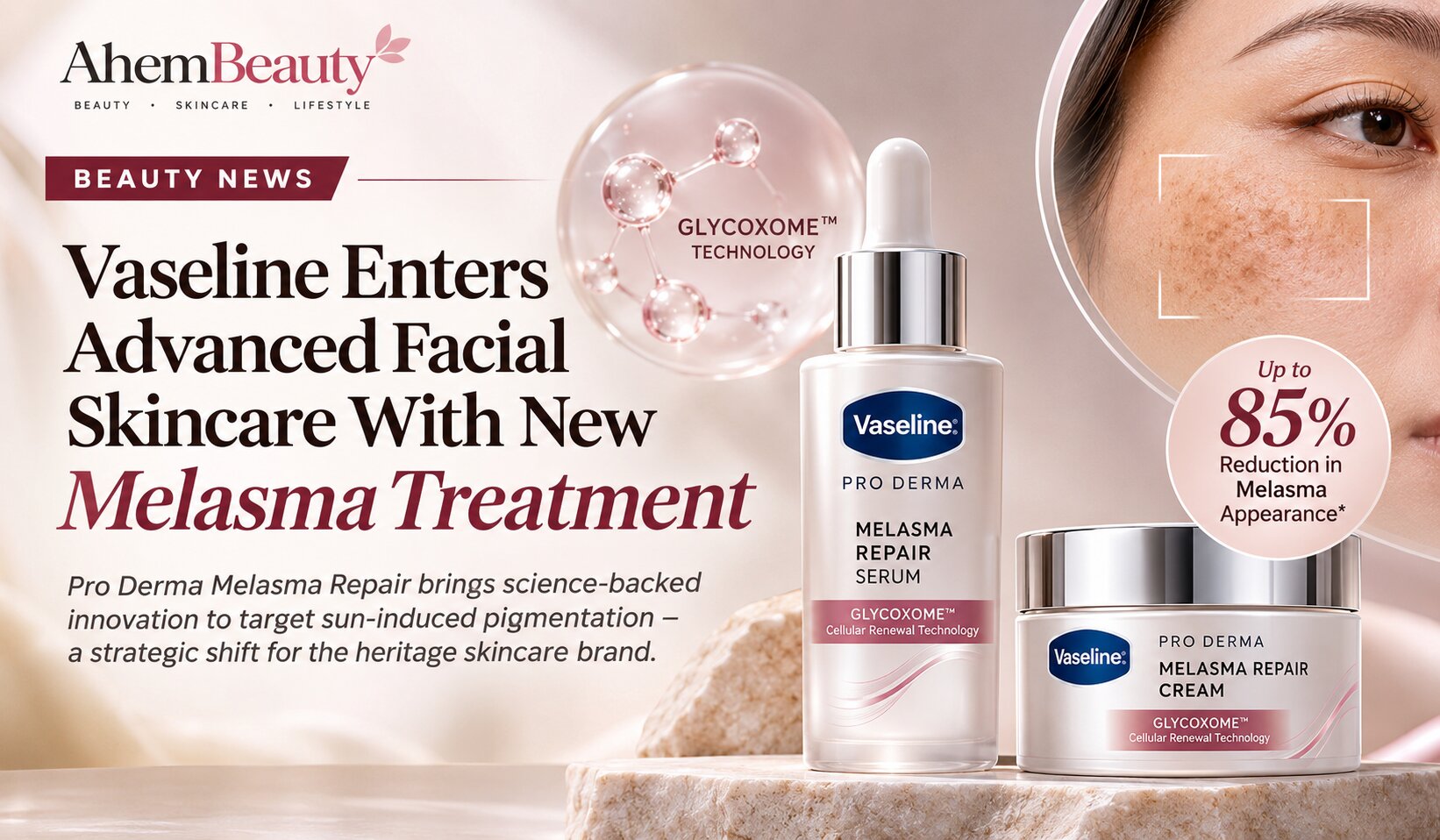
The launch of Pro Derma Melasma Repair signals a strategic shift for the heritage skincare brand, bringing its first targeted facial treatment for sun-induced pigmentation into a competitive market.
For generations, Vaseline has been associated with simple, accessible skincare. Its petroleum jelly has remained a household staple, while its moisturisers and body-care products have built the brand’s reputation around everyday skin protection.
That identity is now expanding.
Vaseline has entered the advanced facial skincare market with Pro Derma Melasma Repair, a new range designed to address sun-induced melasma. Developed by its parent company, Unilever, the range introduces proprietary Glycoxome technology, which the company says targets several processes involved in pigmentation development.
The move is interesting for two reasons. It takes Vaseline into a more specialised area of skincare, and it places the brand in a category where consumers increasingly expect scientific evidence behind product claims.
For a mass-market brand, establishing credibility in this space will depend on more than name recognition.
Why Melasma Has Become a Focus for Skincare Brands
Melasma is a pigmentation condition that causes brown or grey-brown patches, most commonly across the cheeks, forehead and upper lip. Sun exposure can make existing pigmentation more noticeable, while hormonal changes, certain medications and other factors can contribute to its development.
It is also a condition that can be difficult to manage over time. Improvements may take months, and pigmentation can return even after successful treatment.
This creates a different challenge from treating occasional dark spots. Effective melasma management often requires a combination of appropriate skincare, consistent sun protection and, in some cases, prescription treatment.
Vaseline’s decision to enter this category reflects an opportunity in specialised facial skincare, particularly among consumers looking for accessible treatments for persistent pigmentation.
Inside Vaseline’s Glycoxome Technology
At the centre of Pro Derma Melasma Repair is Glycoxome Cellular Renewal Technology, a proprietary development that Unilever says has involved more than 12 years of research and over 200 scientists.
According to the company, the technology is designed to influence melanin-related pathways, reduce the accumulation of excess pigmentation and support natural renewal processes within the epidermis.
The approach aims to address pigmentation at different stages rather than concentrating exclusively on the appearance of existing dark patches.
Glycoxome is a proprietary technology. The company’s explanation of how it works should be distinguished from independently established clinical evidence. More published research would help clarify how it performs against existing melasma treatments.
What Does the 85% Clinical Result Actually Mean?
One of the most prominent claims associated with the new range is a reported reduction of up to 85% in the appearance of sun-induced melasma.
Unilever attributes this result to a 12-week clinical study conducted between July and October 2024. The study involved 35 Thai women aged 25 to 45. Participants applied the test product to their full face twice daily for 12 weeks.
There are several details worth considering before interpreting that result.
First, 35 participants represent a relatively small study population. Second, the reported result relates to the appearance of pigmentation under the specific study conditions. It does not establish that every user will achieve an 85% improvement.
The launch information also does not provide enough detail to establish how the serum performed against a control group or how its results compare with established prescription treatments.
This does not make the finding irrelevant. It means the result should be understood as a manufacturer-reported clinical outcome rather than conclusive evidence of superiority.
Larger, independently published studies would help clarify the technology’s effectiveness.
Why This Launch Matters for Vaseline
Vaseline’s expansion is also a business decision.
The facial skincare market is considerably larger than the body-care category, and demand for specialised products has created opportunities for established brands to move into more targeted treatments.
Unilever estimates that the global facial skincare market is worth approximately €110 billion annually. The company also reports that the dermocosmetic skincare category is growing almost three times faster than the broader global skincare market.
These figures help explain the commercial appeal of the launch.
Vaseline already has substantial brand recognition across international markets. Moving into targeted facial treatments allows it to use that familiarity in a category where consumers may be willing to pay more for products addressing specific skin concerns.
The challenge will be convincing consumers that its new technology offers meaningful benefits beyond the brand’s established reputation.
The Asian Skincare Market Is Central to the Launch
The new range has a particular connection to Asian consumers, where pigmentation concerns and demand for targeted brightening products have created a strong market for specialised skincare.
Unilever reports that Pro Derma Melasma Repair launched in July 2026, with Watsons serving as an exclusive retail partner in its Asian rollout.
The launch also included digital commerce campaigns and creator-led marketing activities. Unilever reported that a promotional 9.9 campaign generated 578 product sales in 24 hours through more than 130 video assets and 470 affiliate livestreams.
This distribution strategy makes commercial sense. Watsons has an established presence in Asian health and beauty retail, while online shopping and beauty content allow brands to introduce specialised products directly to interested consumers.
However, the reported partnership should not be interpreted as confirmation of availability in every Asian country. Availability in Bangladesh would need to be confirmed through local retailers or official product channels.
What People With Melasma Should Know Before Trying It
The arrival of another pigmentation treatment may interest people who have struggled with uneven skin tone. However, melasma requires a more careful approach than choosing a serum based on its brightening claims.
The American Academy of Dermatology (AAD) recommends sun protection as an important part of melasma management.
- Choose a broad-spectrum sunscreen with SPF 30 or higher.
- Consider tinted sunscreen containing iron oxide to help protect against visible light.
- Reapply sunscreen at least every two hours when outdoors.
- Choose gentle, fragrance-free skincare products.
- Seek shade and wear protective clothing when spending time outdoors.
Based on guidance from the American Academy of Dermatology.
This matters because irritation can make pigmentation concerns worse, particularly in skin that is already prone to post-inflammatory discolouration.
A dermatologist can determine whether facial pigmentation is melasma or another condition and recommend an appropriate treatment plan. A new serum should therefore be considered within a broader skincare routine rather than as a replacement for sun protection or professional treatment.
For readers interested in choosing daily sun protection, explore our guide to skincare trends and sunscreen developments in 2026.
A New Direction for a Familiar Skincare Brand
Vaseline’s Pro Derma Melasma Repair launch represents a clear move into specialised facial skincare. It brings the brand into a category where scientific research, clinical evidence and consumer trust play an increasingly important role.
The Glycoxome technology and reported 85% clinical result make the launch worth watching. However, the limited publicly available study details leave questions about how the treatment compares with established alternatives.
For consumers, the most sensible approach is to look beyond the headline percentage and consider the quality of the evidence, product suitability and the importance of consistent sun protection.
For Vaseline, the bigger test will be whether it can turn its long-established reputation in everyday skincare into lasting credibility in advanced facial treatments.
Sources & Further Reading
-
Unilever – Vaseline Enters the Therapeutic Facial Skincare Market
Primary source for product launch, Glycoxome technology and company-reported clinical findings. -
Cosmetics Business – Vaseline Unveils First Facial Skincare Range to Target Sun-Induced Melasma
Independent beauty industry reporting. -
American Academy of Dermatology – Melasma: Diagnosis and Treatment
Medical guidance on diagnosis and available treatments. -
American Academy of Dermatology – Melasma: Self-Care
Dermatologist recommendations for sun protection and daily skincare.
Author: AhemBeauty News Desk
Publication: AhemBeauty.com