
AHEMBEAUTY / SKINCARE NEWS
AhemBeauty | Skincare News
Research presented September 30–October 3, 2026 · Vienna, Austria
What the New Research Reveals About TikTok Skin Care Trends
The two investigations presented at EADV 2026 examined different parts of the growing social media beauty market.
The first looked at the quality of skin care information shared through TikTok videos. The second examined patients who experienced skin problems after using products promoted through social media.
Together, they offer a useful look at the gap between online beauty recommendations and real-world skin care experiences.
Study One: Nearly 95% of Selected Videos Contained Misleading Claims
Researchers examined popular Korean skin care and glass skin videos published on TikTok.
The research team collected videos in May 2026 using a neutral account without previous engagement history. They screened popular results across five Korean skin care-related search terms.
After excluding unsuitable material, 38 videos remained for assessment.
Researchers used two established evaluation methods, the Global Quality Scale and a modified DISCERN tool, to examine the quality and reliability of the information.
The findings included:
- Almost 95% contained at least one potentially misleading claim.
- Around 84% failed to consider differences between skin types.
- Approximately 45% promoted combinations of multiple active ingredients without adequate safety guidance.
- Around 32% promised instant results.
- Only one video mentioned irritation risks.
- Only two videos discussed sun protection.
- None discussed contact dermatitis risks.
- None recommended consulting a dermatologist.
None of the assessed videos cited an external scientific source or reference.
Nearly 82% were created by non-physician influencers, 11% by beauty brands, and 8% by other beauty content creators. No dermatologist-produced videos appeared in this particular sample.
The numbers deserve attention, but the sample matters. Researchers assessed 38 selected videos, not every Korean beauty creator or every skin care video on TikTok.
Study Two: 94 Patients Experienced Skin Problems
The second investigation examined 94 patients who developed new or worsening skin conditions after using cosmetic or dermatological products promoted through social media.
The study covered a 12-month observational period. Participants had an average age of approximately 26, and 71% were female.
Researchers identified several products and usage patterns associated with the reported reactions.
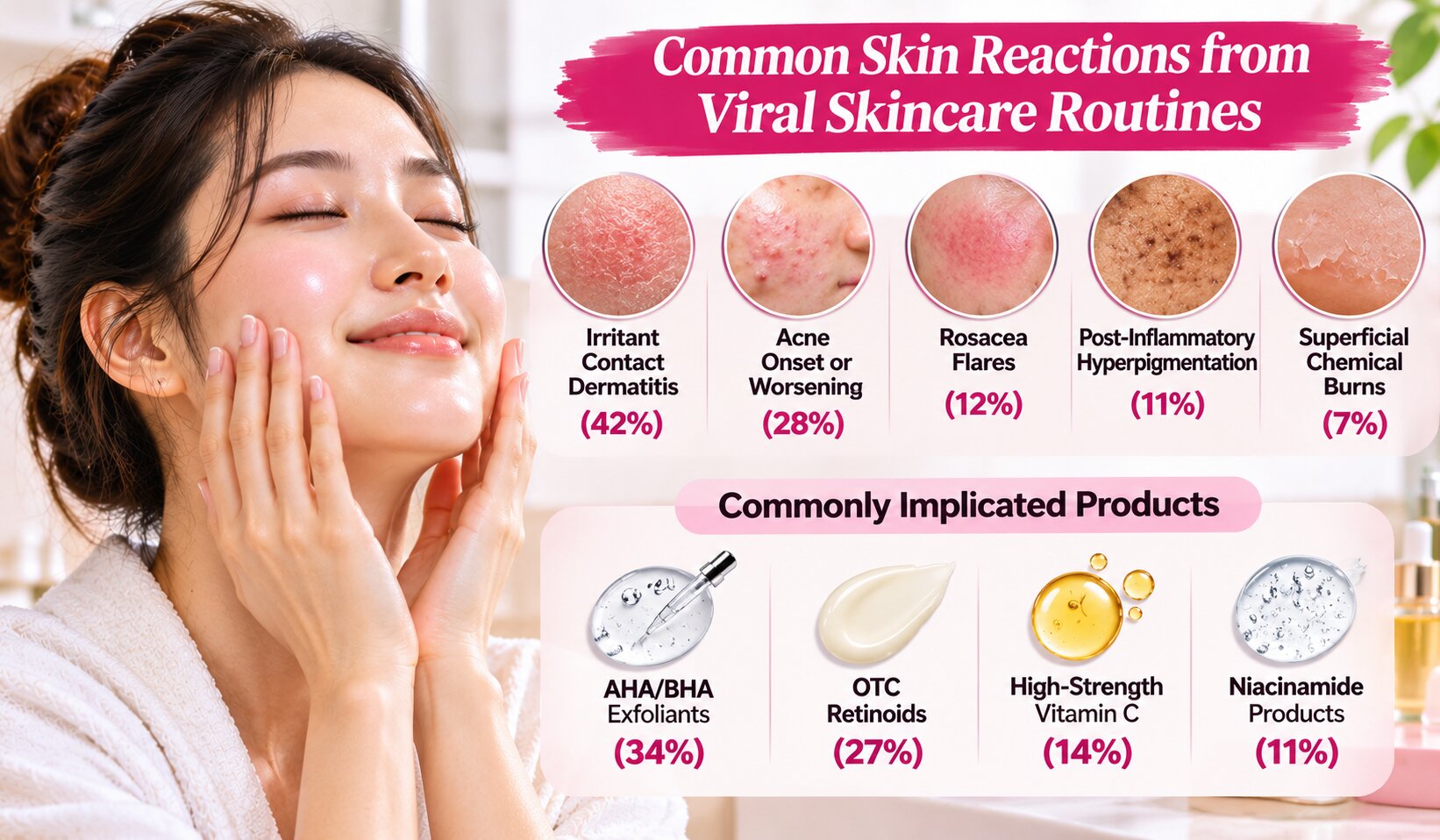
The most frequently implicated product categories were:
| Product category | Reported cases |
|---|---|
| AHA/BHA chemical exfoliants | 34% |
| Over-the-counter retinoid products | 27% |
| High-concentration vitamin C serums | 14% |
| Niacinamide-containing products | 11% |
The researchers also found that 63% of participants used more than three active ingredients simultaneously. Around 48% had adopted complete routines inspired by social media content.
Reported skin reactions included:
| Skin reaction | Percentage |
|---|---|
| Irritant contact dermatitis | 42% |
| Acne onset or worsening | 28% |
| Rosacea flares or similar dermatitis | 12% |
| Post-inflammatory hyperpigmentation | 11% |
| Superficial chemical burns | 7% |
These results describe patients who attended dermatology consultations. They do not establish the risk of developing a skin reaction among everyone who follows viral skin care trends.
Still, the findings give us a reason to look more closely at how online routines are presented and used.
Is Glass Skin Safe? Understanding the K-Beauty Trend
Glass skin is one of the most recognizable ideas in modern K-beauty. Explore our guide to what Korean glass skin means for a closer look at the trend.
The term describes a complexion that appears smooth, hydrated, even-toned, and luminous. The look became popular through Korean beauty culture before gaining international attention through social media.
A typical Korean skin care routine may include:
- Oil-based cleanser.
- Water-based cleanser.
- Hydrating toner.
- Essence.
- Treatment serum.
- Moisturizer.
- Sunscreen.
Some routines add exfoliating acids, retinol, sheet masks, and other treatments. If you are comparing products, see our guides to Korean serums for glass skin and Korean serums for glowing skin.
There’s nothing inherently wrong with these products or the K-beauty approach. Many Korean skin care formulations focus on hydration, gentle cleansing, and skin barrier care.
The problem starts when a routine becomes a fixed formula that everyone is encouraged to copy.
A person with dry, sensitive skin may react differently to the same exfoliating toner used by someone with oily skin. Someone already using a retinoid may not need another strong exfoliating treatment.
Glass skin is an appearance goal, not a medical standard. Your skin doesn’t need to look perfectly reflective to be healthy.
Skin Barrier Damage: What Happens When You Overuse Active Ingredients?
The skin barrier is the outer protective layer of your skin. It helps retain moisture and protects against external irritants.
When this barrier becomes irritated or compromised, you may notice dryness, redness, peeling, itching, or burning sensations.
The EADV patient study found irritant contact dermatitis in 42% of the reported cases.
Several commonly used ingredients deserve attention when building a routine.
Retinol and Exfoliating Acids
Retinol is widely used in products designed to improve the appearance of fine lines, uneven texture, and acne-related concerns.
AHAs, including glycolic acid and lactic acid, help exfoliate the skin surface. BHAs, such as salicylic acid, are commonly used in products targeting clogged pores.
Combining these treatments without considering their strength and frequency may increase irritation.
Can You Use Retinol and Vitamin C Together?
This is one of the common questions surrounding modern skin care routines.
Retinol and vitamin C serve different purposes. Vitamin C is an antioxidant commonly used to improve the appearance of uneven skin tone, while retinol is used in treatments for acne and visible signs of aging.
They can be part of the same overall routine, but introducing both simultaneously may be difficult for people who are new to active ingredients.
One approach is to use vitamin C in the morning and retinol at night, provided both products are suitable for your skin and tolerated well.
Start gradually and pay attention to irritation. You don’t need to use every active ingredient simply because a creator includes it in a routine.
Niacinamide and Hyaluronic Acid
Niacinamide is commonly used in moisturizers and serums designed to support the skin barrier and improve the appearance of uneven skin tone.
Hyaluronic acid is a humectant that attracts and retains water in the outer layers of the skin.
Both ingredients appear in many everyday skin care formulations.
The clinical study also identified niacinamide-containing products among those involved in reported reactions. That finding doesn’t establish that niacinamide itself caused those reactions. The complete formulation and the way products were used also matter.
Where Viral Skin Care Actually Comes From
For US shoppers, discovering a viral skin care product and purchasing it can happen within minutes.
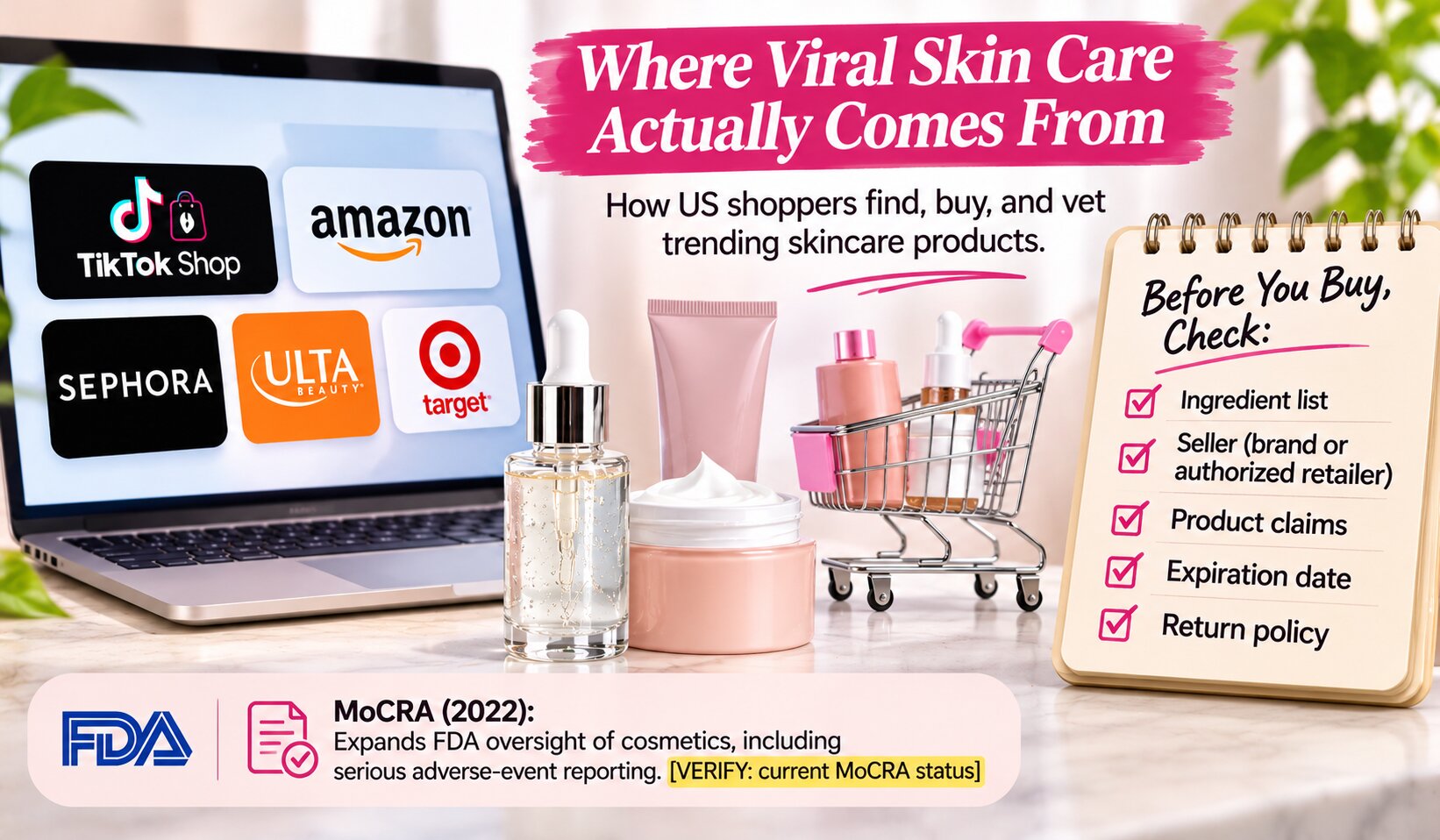
TikTok Shop, Amazon, Sephora, Ulta Beauty, and Target are among the shopping destinations where people may encounter trending beauty products.
Each platform offers a different shopping experience.
TikTok Shop
TikTok Shop connects product discovery with creator videos, demonstrations, and shopping links. A viewer can watch a skin care routine and move directly to a product listing.
The convenience is attractive, but a creator’s recommendation doesn’t replace ingredient research. Sponsored content and affiliate promotions also deserve attention.
Amazon
Amazon offers a wide selection of Korean skin care products, serums, moisturizers, and beauty accessories.
However, some listings are sold by third-party marketplace sellers rather than directly by the brand or an authorized retailer.
Before purchasing, check the seller’s identity, product listing details, packaging information, and return policy. Don’t rely on a product’s rating alone.
Sephora and Ulta Beauty
Sephora and Ulta Beauty provide access to established beauty brands, product descriptions, and customer reviews.
Their product pages can help you compare formulations and intended uses. Still, you should read the ingredient list rather than assuming every trending product is suitable for your skin.
Target
Target also carries a selection of popular skin care brands and everyday beauty products. Check whether a product is sold directly by the retailer or through a marketplace seller, where applicable.
Why the Ingredient List and Seller Matter
A familiar brand name or attractive package doesn’t tell you everything about a skin care product.
Before buying, check:
- The complete ingredient list.
- The product’s intended use.
- The manufacturer’s or responsible company’s information.
- The seller’s identity.
- Expiration dates and packaging condition, where available.
- Whether the product claims sound realistic.
Pay particular attention to products that promise instant wrinkle removal, overnight acne treatment, or dramatic pigmentation changes.
What US Cosmetics Regulation Means for Shoppers
The United States Food and Drug Administration (FDA) oversees cosmetics under federal law.
The Modernization of Cosmetics Regulation Act of 2022 (MoCRA) expanded FDA authority and introduced additional requirements for the cosmetics industry.
One important provision concerns serious adverse event reporting.
Under MoCRA, the responsible person named on a cosmetic product’s label must report serious adverse events associated with the product to the FDA within 15 business days after receiving the report. The responsible person must also provide a copy of the product label. Certain additional medical information received within one year must be submitted within another 15-business-day period.
MoCRA also introduced requirements involving facility registration, product listing, and safety substantiation, subject to applicable exemptions and regulatory provisions.
These measures provide additional oversight, but they don’t mean that every cosmetic product has received FDA approval before reaching the market. Cosmetics generally aren’t subject to the same premarket approval process as drugs, although certain exceptions and separate requirements apply.
For shoppers, checking the manufacturer, label, and product information remains worthwhile.
[VERIFY: current MoCRA status before publication, including any amendments, implementation changes, and applicable exemptions.]