
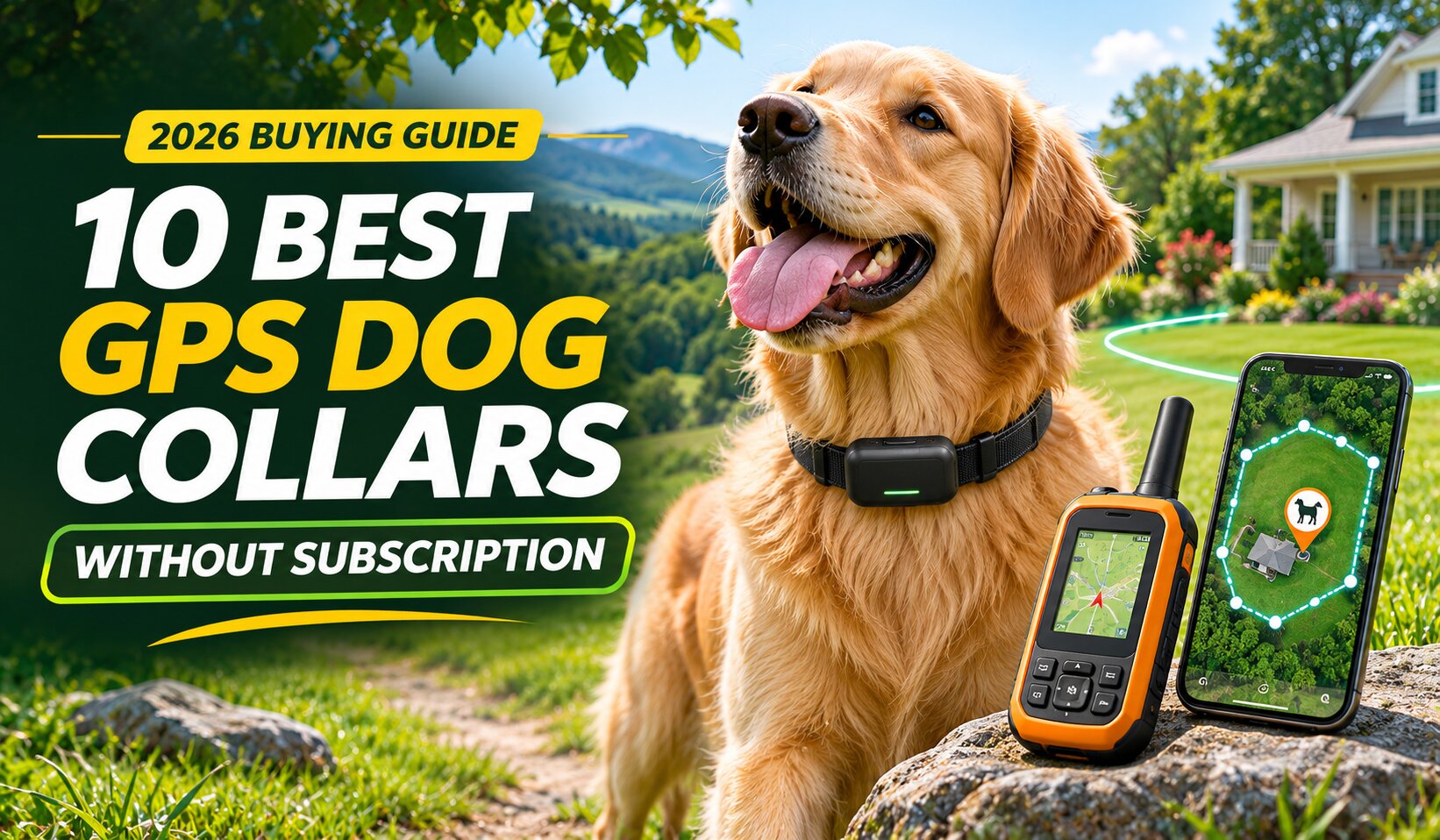
Best GPS Dog Collars Without Subscription are not all designed for the same job. Some devices track a dog’s location directly through a handheld receiver, while others create virtual boundaries around a property. A few combine both functions, but remote-tracking features may still require a paid cellular plan. The right choice depends on whether you need to locate your dog outdoors or keep the dog within a defined area.
That distinction matters. A GPS fence can keep a dog inside a boundary without sending its live location to your phone. A tracking collar, on the other hand, helps you locate a dog that has moved away from you. These are different jobs, even when manufacturers describe both products as GPS collars.
This guide compares four GPS tracking systems and six GPS wireless fence collars. The selection is based on the supplied Amazon listings, manufacturer specifications, and available customer-rating information. These are research-based recommendations, not results from a physical testing program.
Price and rating note: Prices, Amazon ratings, and review counts are based on product information checked on November 27, 2026. Prices, ratings, review counts, package variations, and availability may change.
Quick Comparison: GPS Trackers and Wireless Fences
| Product | Main function | Listed price | Amazon rating |
|---|---|---|---|
| Garmin Alpha TT 25 Bundle | GPS tracking and training | $1,376.97 | 4.7/5 (74 reviews) |
| Dogtra PATHFINDER2 | GPS tracking and training | $569.99 | 3.7/5 (5 reviews) |
| SportDOG TEK 2.0 Add-A-Dog Collar | Additional GPS tracking collar | $386.09 | 4.4/5 (49 reviews) |
| Aorkuler GPS Tracker 2 | Handheld GPS tracking | $229.00 | 3.9/5 (136 reviews) |
| SpotOn GPS Fence Nova | GPS wireless containment | $849.00 | 4.1/5 (167 reviews) |
| PetSafe Guardian GPS Dog Fence | GPS wireless containment | $352.99 | 3.2/5 (323 reviews) |
| Omni GPS Dog Fence | GPS wireless containment | $899.00 | 3.9/5 (494 reviews) |
| Meowant GPS Wireless Fence | GPS fence and remote training | $249.99 | 3.7/5 (19 reviews) |
| DOGOITM GPS Wireless Dog Fence | GPS wireless containment | $99.99 | 5.0/5 (21 reviews) |
| Blingbling Petsfun GPS Wireless Fence | GPS wireless containment | $87.16 | 3.1/5 (12 reviews) |
SportDOG is an additional collar, not a complete tracking package. It requires a compatible TEK handheld. The supplied Amazon information for Dogtra shows a 3.7-star rating from 5 customer reviews.
Part 1: GPS Dog Tracking Collars Without Monthly Fees
These products are designed to help owners locate a dog while walking, hiking, or working outdoors. Some use a dedicated handheld receiver, while others offer a phone app alongside the tracking hardware.
1. Garmin Alpha TT 25 Bundle
Best for: Multi-dog tracking, hunting, and long outdoor trips.
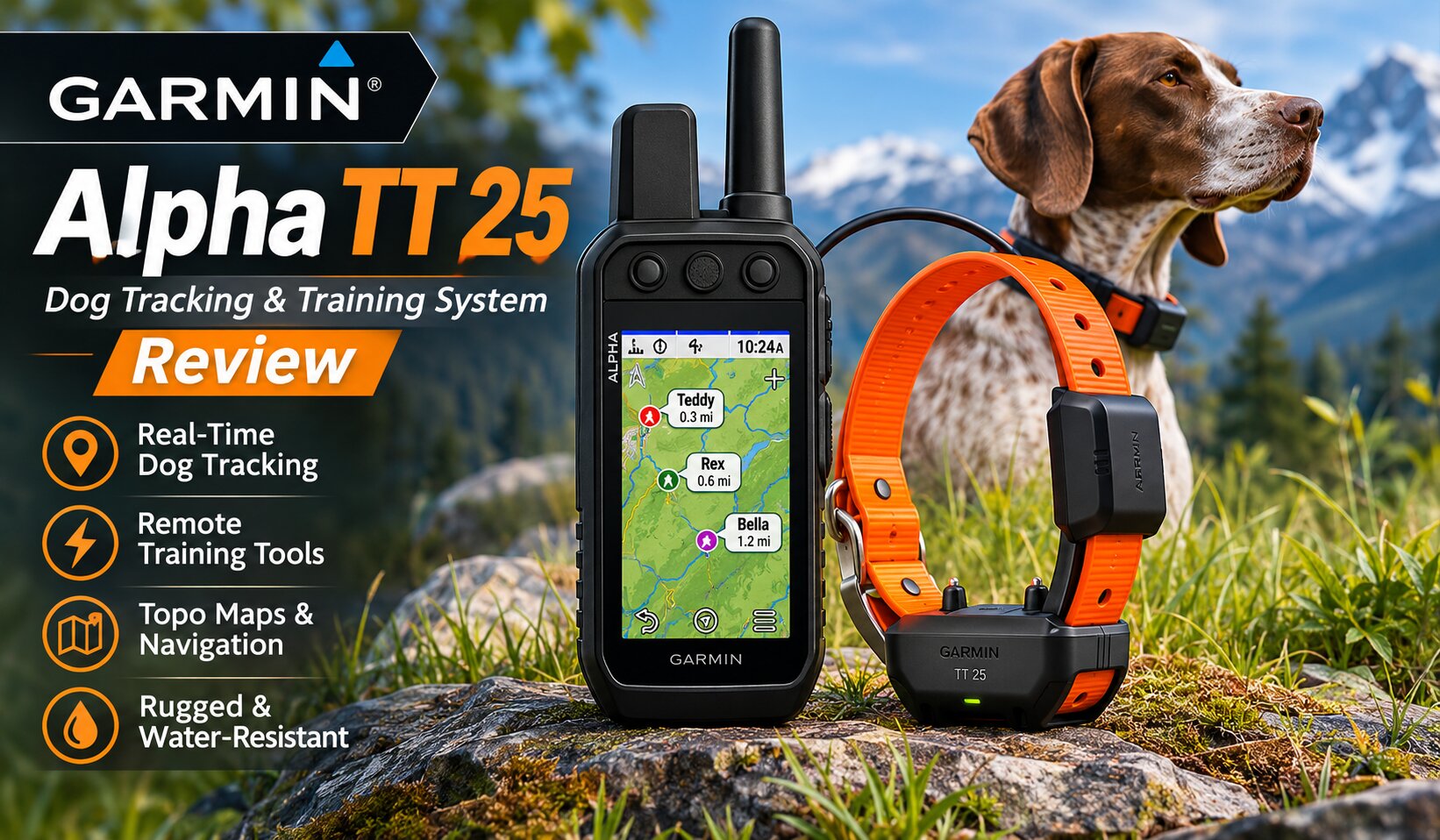
The Garmin Alpha TT 25 bundle is designed for owners who need more than a basic pet-location device. The supplied Amazon package includes an Alpha 300 handheld navigator and two Alpha TT 25 tracking and training collars. That gives owners a complete handheld-and-collar setup for two dogs.
The system can monitor compatible collars and display information such as distance, direction, and dog activity. Garmin specifies a tracking range of up to 9 miles when the TT 25 is paired with a compatible handheld. Actual range depends on terrain, vegetation, and other environmental conditions.
Battery information is clearer when the collar and optional accessories are considered separately. Garmin rates the standard TT 25 battery for up to 68 hours. An optional extended battery box increases the stated maximum to up to 136 hours. The extended figure does not apply to the standard battery alone.
The TT 25 also supports Dynamic Update. This adjusts location transmissions according to the dog’s movement to help balance tracking detail and battery life.
For a weekend hunting trip, a large property, or a hike where two dogs may move in different directions, the handheld display can be more useful than checking a phone repeatedly. The same equipment may be excessive for a family that only wants to keep track of a dog during short walks around a local park.
What to consider: This is a specialist system with a high upfront cost. It makes the most sense for owners who will use its handheld navigation, multi-dog tracking, and training features. A casual pet owner may not need that level of equipment.
2. Dogtra PATHFINDER2
Best for: Off-grid tracking with a dedicated handheld and offline maps.
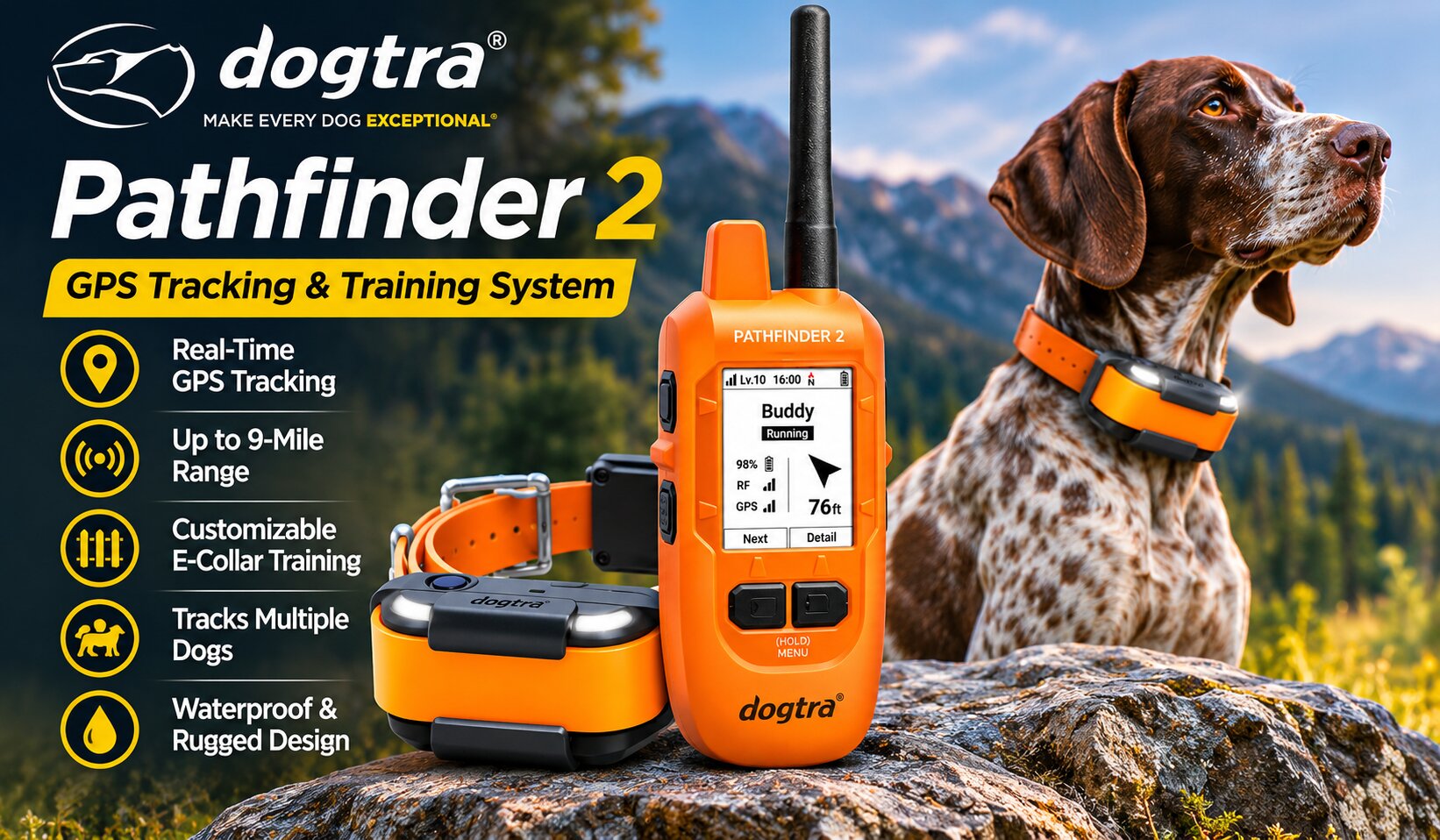
Dogtra PATHFINDER2 combines GPS tracking with an e-collar training system. Its handheld receiver has a built-in compass and a 2-inch LCD screen, allowing the handler to check a dog’s direction, distance, and movement without relying on a phone display.
Dogtra lists a range of up to 9 miles and a 2-second GPS update rate. The system can expand to track up to 21 dogs when compatible receivers are added. Its free app includes offline maps, which are useful when mobile data is unavailable.
This is a practical distinction for people looking for an off-grid GPS dog tracker with no cell service. The handheld receives tracking information directly through the system. The phone app adds another way to view maps and manage the equipment.
PATHFINDER2 also includes training functions such as tone, vibration, and stimulation. Owners can use Tracking Only Mode when they want tracking without the training functions.
There are two important fit considerations. Dogtra specifies PATHFINDER2 for dogs weighing at least 35 pounds, and the listed minimum neck size is 12.5 inches. The receiver itself weighs 6.6 ounces, so it is better suited to medium and large dogs than small breeds.
For someone hiking with a larger dog in areas with patchy phone coverage, the dedicated handheld and offline maps are useful features. For a small family dog that mainly visits a neighborhood park, this system is likely more equipment than necessary.
What to consider: PATHFINDER2 is a tracking and training system, not a lightweight everyday pet tracker. Check the dog’s weight and neck size before ordering.
| Amazon rating snapshot | 3.7 out of 5 stars (5 reviews) |
|---|---|
| Best Sellers Rank | #21,364 in Pet Supplies; #19 in Pet Location Trackers |
| Minimum dog weight | 35 pounds |
| Minimum neck size | 12.5 inches |
| Receiver weight | 6.6 ounces |
| ASIN | B0HD4P8XXC |
3. SportDOG TEK 2.0 Add-A-Dog GPS Collar
Best for: Owners who already have a compatible SportDOG TEK handheld.
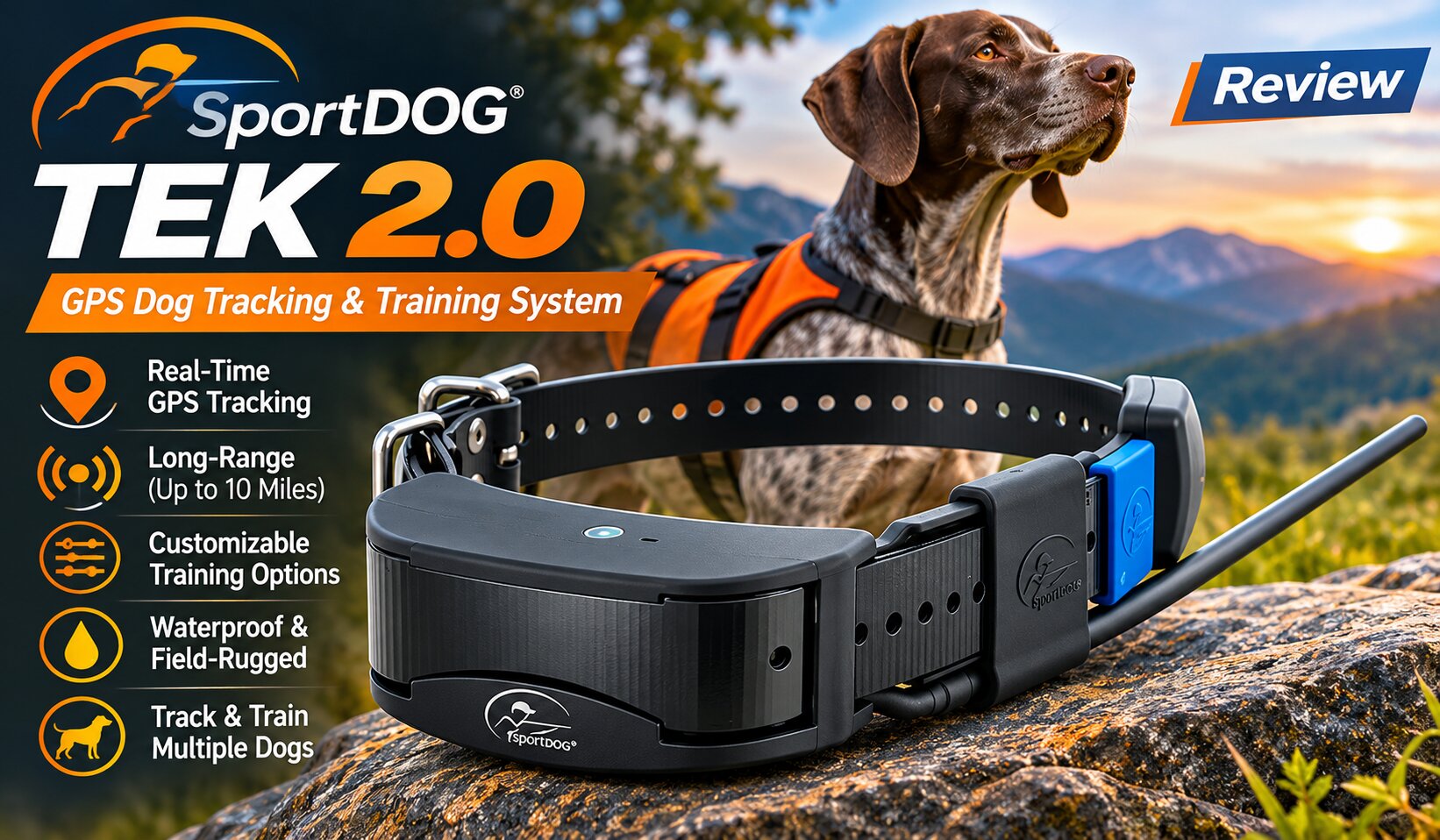
The SportDOG TEK 2.0 listing needs a clear explanation: this is an Add-A-Dog GPS collar, not a complete tracking system. It is designed to work with a compatible TEK handheld. Buying the collar alone will not give a new user the full tracking setup.
The supplied listing describes a range of up to 16 kilometers, which is approximately 10 miles, when used with the TEK 2.0 handheld. It also lists support for tracking multiple dogs and DryTek waterproof protection.
For someone who already owns a compatible SportDOG handheld and has added another dog to the household, this collar may be a practical way to expand the existing system. It avoids replacing equipment that is already working.
The listing also gives the collar a three-year manufacturer warranty. Buyers should check the exact handheld version because range and dog capacity vary between TEK 1.5 and TEK 2.0 systems.
Before ordering: Confirm that your handheld is compatible. This product is not the right starting point for someone who needs a complete GPS tracking package.
4. Aorkuler GPS Tracker 2
Best for: Simple handheld tracking without a phone app.
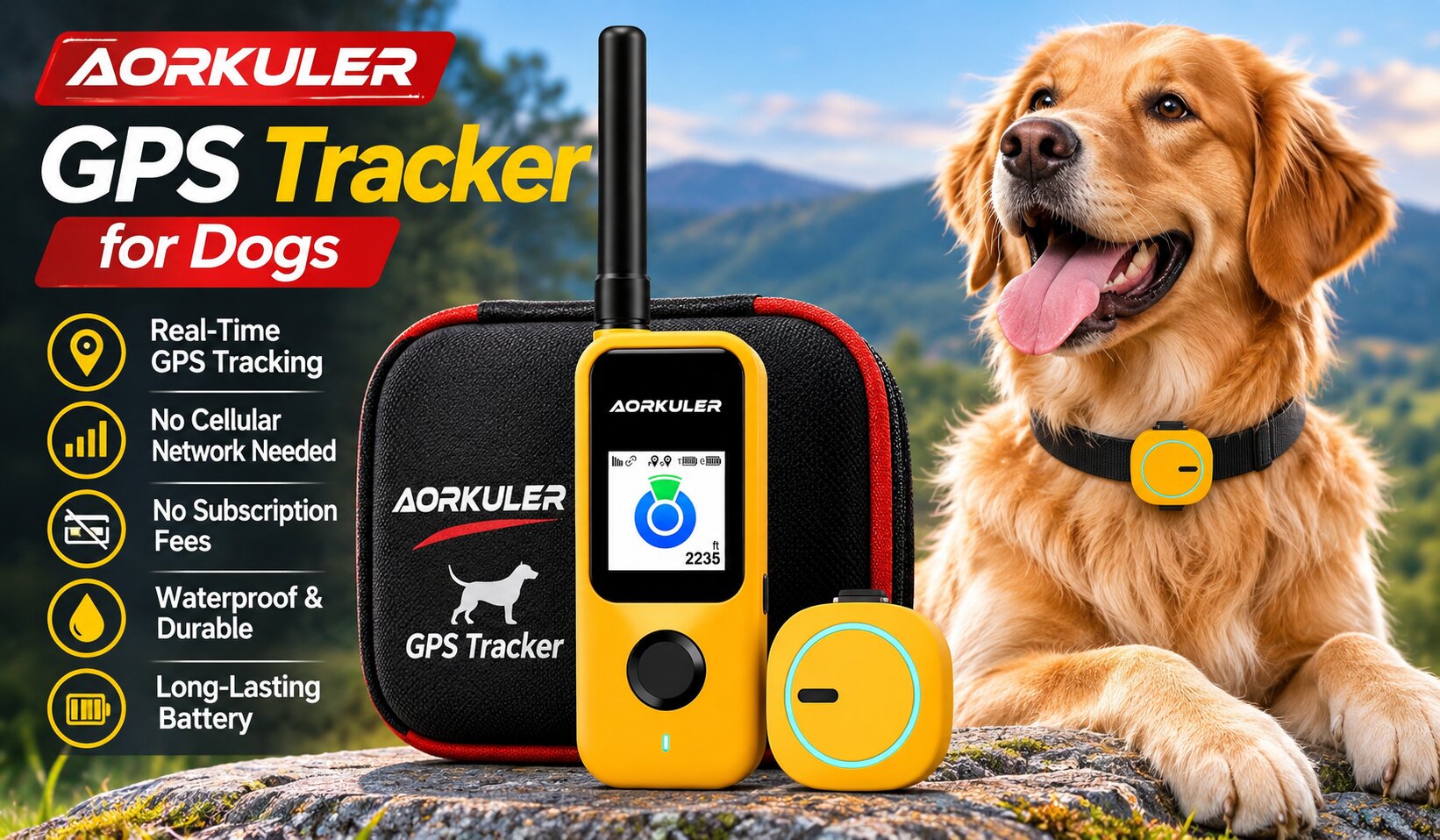
Aorkuler takes a simpler approach than app-connected tracking systems. Its Tracker 2 uses a handheld controller with a directional indicator to show the dog’s direction and distance. The supplied product listing states that it updates every three seconds and has a range of up to 3.5 miles.
The system does not depend on a phone, cellular network, or cloud account for its basic tracking function. That makes it relevant to owners looking for a dog GPS tracker without a subscription, especially when they spend time in places with weak mobile coverage.
The listing gives the tracker a weight of 1.08 ounces and claims up to 24 hours of continuous tracking after a full charge. It also gives a typical-use estimate of more than 10 days when used for one to two hours daily. These figures come from the product listing and have not been independently tested.
Its main limitation is the simpler interface. There is no full map-based app experience in the supplied listing. Owners who prefer seeing a dog’s position on a detailed map may find the handheld direction-and-distance display limiting.
For a weekend walk or a trip to an open park, the straightforward controller may be easier to use than a feature-heavy app. For hiking through dense woods, the stated 3.5-mile range and local terrain should be considered before relying on it.
What to consider: The tracker needs a usable GPS signal. Buildings, dense tree cover, and indoor spaces can affect reception.
Part 2: GPS Wireless Dog Fence Collars Without Monthly Fees
A GPS wireless fence creates a virtual boundary. The collar gives the dog warning cues as it approaches that boundary and may provide vibration or static correction, depending on the model.
A fence collar is not automatically a remote GPS tracker. Some products can contain a dog without a cellular plan but require a subscription to send the dog’s location to a phone over long distances.
5. SpotOn GPS Fence Nova
Best for: Customizable GPS boundaries across large or irregular properties.
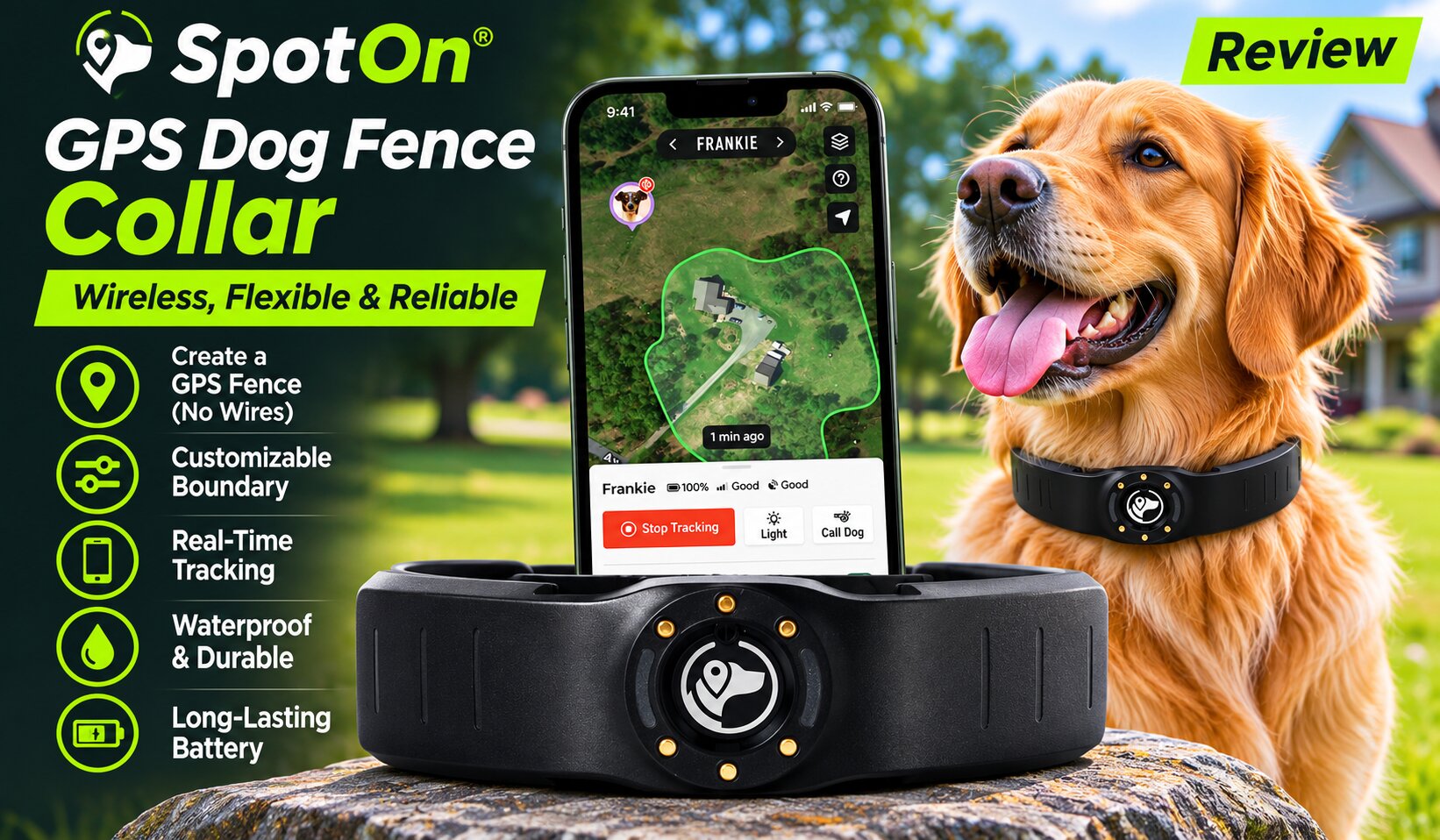
SpotOn GPS Fence Nova is a containment system rather than a conventional tracking collar. Owners create virtual boundaries through the app without installing buried wires or a physical base station. The supplied listing describes customizable fences and keep-out zones, with a collar designed for neck sizes from 10 to 26 inches.
The core fence functions do not require a subscription. SpotOn says owners can create and use GPS fences, manage keep-out zones, and use off-grid features without a cellular plan.
Remote tracking is a separate service. SpotOn’s optional cellular subscription adds features such as viewing the dog’s location in the app, receiving escape alerts, and using remote recall. Without that plan, the collar can still operate as a GPS containment device, but it does not send long-distance location updates to a phone.
This distinction matters for owners searching for a GPS wireless dog fence with no monthly fee. The fence works without a plan; remote phone monitoring is an optional paid service.
For a family with a large yard, a pool, or a garden that needs a keep-out zone, the customizable boundary may be useful. It still requires proper training. A virtual fence is not a physical barrier.
What to consider: Measure the property and review SpotOn’s property-size guidance before buying. The dog must learn to respond to the boundary cues.
6. PetSafe Guardian GPS Dog Fence
Best for: Subscription-free home containment on a suitable property.
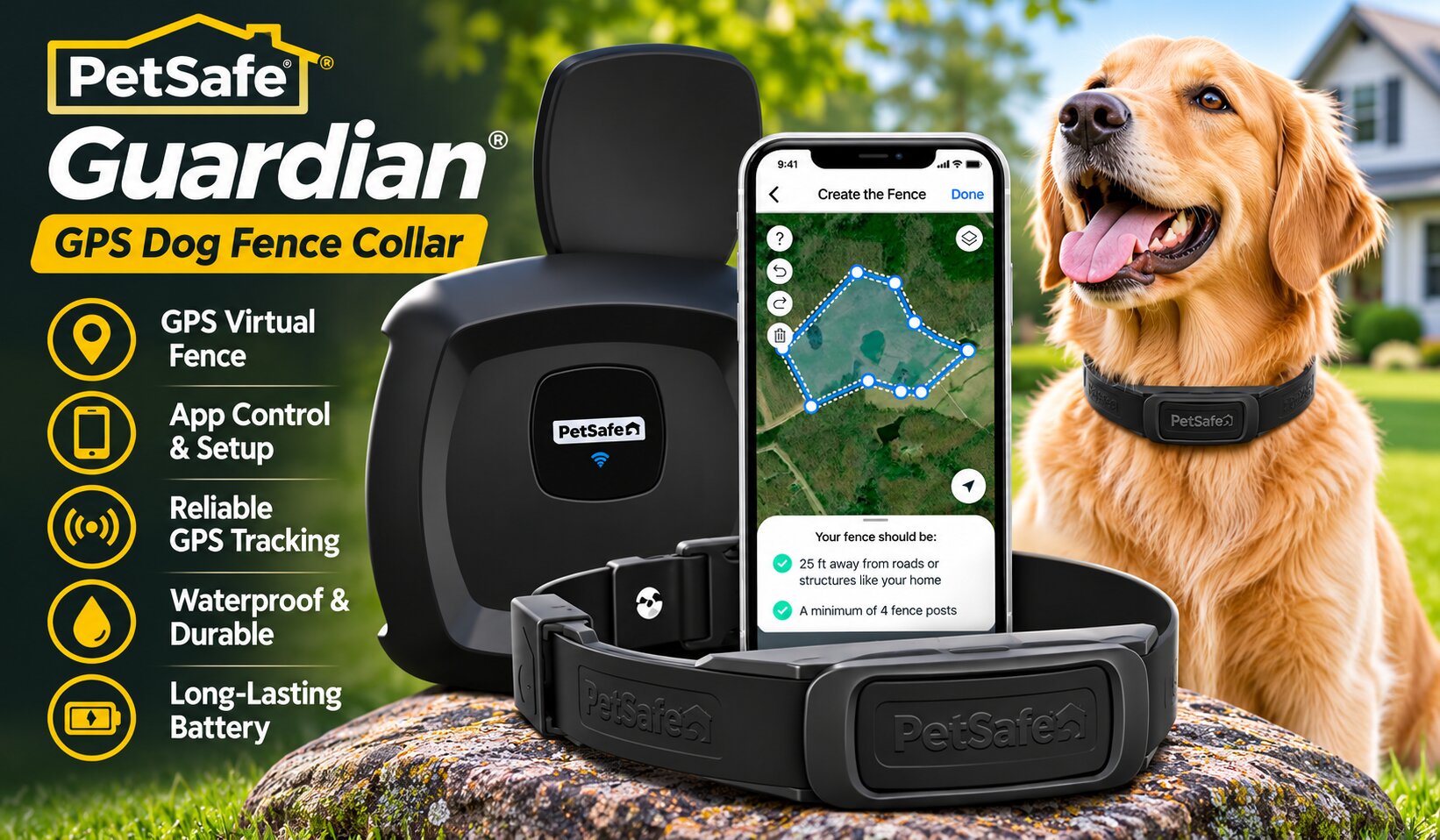
The PetSafe Guardian GPS Dog Fence creates a virtual boundary around a property without buried wires. PetSafe specifies that the property should be larger than three-quarters of an acre. The supplied listing recommends the system for dogs weighing more than 25 pounds, with neck sizes from 13 to 28 inches.
PetSafe’s AccuGuard technology combines GPS satellite data, real-time motion detection, and AI. The system is designed to reduce false corrections and provide boundary cues as a dog approaches the edge of the selected area.
The collar offers tone and vibration or static correction settings. The supplied Amazon listing describes a rechargeable, waterproof collar and claims up to five days of battery life on a charge. PetSafe lists the Guardian GPS Dog Fence as subscription-free.
This model is intended for home containment, not for following a dog across parks or hiking trails. It may suit a family with a larger dog and a property that meets the minimum size requirement. It is not a good match for a small apartment dog or a household that needs remote location tracking.
Before ordering: Check the exact model name. The Guardian GPS Dog Fence is different from PetSafe’s Guardian GPS + Tracking product, which adds tracking features.
7. Omni GPS Dog Fence
Best for: Owners comparing SpotOn’s Omni edition with other GPS fence systems.
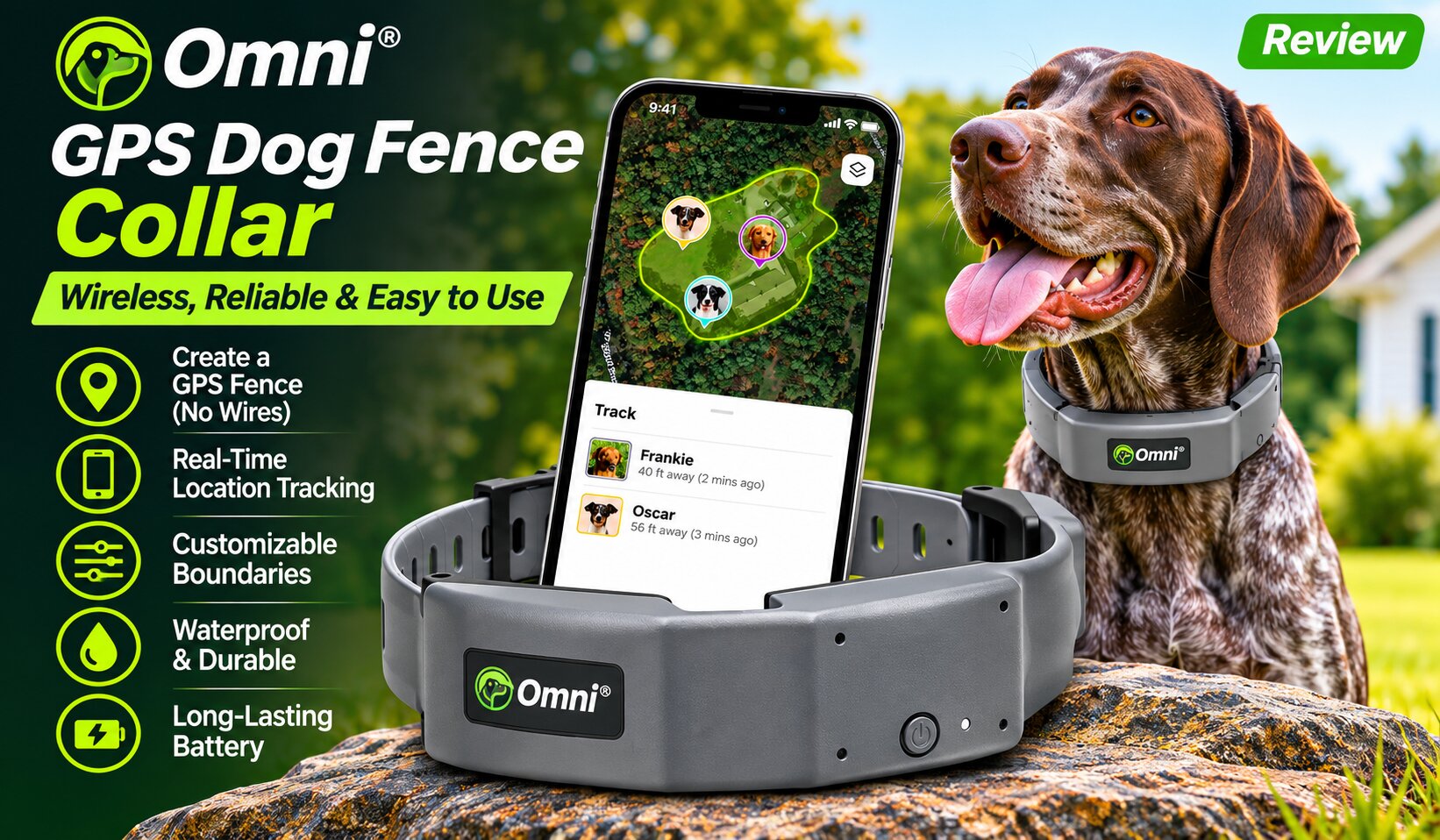
The Omni GPS Dog Fence is an edition of the SpotOn GPS Fence. It is designed for owners who want virtual containment without installing buried wires or a physical base station.
The core GPS fence functions work without a subscription or cellular service. Owners can create and use boundaries, manage off-limits areas, and use the fence’s basic containment features without paying a monthly fee. The optional cellular subscription adds remote features such as viewing the dog’s location on a phone, escape notifications, and remote recall.
The supplied Amazon listing describes unlimited GPS fences, off-limits areas, and correction-free zones. It also states that the collar can provide more than 40 hours of runtime without a subscription. Battery performance depends on how the collar is used and which features are active.
The supplied Omni listing is priced at $899, compared with $849 for SpotOn GPS Fence Nova. That $50 difference makes it worth checking the included package, collar sizing, and feature set carefully before choosing between them. Nova is the lower-priced option in the supplied price snapshot.
What to consider: The core fence function is subscription-free. Before ordering, check the selected collar size, included accessories, warranty, and any optional cellular services you may want to use.
| Listed price | $899.00 |
|---|---|
| Size information | Medium: 12–18 inches |
| Amazon rating | 3.9/5 (494 reviews) |
| Subscription for core fence | Not required |
| ASIN | B0D1LFQW5B |
8. Meowant GPS Wireless Fence
Best for: Owners who want a GPS fence with local app control and a separate training remote.
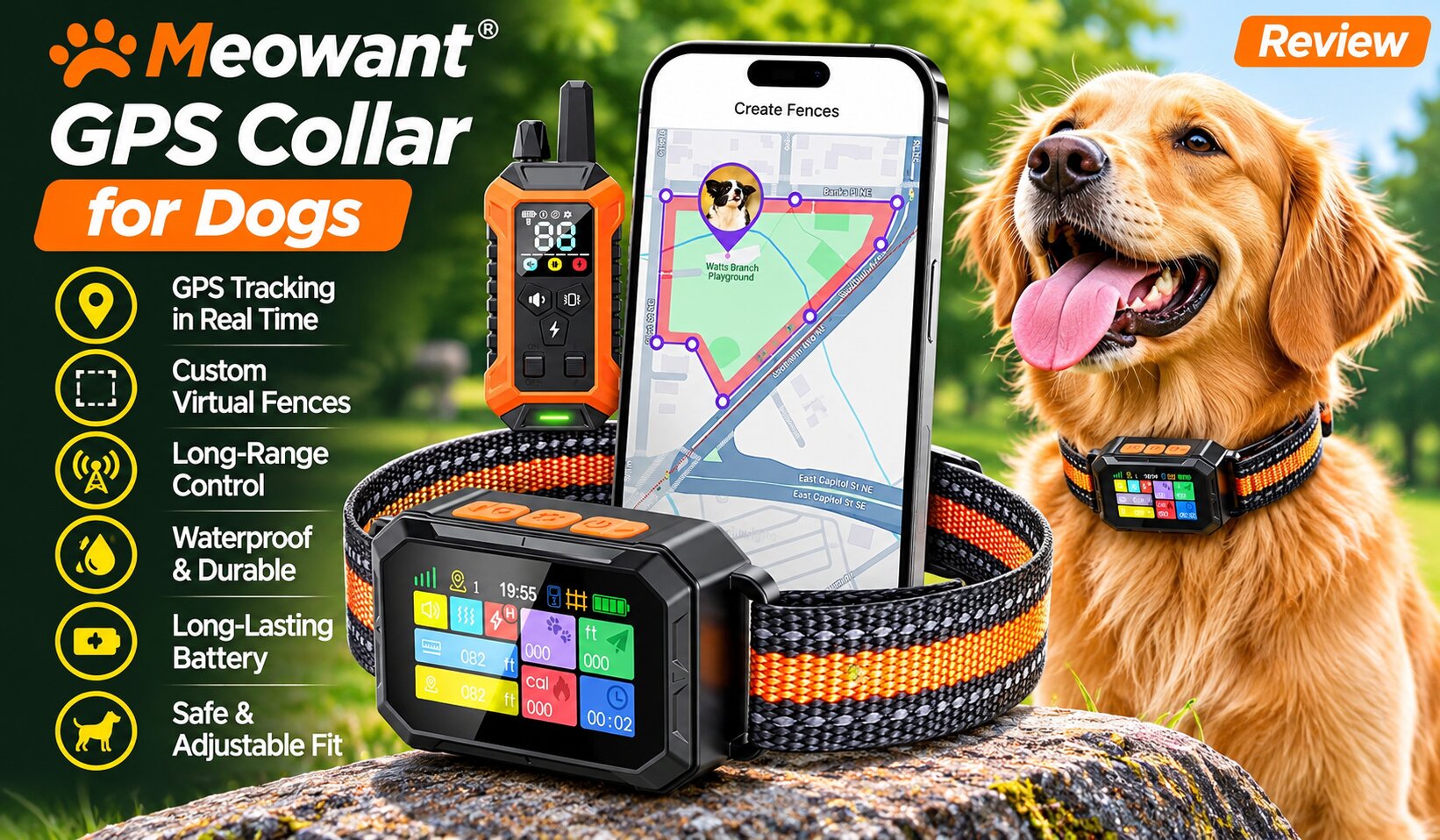
Meowant combines a GPS wireless fence with remote training functions. The supplied listing says owners can create circular or polygon-shaped boundaries through the app and choose warning options such as beeping, vibration, or static stimulation.
The app’s stated location range is approximately 98 feet. That is local connection range, not unlimited-distance live GPS tracking over a cellular network. The supplied listing gives the handheld remote a control range of up to 1,640 feet in open areas.
The collar is listed for dogs weighing at least 10 pounds. It also includes an LCD screen and activity-related information. The product listing claims up to 20 hours of GPS-active use, so owners should not confuse that figure with standby time.
Meowant may suit owners who want a portable fence and training functions in one package. It is less suitable for someone whose main requirement is checking a dog’s live location from far away while the dog is out of sight.
Check the range carefully: The app’s 98-foot local connection, the remote-control range, and GPS positioning are three different functions.
9. DOGOITM GPS Wireless Dog Fence
Best for: Budget-conscious buyers who want a basic GPS containment system without an app.
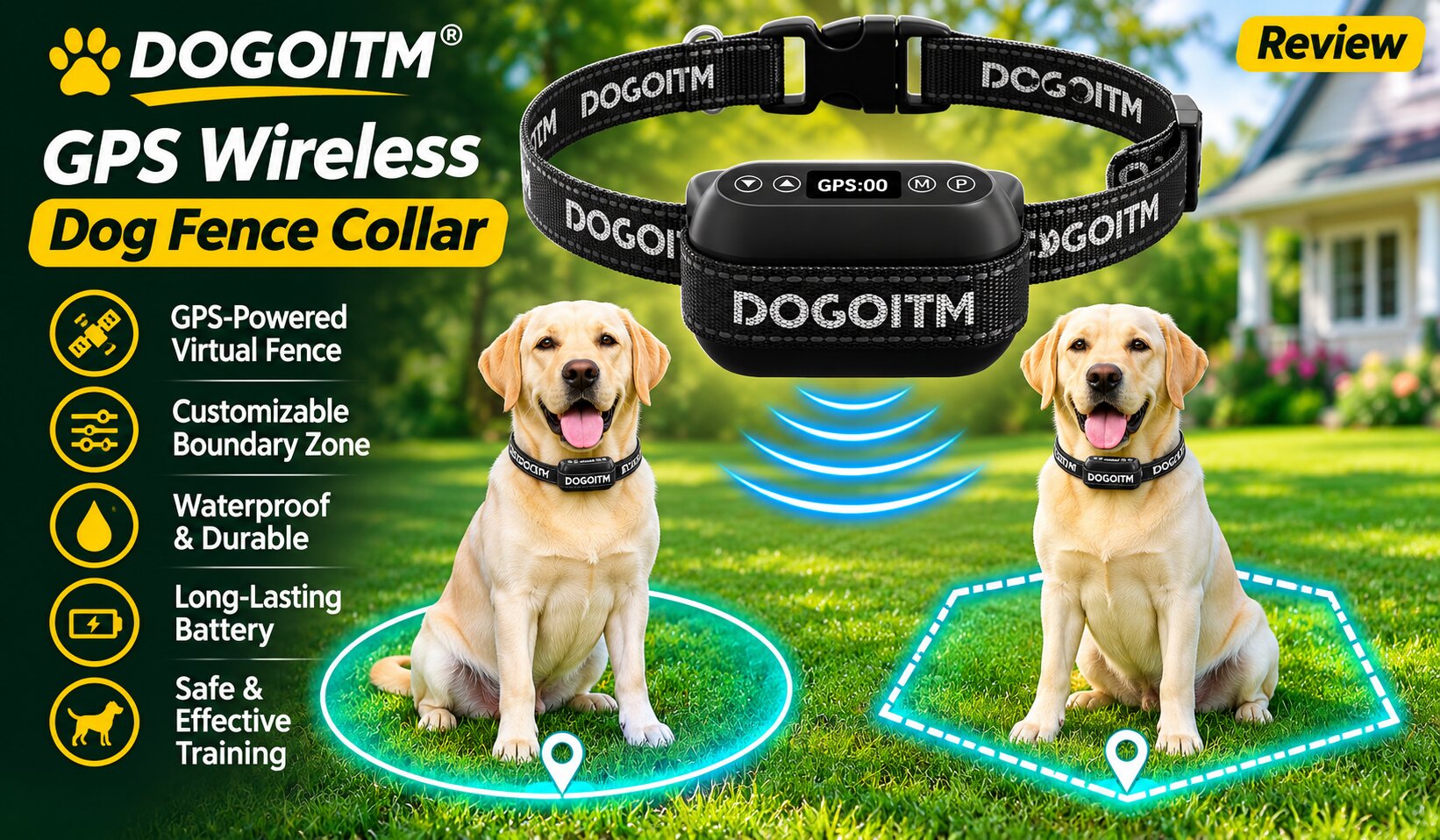
DOGOITM uses a simple control system rather than an app-based setup. The supplied listing says owners can set a circular or custom boundary using the device’s controls. It does not require an app download, buried wire, or monthly fee for its basic containment function.
The Amazon listing gives an adjustable boundary radius from approximately 65 feet to 9,840 feet. It also claims up to 50 hours of continuous use per charge and an IPX7 waterproof rating.
There is a specification difference worth checking. The supplied Amazon listing states IPX7, while an available copy of the GM08 user manual states IPX6. Buyers should confirm the rating printed in the manual supplied with the exact package.
The listing describes the system for dogs weighing between 15 and 120 pounds. It also includes beep, vibration, and static correction modes.
The 5.0-star Amazon rating in the supplied snapshot is based on 21 reviews. That is a small review sample, so the average alone cannot establish long-term reliability.
What to keep in mind: This is a containment device, not a remote tracking collar. Follow the manufacturer’s training instructions and supervise the dog while introducing the boundary.
10. Blingbling Petsfun GPS Wireless Dog Fence
Best for: Buyers comparing low-cost GPS fence systems who are willing to examine the limitations.
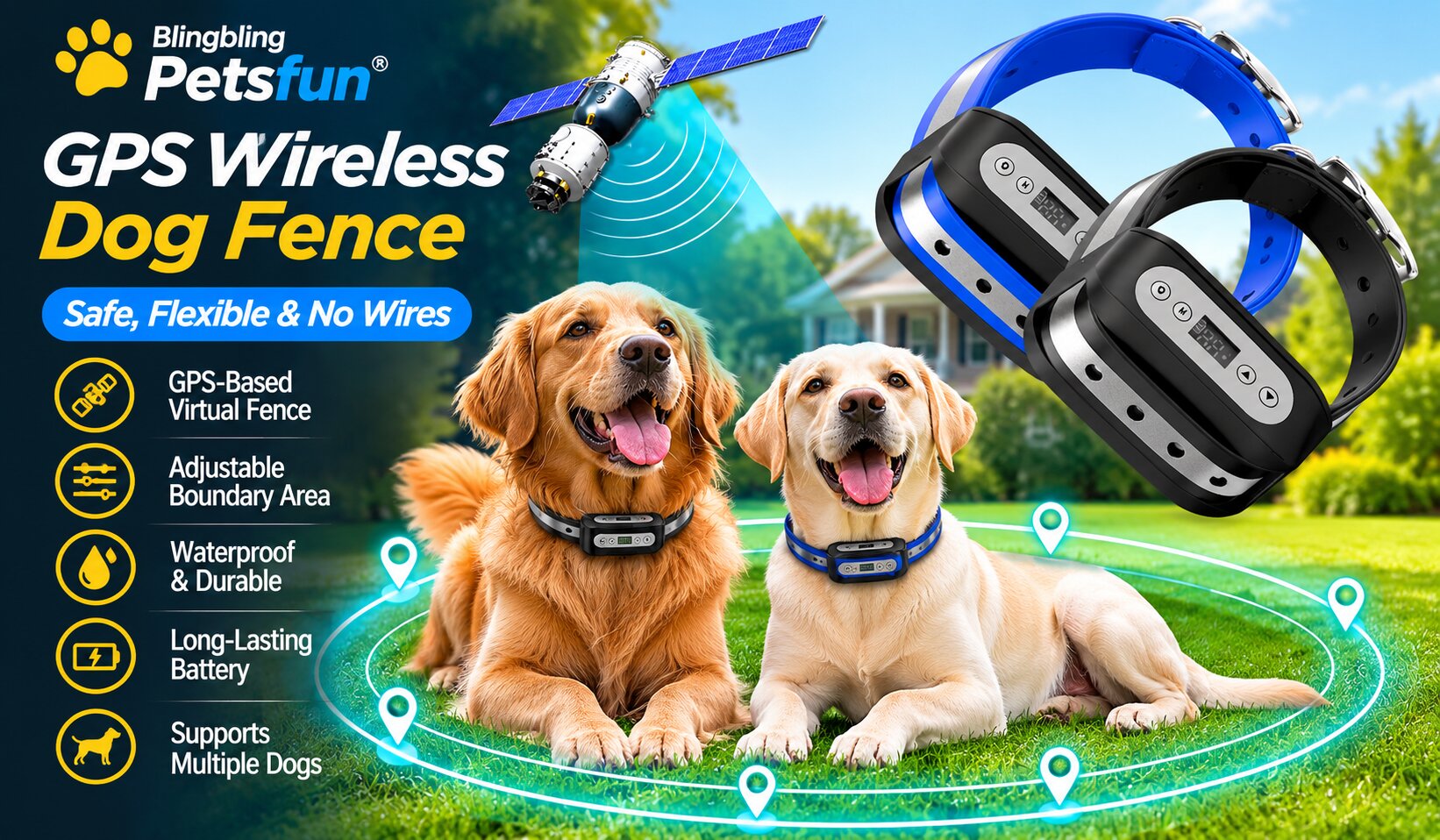
Blingbling Petsfun is the lowest-priced option in this roundup, but its customer-rating snapshot is also the weakest. The supplied Amazon information shows a 3.1-star average from 12 reviews. That small sample does not tell the whole story, but it offers less reassurance than a product with a larger and stronger review history.
The listing describes an adjustable boundary radius from 10 to 990 meters, which is approximately 33 to 3,248 feet. It also lists an IP67 water-resistance rating and says the collar fits neck sizes from 7 to 26.5 inches.
The system offers vibration and static correction modes. The listing says it does not require a SIM card or monthly subscription. It also states that each system works with one dog, while multiple systems can be used together.
This product may look attractive on price, but buyers should read the return policy, warranty details, and recent customer feedback before choosing it. The relatively low rating and small number of reviews make it difficult to draw a confident conclusion about long-term performance.
GPS Dog Tracker vs. GPS Wireless Fence: What Is the Difference?
The phrase “GPS dog collar” covers products that do very different jobs. Understanding the difference is more useful than comparing every device by range or price alone.
| Feature | GPS tracking collar | GPS wireless fence |
|---|---|---|
| Main purpose | Locate a dog | Keep a dog within a virtual boundary |
| Typical setup | Collar plus handheld or app | Collar plus boundary setup |
| Works without cellular service? | Some handheld systems do | Many GPS fence systems do |
| Remote location on a phone | Depends on the system and connection | Often requires an optional cellular plan |
| Boundary warnings | Not always included | Core function |
| Best suited to | Hiking, hunting, and off-leash tracking | Home or property containment |
A handheld GPS tracker such as Garmin Alpha TT 25 or Dogtra PATHFINDER2 is designed to show where a dog is in relation to the handler. A GPS fence such as SpotOn or PetSafe Guardian is designed to create a virtual perimeter.
Some fence products add remote tracking through a paid cellular plan. The containment function and the remote-monitoring service have different requirements.
AirTag for Dogs vs. a GPS Dog Tracker: Bluetooth or GPS?
Apple AirTag is sometimes used as a dog collar accessory, but it is not a dedicated GPS dog tracker. It uses Bluetooth and Apple’s Find My network to help locate an item. Nearby Apple devices can detect an AirTag and anonymously relay its approximate location to the owner’s account.
This can be useful if a dog gets lost in a populated area where many compatible Apple devices are nearby. However, an AirTag does not independently calculate and transmit its live GPS position in the way a dedicated GPS tracking collar does. Its location updates depend on nearby devices in the Find My network.
A dedicated GPS dog tracker uses satellite positioning and communicates with a compatible handheld receiver or another supported connection. Systems such as Garmin Alpha and Dogtra PATHFINDER2 can provide tracking directly to their handheld receivers without depending on nearby smartphones or a cellular subscription for that basic tracking link.
| Feature | Apple AirTag | Dedicated GPS dog tracker |
|---|---|---|
| Location technology | Bluetooth and Find My network | GPS satellite positioning |
| Independent GPS tracking | No | Yes, depending on the system |
| Needs nearby devices for remote location updates | Yes | No for handheld radio-based systems |
| Live tracking while hiking | Not designed for continuous live tracking | Available on compatible systems |
| Works without a cellular subscription | Yes, but location updates depend on the Find My network | Yes, on compatible handheld systems |
| Best use | Finding misplaced items or providing an extra identification aid | Following a dog’s location outdoors |
An AirTag may provide an additional way to identify or locate a dog, but it should not be treated as a replacement for a GPS collar when reliable outdoor tracking is the priority. A dog can move beyond Bluetooth range, and location updates may be delayed if there are no nearby Find My network devices.
For owners who regularly hike, hunt, or walk dogs in rural areas, a dedicated GPS tracking collar with a handheld receiver is generally the more appropriate tool. For everyday item-finding or as a secondary identification accessory, an AirTag may have a role, but it is not a purpose-built pet safety tracker.
How GPS Dog Collars Work Without a Monthly Fee
GPS itself does not require a monthly subscription. A GPS receiver calculates its position using signals from satellites. The recurring cost usually comes from a separate service that sends location information from the collar to a phone over a cellular network.
This is why two products can both advertise GPS and have different subscription policies.
A handheld tracking system can communicate directly with its receiver. It does not need to send data through a mobile network. A fence collar can store and use its boundary information locally, without sending the dog’s location to a remote server.
A phone app that shows a dog’s location from far away needs a way to receive that information. Depending on the product, this may require cellular service and a paid plan.
Before buying, ask one specific question: Will the feature I need still work when I do not pay for a subscription?
For a fence, check whether boundary creation and correction remain available. For a tracker, check whether the handheld can receive the collar’s location directly.
Can a GPS Dog Tracker Work Without Cell Service?
Yes. Some systems use a dedicated handheld receiver to receive location information from a compatible collar. Garmin Alpha and Dogtra PATHFINDER2 are examples.
That makes these systems relevant for rural areas, hunting grounds, and outdoor routes where phone coverage may be unreliable.
GPS reception can still be affected by terrain, dense tree cover, buildings, and the position of the collar antenna. The stated range is a manufacturer specification, not a guarantee for every landscape.
A Bluetooth-only tracker is different. Bluetooth has a much shorter operating distance and is not a replacement for a long-range GPS tracking system. An AirTag relies on nearby devices in Apple’s Find My network for remote location updates, rather than providing the same direct handheld tracking link.
GPS Dog Collar Without Subscription for iPhone and Android
Phone compatibility is only one part of the decision. A product may support both iPhone and Android but still need a compatible handheld, Bluetooth connection, or cellular plan for certain features.
Dogtra’s official PATHFINDER2 page lists iOS 14 or Android 7.0 and later, with Bluetooth 5.0 required. The handheld and GPS Connector can operate independently of mobile data for the basic tracking link. Offline maps must be downloaded before entering an area without data access.
SpotOn and Meowant use phone apps for fence setup and local control. Their local app functions are different from remote tracking over unlimited distances. SpotOn’s remote tracking and escape notifications require its optional cellular subscription. Meowant’s supplied listing describes app-based location viewing within approximately 98 feet.
Check the manufacturer’s current app requirements before buying. Phone compatibility can change as operating systems are updated.
What to Check Before Buying a GPS Dog Collar
1. Decide whether you need tracking or containment
If your main concern is finding a dog that runs ahead on a hike, compare dedicated GPS tracking systems. If you want to create a safe boundary around a property, compare GPS fences.
Buying a fence when you need remote tracking can lead to disappointment, especially if the phone-based tracking service requires a subscription.
2. Check what “no subscription” actually includes
Read the manufacturer’s subscription comparison rather than relying on the headline. Confirm whether the no-fee version includes:
- GPS positioning
- Boundary creation and storage
- Handheld tracking
- Live location on a phone
- Escape notifications
- Remote recall
- Activity history
A product may provide several of these features without a plan while reserving others for a paid service.
3. Check the dog’s weight and neck size
A collar that is too large or heavy may be uncomfortable for a smaller dog. Some fence collars also have minimum weight requirements. Dogtra PATHFINDER2 is listed for dogs weighing at least 35 pounds, with a minimum neck size of 12.5 inches, while PetSafe Guardian is designed for dogs over 25 pounds. Meowant’s supplied listing starts at 10 pounds.
Measure the dog’s neck and check the manufacturer’s sizing guidance before ordering. Do not rely only on broad labels such as small, medium, or large.
4. Understand the real battery figure
Battery life depends on how often the collar updates its position, whether cellular tracking is active, and how frequently the device is used.
Check whether a quoted figure refers to the collar, handheld receiver, or optional battery accessory. Garmin’s 136-hour figure applies to the TT 25 with an optional extended battery box. The standard TT 25 battery is rated for up to 68 hours.
5. Treat range as a best-case specification
A stated range does not guarantee that the device will work at that distance in every location. Terrain, vegetation, buildings, antenna placement, and interference can affect performance.
For a tracking collar, the range between the dog and handheld matters. For a fence, the usable property size and boundary performance matter more than a large advertised radius.
6. Read the review count alongside the rating
A 5.0-star average from 21 reviews is not directly comparable with a 4.1-star average from 167 reviews or a 3.9-star average from 494 reviews. The number of reviews gives useful context, although it does not replace reading recent, detailed feedback.
For products with a small review sample, check the return policy and warranty before buying.
GPS Dog Collars for Small Dogs: What Should Owners Check?
Small dogs need a collar that fits their body and neck comfortably. Weight limits matter as much as the strap size. Dogtra PATHFINDER2 is designed for dogs weighing at least 35 pounds, with a minimum neck size of 12.5 inches, and PetSafe Guardian is specified for dogs over 25 pounds, so neither is a suitable starting point for many small breeds. Meowant’s supplied listing starts at 10 pounds, while DOGOITM lists a 15-pound minimum. Check the full receiver weight, contact-point design, and fit instructions before ordering. A collar that meets the weight limit may still be too bulky for a very small dog.
Are GPS Dog Collars Waterproof?
Water resistance varies by model. SportDOG’s supplied listing describes its TEK 2.0 collar as waterproof for submersion up to 25 feet. SpotOn Nova is rated IP67 by its manufacturer, and Meowant’s listing also states IP67. Garmin Alpha TT 25 has a 1 ATM water rating, while Dogtra describes PATHFINDER2 as fully waterproof. These ratings are not interchangeable. Check the exact model’s manual before swimming or prolonged water exposure. For DOGOITM GM08, the supplied Amazon listing says IPX7, while an available manual copy says IPX6, so confirm the rating for the package being sold.
Which GPS Dog Collar Is Right for Your Situation?
The right choice depends on what you need the collar to do.
- For multi-dog outdoor tracking: Garmin Alpha TT 25 is the most feature-rich option in this selection, especially for owners who need a dedicated handheld and training controls.
- For off-grid tracking with offline maps: Dogtra PATHFINDER2 is worth comparing, provided the dog meets its 35-pound minimum and 12.5-inch neck-size requirement.
- For adding another dog to an existing system: SportDOG TEK 2.0 makes sense only if you already own a compatible handheld.
- For simple handheld tracking: Aorkuler offers a more straightforward approach without a phone app.
- For a customizable GPS fence: SpotOn Nova offers subscription-free containment, with remote tracking features available through an optional cellular plan.
- For home containment without recurring fees: PetSafe Guardian is a dedicated subscription-free option for properties larger than three-quarters of an acre and dogs over 25 pounds.
- For a GPS fence with no subscription for core containment: Omni offers SpotOn’s virtual fence functions without a required monthly fee. Remote cellular features are optional.
- For a lower-cost fence with a simple setup: DOGOITM is worth examining, but its small review sample and conflicting waterproof ratings deserve attention.
- For the lowest upfront price: Blingbling Petsfun is inexpensive, although its rating snapshot gives less confidence than the stronger-rated alternatives.
Think about how the collar will fit into an ordinary week. A family taking a dog to a weekend park may need simple tracking rather than a property fence. Someone hiking with a large dog may value a handheld receiver that works beyond phone coverage. A household with a large yard may get more use from a GPS fence and its training features. Choosing by the actual routine helps avoid paying for functions that will rarely be used.
Frequently Asked Questions
Is there a GPS dog collar with no monthly fee?
Yes. Garmin Alpha, Dogtra PATHFINDER2, and Aorkuler Tracker 2 are examples of tracking systems that do not require a monthly cellular subscription for their basic handheld tracking functions. GPS fence products such as PetSafe Guardian, SpotOn, and Omni also offer core containment functions without a recurring fee. The exact features included without a plan vary by model.
What is the best GPS dog collar without a subscription?
There is no single best choice for every owner. Garmin Alpha TT 25 is suited to advanced multi-dog tracking and training. Dogtra PATHFINDER2 is a strong option for off-grid handheld tracking. Aorkuler is simpler, while PetSafe Guardian, SpotOn, and Omni are designed for virtual containment rather than ordinary location tracking.
Can I track my dog without cell service?
Yes, if you choose a system that sends GPS information directly to a compatible handheld receiver. Garmin Alpha and Dogtra PATHFINDER2 are examples. A collar that relies on cellular service to send its location to a phone will not provide that remote phone-tracking feature where the required network connection is unavailable.
Does SpotOn work without a subscription?
SpotOn says its core GPS fence functions work without a subscription. Owners can create and use fences without a cellular plan. Features such as remote location viewing, escape notifications, and remote recall require an optional cellular subscription.
Is Omni the same company as SpotOn?
Omni is an edition of the SpotOn GPS Fence, not a separate manufacturer. Its core GPS fence functions work without a cellular subscription. Remote location viewing and escape notifications require an optional cellular plan. Check the selected collar size and package details before ordering.
Does PetSafe Guardian require a monthly fee?
The Guardian GPS Dog Fence model identified in this guide is listed by PetSafe as subscription-free. It is different from the Guardian GPS + Tracking model, which adds tracking features. Check the model name and product number before ordering.
Do GPS dog collars work with iPhones and Android phones?
Some do, but compatibility depends on the model and app. Dogtra PATHFINDER2 lists iOS and Android support with specific operating-system and Bluetooth requirements. Other systems may use an app mainly for fence setup or local control. Check the manufacturer’s current phone requirements before purchasing.
Can a GPS wireless fence replace a physical fence?
A GPS fence creates a virtual boundary and uses warning cues or correction settings to teach a dog where the boundary is. It is not a physical barrier. Training, supervision, and a suitable property layout remain important. It may not be appropriate for every dog or every environment.
Are GPS dog collars accurate in wooded areas?
Performance varies by product and surroundings. Trees, buildings, terrain, and other obstructions can affect satellite reception. Some manufacturers design their antennas and software to improve performance in challenging conditions, but no GPS system should be assumed to work perfectly in every wooded area.
How long does the Garmin Alpha TT 25 battery last?
Garmin rates the standard TT 25 battery for up to 68 hours. The optional extended battery box increases the stated maximum to up to 136 hours. Actual runtime depends on the update settings and how the collar is used.
Can GPS dog collars work in rural areas?
Some can. Handheld systems such as Garmin Alpha and Dogtra PATHFINDER2 communicate directly with a compatible receiver, so their basic tracking link does not depend on cellular coverage. GPS reception can still be affected by terrain, tree cover, and the position of the collar antenna.
Do GPS wireless dog fences need Wi-Fi or internet?
Many GPS fence systems can use their stored boundary information without a home Wi-Fi connection. However, app setup, account features, software updates, and remote phone tracking may have separate connectivity requirements. Check the manufacturer’s instructions for the exact model and the features you plan to use.
Final Verdict
The best GPS dog collars without subscription fall into two main groups: tracking systems that send location information to a handheld receiver, and fence collars that keep a dog within a virtual boundary. Choosing between them starts with deciding whether you need to locate your dog outdoors or manage containment at home.
For dedicated tracking, Garmin Alpha TT 25 and Dogtra PATHFINDER2 are the more advanced choices in this selection. Garmin is better suited to owners managing multiple dogs and longer outdoor trips. Dogtra offers offline maps and handheld tracking, but its 35-pound minimum and 12.5-inch minimum neck size make it unsuitable for many small dogs. Aorkuler is simpler, while SportDOG is relevant mainly to owners who already have a compatible handheld.
For containment, PetSafe Guardian offers a clearly defined subscription-free fence, while SpotOn Nova and Omni provide core fence functions without a required cellular plan. Their remote phone-tracking features are separate and require a paid subscription.
Think about where your dog spends most of its time. A large dog that joins you on hikes may benefit from a dedicated handheld tracker. A family dog that spends weekends in a large yard may be better served by a GPS fence. For a small dog that mainly goes on short walks, size and comfort may matter more than a long advertised range.
The most important buying step is to check which functions remain available after you decline the subscription. That detail can make the difference between buying the right GPS dog collar and paying for a device that does not do what you expected.

About the Author: Shahin Shuvro
Shahin Shuvro is an AhemBeauty contributor who writes research-led buying guides on consumer products and everyday technology. His articles focus on comparing product specifications, manufacturer documentation, retailer listings, and customer feedback so readers can understand the practical differences between competing products.
This guide uses published product information and manufacturer specifications. The listed devices were not physically tested by the author, and no hands-on testing or professional dog-training credentials are claimed.
AhemBeauty Editorial Note: Product specifications, prices, availability, and subscription terms can change. Confirm the exact model and included features with the manufacturer or retailer before purchase.




11 Comments