
GPS Tracking Research · AhemBeauty
How GPS positioning works, how collars transmit location data, and what owners should know about accuracy, battery life, coverage and monthly fees.
Research note: GPS positioning and location transmission are separate functions. Understanding that difference is the key to choosing a dog collar without unexpected monthly costs.
How GPS Dog Tracking Works Without Monthly Fees depends on the positioning and communication technology inside the collar. Some systems use direct radio connections, while others rely on cellular networks or locally stored GPS boundaries. Understanding these differences helps dog owners choose a tracking system that fits their needs without paying for features they may never use.
The answer depends on the technology inside the collar.
Some GPS tracking systems communicate directly with a handheld receiver. Others use cellular networks to send location updates to a smartphone. GPS fences can store digital boundaries and continue operating locally, even when an internet connection is unavailable. These systems may all advertise GPS tracking, but their capabilities and ongoing costs are quite different.
This guide explains how GPS dog tracking works without monthly fees, what affects location accuracy, where tracking systems can fail, and which features may still require a paid service. If you are ready to compare specific models, see our GPS dog collar buying guide.
The short answer: GPS positioning itself does not normally require a subscription. The recurring cost usually comes from cellular connectivity, cloud services or additional features. A direct-radio tracker can avoid cellular fees, but it requires a compatible receiver and has a practical range limit.

What Owners Should Know Before Choosing a GPS Collar
Three questions matter more than the headline range or the word “GPS” on the packaging:
- How does the collar determine the dog’s location?
- How does that location reach the owner?
- Which features remain available without a paid plan?
A collar can calculate coordinates without mobile service and still be unable to show a fresh location in a remote smartphone app. Another system may continue enforcing a previously saved virtual fence while its remote alerts stop working.
That distinction is the foundation of this comparison.
1. How GPS Dog Collars Actually Work
GPS stands for Global Positioning System. It is a satellite navigation service that allows compatible receivers to calculate their location.
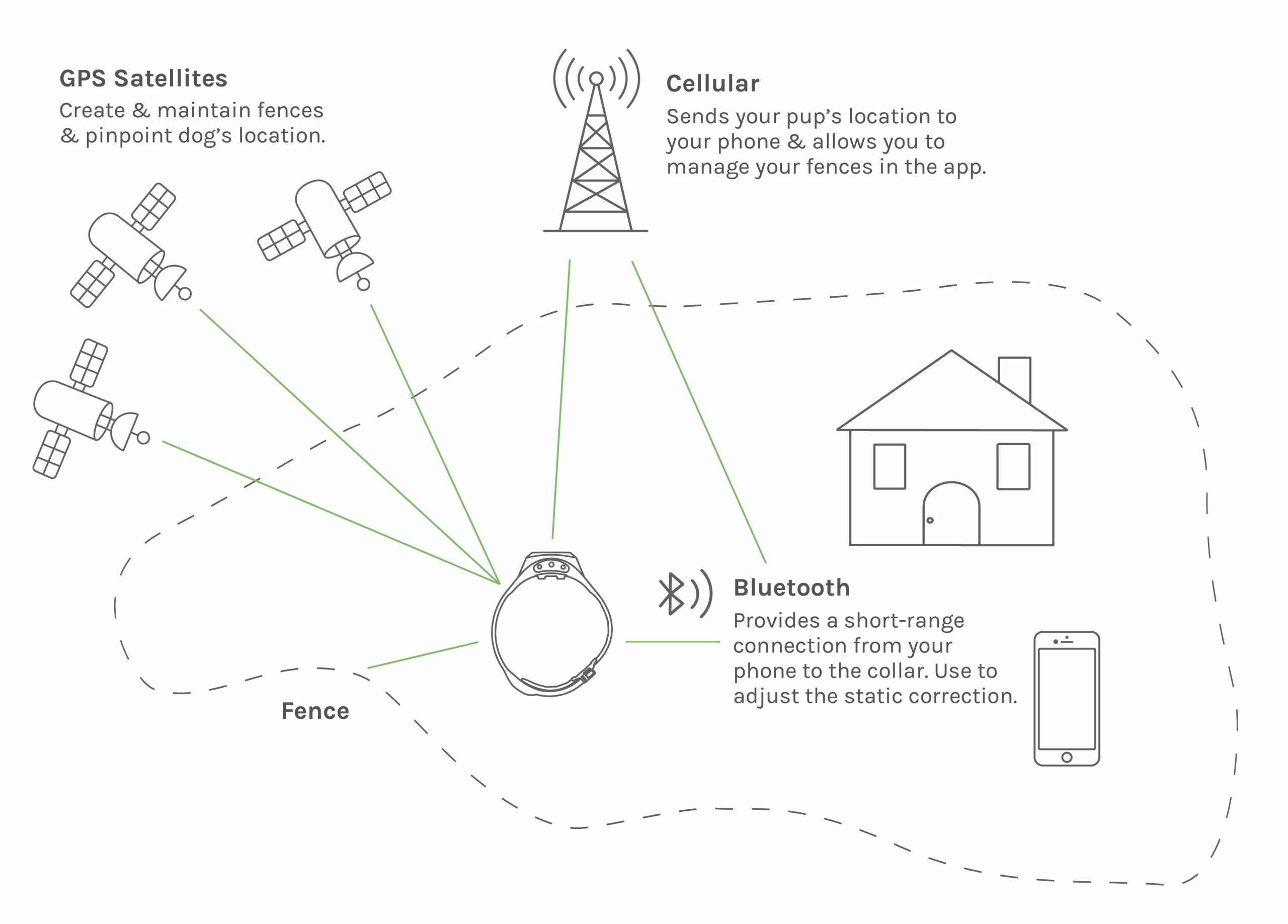
A dog collar with GPS or GNSS technology receives signals from navigation satellites and uses their timing information to estimate its position. GNSS is the broader term for global navigation satellite systems. It includes GPS, Galileo, GLONASS and BeiDou.
The collar’s receiver generally needs signals from multiple satellites to calculate a position. Once it has coordinates, the device needs a separate way to communicate them.
Think of it as two separate jobs:
GPS finds the location. Communication delivers the location.
That communication may use a radio link, cellular data, Wi-Fi or a nearby Bluetooth connection. The choice determines whether the owner can follow the dog from a handheld device, a phone nearby or a remote location.
The US government’s GPS programme explains how satellite signals support positioning: GPS.gov’s GPS overview
The four main technologies
| Technology | Main job | What the owner receives |
|---|---|---|
| GPS/GNSS | Calculates coordinates | A location inside the device |
| Direct radio | Sends coordinates to a receiver | Local tracking on a compatible handheld |
| Cellular | Sends coordinates over mobile networks | Remote updates through an app |
| Bluetooth | Connects nearby devices | Short-range communication or network-assisted finding |
A product may combine several of these technologies. That is why reading the connectivity specifications is more useful than relying on the product title alone.
2. Cellular GPS vs Direct-Radio Tracking
This is where many buyers make the wrong comparison. Cellular GPS and direct-radio GPS can both use satellite positioning. The difference is how the location reaches the owner.
Cellular GPS tracking
A cellular collar calculates its location and sends the coordinates through a mobile network to an online service. The owner then views the location through a smartphone application.
This setup is convenient for someone who wants to check a dog’s position from another location. It can also support remote alerts, location history and other connected features.
The drawback is network dependence. If the collar enters an area without supported mobile coverage, the app may stop receiving fresh updates.
Many manufacturers charge a recurring fee for this service because the collar uses mobile connectivity and a managed tracking platform.
Direct-radio GPS tracking
A direct-radio system sends location information from the collar to a compatible handheld receiver.
It does not need a cellular tracking plan for that local connection. The owner can follow the dog on the handheld’s map, subject to the system’s radio range and environmental conditions.
This arrangement is common in hunting and working-dog equipment.
Garmin’s Alpha TT 25, for example, lists a VHF radio range of up to 14.48 km (9 miles). Garmin also lists battery life of up to 68 hours, or up to 136 hours with an optional extended battery box. These are manufacturer specifications, not guaranteed results in every environment.
Source: Garmin Alpha TT 25 technical specifications
Which one makes more sense?
For someone who wants to check a dog while sitting at work, cellular tracking may be more convenient. For someone walking or hunting with a dog in remote terrain, a direct-radio system may be more useful if its range and handheld requirements fit the activity.
Neither system removes every limitation. Cellular tracking depends on network coverage; radio tracking depends on the connection between the collar and receiver.
3. How GPS Dog Collars Work Without a Subscription
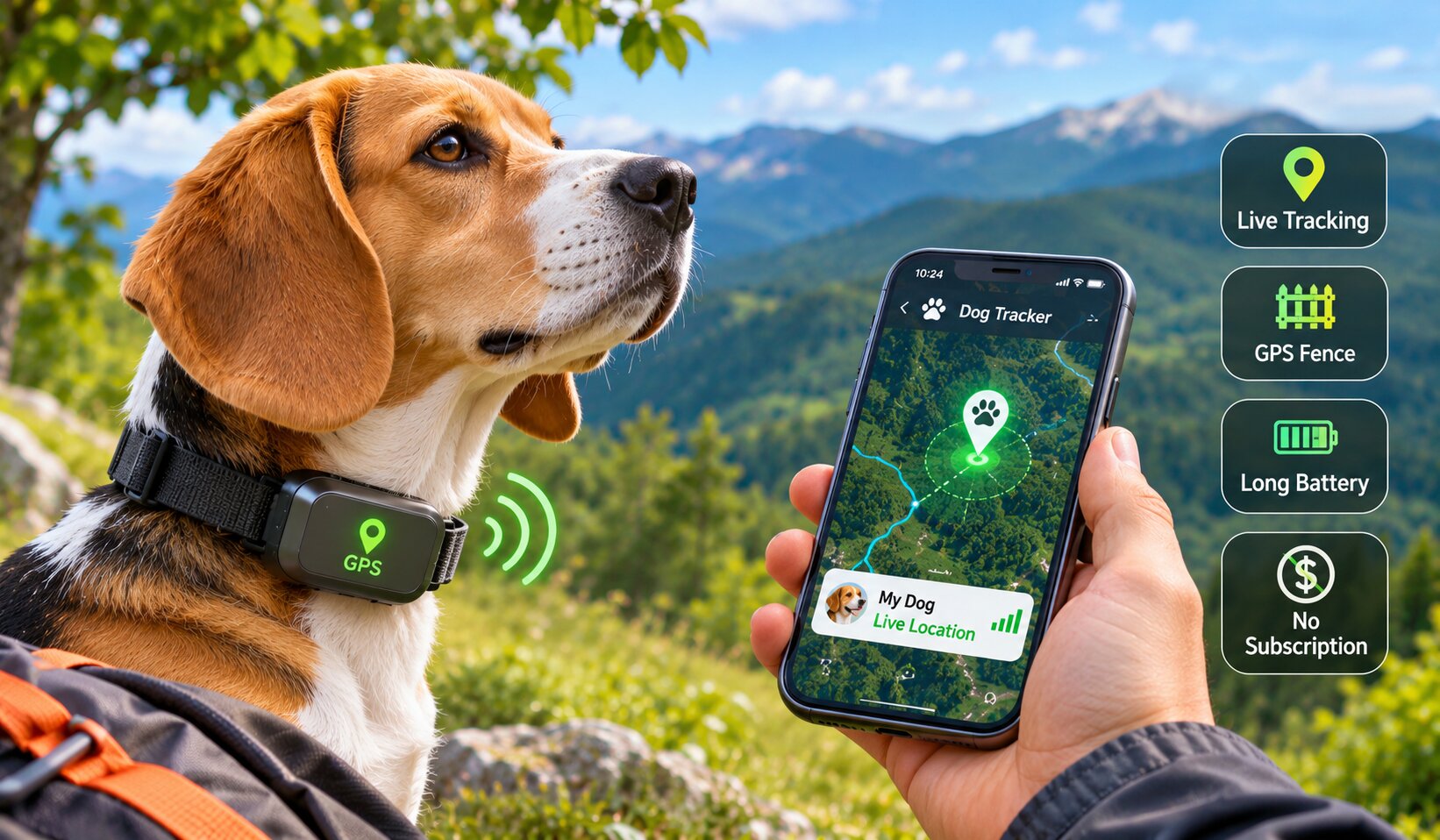
A subscription-free system usually avoids a paid cellular tracking service by handling its main tracking functions locally.
There are three common arrangements.
Direct-radio tracking: The collar sends its calculated location to a handheld receiver. No mobile data plan is needed for that local connection.
Stored GPS boundaries: A GPS fence can store a previously configured boundary in the collar. The device uses its location to determine whether the dog is approaching or crossing that boundary.
Local phone or controller connection: Some devices use Bluetooth or another nearby connection for setup and local functions. These features do not necessarily provide remote tracking.
There is an important difference between operating offline and providing remote tracking. A device may continue calculating its position or enforcing a saved boundary when disconnected, but the owner’s phone may not receive live updates.
What happens when the signal disappears?
Imagine taking a dog to a remote holiday property. The collar has a clear view of the sky, so it can still calculate GPS coordinates. But the mobile network is unavailable.
A direct-radio system may continue sending location updates to its handheld if the receiver is within range. A cellular collar may calculate the location but fail to deliver it to the remote app. A GPS fence with stored boundary information may continue its local containment function while phone notifications are delayed.
The device has not necessarily stopped working. The communication route has changed or disappeared.
4. Four GPS Dog Tracking Systems Compared
The following examples illustrate different approaches to GPS tracking and containment. This is a technical comparison, not a ranking or a claim that the products have been independently tested by AhemBeauty.
| System | Main technology | Published capability | Subscription position |
|---|---|---|---|
| Garmin Alpha TT 25 | GNSS + VHF radio | Up to 9-mile VHF range; up to 68-hour battery life | Local collar-to-handheld tracking does not require a cellular plan |
| Dogtra PATHFINDER2 | GPS + handheld/app connection | Up to 9-mile stated range; supports up to 21 dogs and hunters | Manufacturer states no monthly subscription |
| SportDOG TEK 2.0 | GPS + handheld radio | Up to 10-mile line-of-sight range | Local tracking system; compatible handheld required |
| Halo Collar | GPS + cellular + Wi-Fi/Bluetooth | GPS fence and app-based tracking | Active membership required for its services |
Garmin Alpha TT 25: This is a dedicated tracking collar designed to work with a compatible Garmin handheld. Its VHF connection is the key to its subscription-free local tracking arrangement. The advertised nine-mile range is a maximum specification, not a promise of that distance through every landscape.
Dogtra PATHFINDER2: Dogtra describes this as an app-based GPS tracking and training system with no monthly subscription. It offers offline map access and a stated range of up to nine miles. The manufacturer says cellular service is not required for the system to operate. Its app requires a compatible smartphone and the PATHFINDER2 hardware.
Source: Dogtra PATHFINDER2 product information
SportDOG TEK 2.0: This system uses GPS tracking with a dedicated handheld. SportDOG lists a range of up to 10 miles under line-of-sight conditions and support for multiple dogs when compatible additional collars are used. Its operating guide warns that terrain, weather, vegetation and radio interference can reduce range.
Sources:
Halo Collar: Halo combines GPS positioning, connectivity and virtual fencing. It is a useful contrast because its official plans require an active membership for its services, including cellular data and GPS fence features. Its support documentation says saved fences can continue operating when cellular or Wi-Fi coverage is unavailable, although remote phone alerts and live map updates may be affected.
Sources:
What this comparison tells us: “GPS” does not automatically mean “subscription-free.” The communication system and the manufacturer’s service policy determine the ongoing cost.
Prices and service terms can change, so check the official product page before purchasing. Battery figures are included only where the cited documentation provides them.
5. GPS Accuracy, Location Updates and Real-World Conditions
A GPS collar does not always show a dog’s exact physical position. It displays a calculated location, and that calculation can be affected by the surroundings.
GPS.gov gives a general reference of around 4.9 metres (16 feet) for GPS-enabled smartphones under open-sky conditions. Accuracy can worsen near buildings, bridges and trees. This is a smartphone reference, not a guaranteed specification for dog collars.
Source: GPS.gov’s GPS accuracy guidance
Why the location can be wrong
- Tall buildings: Satellite signals may be blocked or reflected between buildings.
- Dense trees: A thick canopy can reduce the number and quality of satellite signals received.
- Hills and valleys: Terrain may obstruct the receiver’s view of the sky.
- Signal reflections: A signal that bounces off a surface can distort the position calculation.
- Receiver design: Antenna quality and signal processing vary between devices.
A map pin that appears a few metres away from a dog does not necessarily mean the collar is defective. The environment and receiver design matter.
Update frequency is a separate issue
Accuracy tells you how close the location is to the dog’s actual position. Update frequency tells you how often the device sends a new location.
A collar that updates every two seconds may give a more detailed picture of a moving dog than one that updates every minute. But frequent updates can consume more battery and increase communication activity.
Garmin’s Alpha TT 25 documentation describes configurable tracking rates, including 2.5 seconds, 5 seconds, 10 seconds and 2 minutes. The appropriate setting depends on the activity and the need for frequent updates.
Sou