Most cat owners learn the same lesson eventually: the things they buy for their cats are often less important than the things they notice.
A cat may ignore the expensive bed and sleep in the cardboard box it came in. It may refuse a new toy but spend twenty minutes chasing a shadow on the wall. And it may appear completely normal while quietly developing a problem that only becomes obvious when its eating, drinking, grooming or litter-box habits change.
That is what makes cat care different from simply keeping a pet fed.
Cats are remarkably good at hiding discomfort, and their idea of a good day does not always look like ours. A cat that spends much of the afternoon sleeping may be perfectly healthy. A cat that suddenly starts sleeping much more than usual is a different story.
For owners, knowing that difference matters.
Good cat care is built around the ordinary details: appropriate nutrition, fresh water, a clean litter box, preventive veterinary care, safe places to rest, opportunities to play and explore, and an environment where a cat can behave like a cat.
The right routine also changes as the animal grows. A kitten has different nutritional and behavioral needs from a seven-year-old adult, and a senior cat may need a home arranged around comfort and easy access rather than endless climbing.
The good news is that caring for a cat does not have to become complicated.
It starts with learning what is normal for the individual cat living in your home.

What Does a Cat Actually Need Every Day?
There is no shortage of advice about what cats “need.”
Automatic feeders. Water fountains. Interactive toys. Special beds. Supplements. Smart litter boxes.
Some can be useful. None of them replaces the basics.
A cat needs suitable food, access to clean water, a comfortable place to sleep, appropriate toileting facilities, opportunities for activity and exploration, scratching outlets, and somewhere it can retreat when it wants privacy.
Feline veterinary guidelines place considerable emphasis on the cat’s environment because behavior and health are closely connected. Resources such as food, water, litter boxes, scratching posts and resting areas should be thoughtfully distributed rather than crowded into one location.
Sometimes improving cat care means buying less and rearranging more.
This sounds simple until you look at a real household.
Imagine a nervous cat whose food bowl sits beside the washing machine, its litter box is in a busy hallway and its only hiding place is under a bed that everyone walks past.
The owner may think the cat has everything it needs.
The cat may disagree.
The First Rule of Cat Care: Learn Your Cat’s Normal
This may be the most useful piece of advice in the entire guide.
Before worrying about what is normal for cats in general, learn what is normal for your cat.
How enthusiastically does it usually eat?
Where does it sleep?
How often does it use the litter box?
Does it normally greet you?
Does it jump onto the sofa?
How much does it usually groom itself?
Is it naturally quiet or constantly vocal?
There is a reason veterinary guidelines encourage owners to pay attention to subtle changes in behavior, appetite, hydration, grooming, mobility and elimination. A change from an individual’s normal pattern can provide useful information during a veterinary assessment.
Normal does not always mean healthy, and unusual does not automatically mean illness.
A cat sleeping for long stretches can be normal. A cat that suddenly sleeps most of the day when it previously followed you around the house is worth watching.
That is a much more useful way to think about cat health than trying to memorize a list of symptoms.
Cat Nutrition: Feed the Cat You Have, Not the Marketing on the Bag
Choosing cat food can feel harder than it should.
One package promises natural ingredients. Another talks about high protein. Another focuses on digestive health. Another is marketed for indoor cats.
The label matters, but the first question should be whether the diet is nutritionally complete and appropriate for the individual cat.
Cats have specific nutritional requirements, including essential amino acids and other nutrients they cannot simply obtain by eating a generic human-style diet. AAHA and AAFP guidance recommends nutritionally adequate diets and individualized feeding plans based on factors such as age, reproductive status, body condition, activity and health.
That means there is no universal “best cat food” that makes sense for every cat.
A growing kitten has different requirements from a mature adult. A senior cat may have completely different nutritional concerns from a young, active cat. A cat with kidney disease, diabetes, obesity or another medical condition may require a veterinary-directed diet.
This is where online arguments about whether wet food or dry food is “better” can become misleading.
What feeding plan meets this cat’s nutritional needs and supports a healthy body condition?
If you are researching the practical side of making a cat comfortable at home, our guide to cat beds for kittens can also be useful when choosing a suitable resting space for a young cat.
Wet Food vs. Dry Food: What Should Cat Owners Know?
Wet food and dry food can both be part of a suitable feeding plan.
Wet diets contain substantially more water than dry diets, which can be useful for overall fluid intake. Some cats also prefer wet food because of its smell and texture.
Dry food is convenient, easy to store and can be practical for measured feeding.
The mistake is assuming that one format automatically solves every nutrition problem.
A cat eating dry food still needs access to fresh water. A cat eating wet food still needs an appropriately balanced diet and sensible portions.
Some cats are also extremely opinionated about texture.
Anyone who has watched a cat reject a perfectly good meal because the food was served in a slightly different form already knows this.
When changing diets, gradual transitions are generally recommended. AAHA/AAFP guidance describes transitioning to a new diet over roughly 7–10 days, while individual circumstances may require a different approach.
If a cat is ill, refusing food or losing weight, diet changes should be discussed with a veterinarian rather than managed through trial and error.
How Much Should You Feed a Cat?
This is where many loving owners accidentally overfeed.
Cats are persuasive.
A cat can finish dinner, stare at its owner and behave as though the household has committed a serious moral failure by not immediately serving another meal.
That does not necessarily mean it needs more calories.
Free-choice feeding can encourage overeating in some cats, and maintaining a healthy body condition requires monitoring food intake and adjusting portions when necessary. AAHA/AAFP guidance specifically identifies obesity prevention and weight monitoring as important parts of feline care.
Treats deserve the same attention.
A small treat is still food. Several small treats every day can gradually become a meaningful source of extra calories.
Rather than deciding whether a cat is “fat” by looking at it casually, ask a veterinarian to assess body condition and weight.
This matters because excess weight is associated with several health problems, including diabetes and mobility issues.
And if a cat needs to lose weight, the answer is not necessarily to dramatically cut its food overnight.
Weight management should be safe and gradual, particularly because cats can become seriously unwell when they stop eating.
Water: The Part of Cat Care Owners Often Overlook
Food gets most of the attention.
Water deserves more.
Some cats are enthusiastic drinkers. Others seem to treat the water bowl as an item of furniture.
Fresh water should be available every day, and bowls should be kept clean. Some cats prefer moving water, while others have preferences about the shape and location of the bowl. Veterinary guidance notes that these individual preferences can be accommodated, and that diets with higher water content can contribute to overall water intake.
A fountain can be useful if your cat likes one.
It is not mandatory.
The more important thing is to know your cat’s usual drinking pattern.
A sudden increase in drinking or urination can sometimes be associated with medical problems. So can a marked reduction in water intake, particularly when accompanied by poor appetite, vomiting, weakness or other changes.
Do not diagnose the cause from a search result.
Notice the change and discuss it with a veterinarian.
The Litter Box Is a Health Monitor Hiding in Plain Sight
People often think of the litter box as a housekeeping issue.
For cat owners, it can also be a useful source of health information.
You may notice that the urine clumps suddenly look much larger. Or that your cat is visiting the box repeatedly. Perhaps the stool has changed. Perhaps the cat has stopped using the box altogether.
Those observations can matter.
AAHA/AAFP guidance specifically recommends discussing elimination habits and house-soiling during feline healthcare visits.
There is also a simple behavioral principle: cats generally benefit from clean, accessible litter facilities in locations where they feel secure.
In multi-cat households, providing multiple boxes and distributing resources can reduce competition.
And if a previously reliable cat suddenly begins urinating outside the litter box, do not immediately label it “bad behavior.”
A cat starts urinating beside the litter box. The owner changes the litter. Then the box. Then the location. Nothing works.
The missing step may be a veterinary assessment.
House-soiling can have behavioral causes, but medical causes need to be considered too. The behavior is information.
The cat is telling you something has changed.
If you are reviewing litter-box options for your home, you can also see our guide to the best cat litter boxes for practical considerations around setup and everyday use.
Why Scratching Is Not Bad Behavior
If your cat scratches the sofa, it can feel personal.
It is not.
Scratching is a normal feline behavior associated with claw maintenance, stretching and communication. Veterinary guidance recommends providing appropriate scratching outlets and discouraging punishment.
The practical solution is usually to offer the cat something better.
Some cats prefer tall vertical scratching posts. Others like horizontal cardboard scratchers.
Location matters.
A scratcher hidden in an unused corner may be ignored. A scratcher placed near the sofa where the cat already scratches has a much better chance of being used.
This is one of the recurring themes of good cat care:
Do not automatically fight a normal behavior. Redirect it.
How to Keep an Indoor Cat Happy
Indoor cats can have safe, comfortable lives, but indoor living does not automatically provide enough stimulation.
A house has walls.
A cat’s natural behavioral repertoire is much larger.
Cats stalk. They chase. They investigate. They climb. They hide. They watch movement. They explore smells.
Good indoor cat care gives those behaviors somewhere to go.
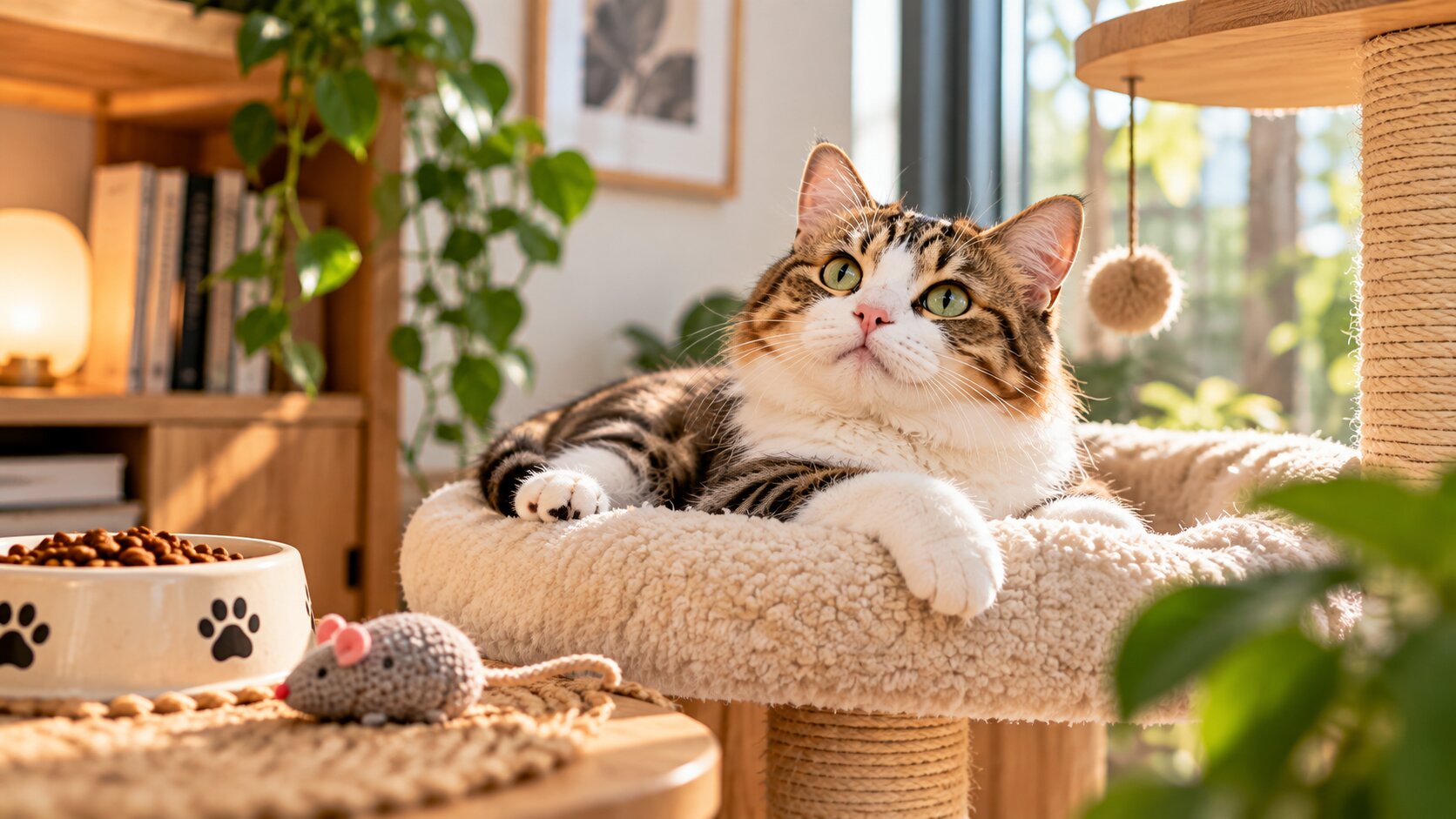
A window perch can turn an ordinary afternoon into something interesting. A cardboard box can become a hiding place. A food puzzle can make mealtime more engaging. A scratching post provides an appropriate physical outlet.
Interactive play is particularly useful.
You do not need to buy the most expensive toy.
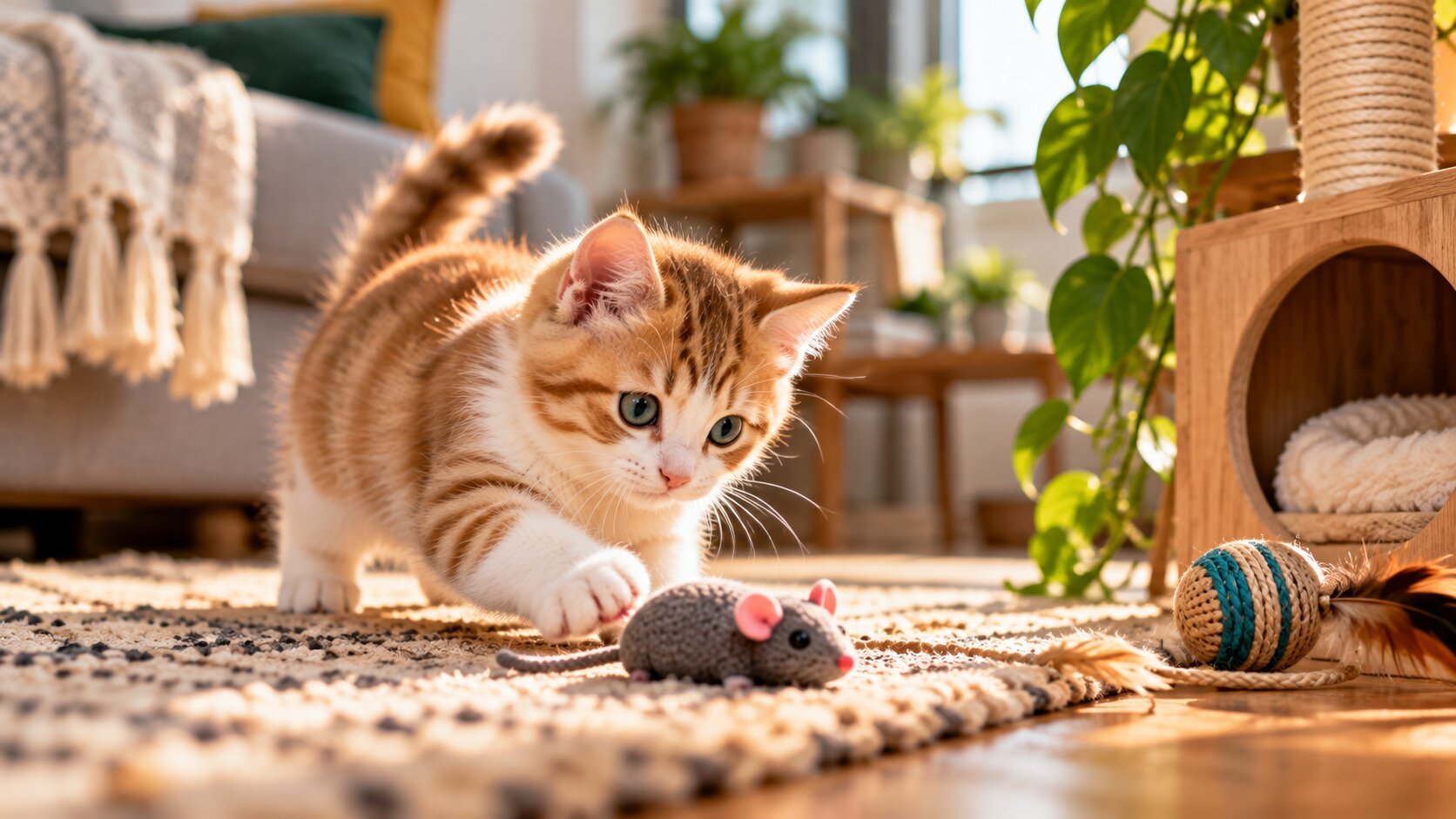
A simple wand toy can encourage stalking and chasing. Move it like prey rather than waving it randomly. Let the cat watch. Pause. Move away. Give it opportunities to catch the toy.
Short sessions are often easier to maintain than trying to provide one long workout.
And rotate toys.
A toy that has been sitting in the same place for three weeks can become invisible to the cat.
AAHA/AAFP guidance recommends enrichment, play, scratching opportunities, resting areas and thoughtfully distributed resources as part of feline environmental care.
If you are setting up a comfortable sleeping area, our collection of recommended cat beds may help you compare different types of resting spaces.
What Does a Happy Cat Actually Look Like?
This question sounds simple, but “happy” does not look identical in every cat.
Some cats follow their owners from room to room.
Others prefer to sit nearby without touching.
Some greet visitors.
Others disappear the moment the doorbell rings.
A happy cat is not necessarily an affectionate cat.
Instead, look for a broader pattern.
A cat that is eating normally, grooming normally, moving comfortably, exploring, playing at its usual level, using the litter box appropriately and choosing where it wants to rest is generally giving you useful signs about its day-to-day wellbeing.
The ability to retreat is important too.
A cat should not have to be sociable every minute of the day.
A quiet hiding place can actually make a home more comfortable.
The Home Should Give Your Cat Choices
This is where good cat care becomes surprisingly architectural.
Think about the home from the cat’s point of view.
Where can it go if the children are noisy?
Where can it sleep without being disturbed?
Where can it climb?
Where can it scratch?
Where can it drink?
Where can it use the litter box without being cornered by another animal?
Where can it watch the room?
Cats benefit from multiple resting and hiding options, and veterinary guidelines emphasize the number, distribution and location of resources within the home.
You do not need to turn the living room into a cat playground.
A secure high shelf, a window perch, a box and a comfortable bed can already create meaningful choices.
Multi-Cat Homes Need More Than Extra Food
Two cats living peacefully together can be wonderful.
Two cats competing over one litter box is another matter.
In multi-cat homes, resources should be distributed so that individual cats can access food, water, litter facilities, resting spaces and scratching areas without constant confrontation.
Quiet conflict can be harder to see than fighting.
One cat may block a doorway.
Another may stop entering a particular room.
One may begin hiding.
Another may start eliminating outside the litter box.
If a cat’s behavior changes after another cat enters the household, think about the environment before blaming the animal.
Sometimes the problem is not aggression.
It is lack of options.
Grooming: Look Beyond the Fur
Cats are naturally clean animals, but grooming is still part of responsible cat care.
Long-haired cats often need more brushing than short-haired cats. Regular grooming can help prevent mats and gives owners a chance to notice changes in the skin and coat.
But grooming also gives you a useful opportunity to observe the whole animal.
Is there a new lump?
Does one area seem painful?
Has the cat stopped grooming a particular part of its body?
Are the claws becoming overgrown?
Does the cat suddenly dislike being touched somewhere it previously tolerated?
These observations can be worth discussing with a veterinarian.
Dental health deserves the same attention.
Cats do not always show obvious signs of oral pain, and eating normally does not prove that a cat’s mouth is healthy.
Routine veterinary dental assessment and appropriate home care can therefore be important parts of long-term cat wellness.
Cat Care by Life Stage
A cat’s needs change with age.
The AAHA/AAFP feline life-stage framework describes kittens as cats from birth to one year, young adults from one through six years, mature adults from seven through ten years and seniors over ten years.
Kitten Care
Kittens are growing rapidly and have different nutritional requirements from adult cats.
They also have an important learning period.
Gentle handling, positive experiences with people, grooming, nail care and carrier training can make future veterinary visits and routine care easier. AAHA/AAFP guidance recommends gradual, positive exposure rather than forcing kittens into frightening experiences.
Do not use your fingers and toes as toys simply because a tiny kitten’s bites seem harmless.
A kitten learns through repetition.
The behavior that looks cute now may be considerably less cute when attached to an adult cat.
Kittens can also benefit from food puzzles and appropriate opportunities to stalk, chase and forage.
Young Adult Cats
This is the stage where some owners become less vigilant.
The kitten has grown up.
The vaccinations may be complete.
The cat appears healthy.
But young adult cats can gain weight, especially when food intake does not match activity. Neutering can also affect energy needs and weight-management considerations.
This is a good period to establish sustainable habits around feeding, play, dental care and preventive veterinary visits.
Mature Adult Cats
Around seven to ten years, changes may become more subtle.
Weight gain or loss, changes in appetite, hydration, mobility, grooming or nighttime behavior deserve attention rather than being automatically dismissed.
This is also a useful time to make the home easier to navigate if the cat is becoming less athletic.
Senior Cats
Senior does not mean “broken.”
Older cats can remain affectionate, curious and playful.
But they may benefit from easier access to food, water and litter boxes, warmer resting areas and closer monitoring of weight, appetite, hydration, mobility and behavior.
AAHA/AAFP guidance recommends at least six-monthly examinations for senior cats and specifically warns against assuming subtle changes are simply part of getting old.
Age explains some changes. It should not automatically excuse them.
What Cat Owners Commonly Get Wrong
“My indoor cat does not need regular veterinary care.”
Indoor living changes risk; it does not eliminate the need for preventive healthcare. Vaccination, parasite prevention and examination frequency should be based on the individual cat’s lifestyle and health risks.
“My cat is eating, so it must be fine.”
Eating is a good sign, but it is not a complete health assessment.
Cats can continue eating despite dental pain or other problems.
“Scratching means my cat is destructive.”
Scratching is normal feline behavior. The better solution is to provide an appropriate outlet and guide the behavior.
“My cat is naturally big.”
Body condition matters more than the owner’s preferred description.
A veterinarian can help determine whether a cat is carrying excess body fat.
“My cat is hiding, so it must be unhappy.”
Maybe. Maybe not.
Some cats naturally seek quiet spaces.
The important question is whether hiding has increased or changed suddenly.
“I can solve every behavior problem with discipline.”
Punishment can increase fear and stress. Veterinary guidance favors environmental changes, positive reinforcement and investigation of possible medical causes.
How to Tell When Something Is Wrong
You do not need to panic every time your cat skips a toy or takes a longer nap.
Look for patterns.
Changes that deserve veterinary attention can include:
- sudden loss of appetite
- significant weight loss or gain
- major changes in drinking or urination
- repeated vomiting or diarrhea
- persistent hiding
- reduced grooming
- difficulty jumping or walking
- unusual aggression or sensitivity to touch
- changes in litter-box habits
- persistent coughing or breathing difficulty
- sudden weakness or collapse
A cat that cannot urinate, has difficulty breathing, collapses, has a seizure, suffers significant trauma or may have been poisoned needs prompt veterinary attention.
Urinary obstruction in particular can become an emergency.
The important point is not to diagnose the problem yourself.
The important point is to recognize that something has changed and act accordingly.
Cat-Proofing the Home
Cats investigate with their mouths and paws.
That makes ordinary household objects potential hazards.
Keep medicines, cleaning chemicals and other dangerous substances secured. Be careful with strings, ribbons, small objects and anything that could be swallowed.
Plants deserve attention too. Check whether a plant is safe for cats before bringing it home. The ASPCA maintains a searchable database of toxic and non-toxic plants for cats and other companion animals.
Windows should be secure, particularly on upper floors.
And remember that “my cat has never done that before” is not a safety system.
Curiosity changes quickly.
A bored cat can suddenly discover a shelf, cupboard or electrical cord that it previously ignored.
Bringing a New Cat Home
The first few days should be about adjustment, not performance.
Some cats walk through the front door as though they have been waiting for the house to become available.
Others disappear beneath the furniture.
Neither reaction automatically tells you how the cat will behave long term.
Prepare food, water, litter facilities, a scratching surface, a comfortable resting area and a hiding place before arrival.
A quiet starter area can make the transition easier.
If changing food, do it gradually unless a veterinarian advises otherwise. And avoid forcing interaction.
Let the cat investigate.
Sit nearby.
Speak quietly.
Allow it to approach.
The goal is to make the new environment predictable.
If you are preparing for travel with a new or nervous cat, our guide to a cat carrier backpack can provide additional practical considerations for choosing and using a carrier.
A Simple Daily Cat Care Routine
Good cat care does not require constant attention.
A practical routine might look like this.
Morning: check food and water, scoop the litter box and notice whether the cat looks and behaves normally.
During the day: provide opportunities for rest, observation, exploration and play.
Evening: offer another short interactive play session, check food and water again and clean the litter area as needed.
Weekly: inspect the coat, claws, scratching areas, toys, food bowls and water containers.
Regularly: review weight, preventive treatments, dental care and veterinary appointments.
The routine does not have to be identical for every cat.
What matters is consistency.
When Cat Care Gets Hard, Return to the Basics
There will be days when the cat refuses the new food.
There will be mornings when you discover litter scattered across the floor.
There will be a toy abandoned beside a much more interesting receipt.
That is ordinary life.
The goal is not to create a perfect cat household.
It is to create a safe and predictable one.
Feed appropriately.
Keep water available.
Maintain clean litter facilities.
Provide places to scratch, climb, rest and hide.
Make time for play.
Watch weight.
Take dental and preventive healthcare seriously.
Adjust the environment as your cat ages.
And, above all, notice changes.
Frequently Asked Questions About Cat Care
How often should I feed my cat?
Feeding frequency depends on age, health, food type and the individual cat. Kittens have higher energy needs during growth and require feeding plans appropriate for development. Adult cats generally need measured portions rather than unlimited food. A veterinarian can help determine an appropriate amount based on body condition and health.
Is wet food better than dry food for cats?
Neither is automatically best for every cat. Wet food contains substantially more water and may help increase overall water intake, while dry food can be convenient and easy to portion. The nutritional adequacy of the overall diet and the individual cat’s needs matter more than the format alone.
How can I tell if my cat is overweight?
Do not rely only on appearance or the number on the scale. Veterinarians use body condition scoring and muscle condition assessment to evaluate whether a cat is carrying an appropriate amount of body fat and muscle. Regular weight monitoring can help identify gradual changes.
How many litter boxes should I have?
A commonly used guideline is one litter box per cat plus an additional box when practical. Placement matters too. Boxes should be accessible and located where cats can use them without feeling trapped or constantly disturbed.
Do indoor cats need veterinary care?
Yes. Indoor living can reduce some risks but does not eliminate health problems or every infectious and parasite risk. Preventive care should be tailored to the cat’s lifestyle and circumstances.
How can I keep an indoor cat mentally stimulated?
Use short interactive play sessions, scratching posts, elevated resting places, window views, hiding areas, food puzzles and opportunities to explore. Rotate toys rather than leaving every toy available all the time.
Why is my cat suddenly hiding?
Hiding can be normal, particularly after environmental changes. But a sudden increase in hiding can also accompany stress, pain or illness. Look for other changes in eating, drinking, grooming, movement and litter-box habits.
How often should my cat see a veterinarian?
The appropriate schedule depends on age and health. AAHA/AAFP guidance recommends at least annual examinations for many cats and at least every six months for senior cats, with individual circumstances determining whether more frequent visits are appropriate.
Is it normal for cats to sleep most of the day?
Cats naturally spend substantial amounts of time resting. The more useful question is whether the amount of sleep is normal for that individual cat. A sudden change in activity or sleep pattern deserves attention, especially when accompanied by other symptoms.
How do I make veterinary visits easier for my cat?
Start before the appointment. Gradually make the carrier familiar, reward calm behavior and handle paws, ears and other body areas gently when the cat is comfortable. Positive reinforcement and gradual acclimation are recommended approaches for reducing stress around handling and veterinary visits.
The Real Secret to Better Cat Care
The best cat-care routine is not necessarily the one with the most products.
It is the one that makes you familiar with your cat’s ordinary life.
You know where it sleeps in the afternoon. You know how it asks for breakfast. You know which sound makes its ears move. You know whether it drinks from the bowl or waits for the tap. You know how quickly it normally eats and where it usually disappears when the house becomes noisy.
Those details can seem insignificant.
They are not.
A cat cannot explain that its mouth hurts or that urinating has become uncomfortable. It cannot tell you that jumping onto the sofa suddenly feels difficult. It cannot say that the litter box location has become frightening because another animal keeps waiting nearby.
It can only change its behavior.
That is why observation is such an important part of cat care.
You do not need to become a veterinarian to become a better cat owner. You need to know your animal well enough to recognize when its ordinary day no longer looks ordinary.
Feed it properly. Give it choices. Keep its environment safe. Let it scratch. Let it play. Give it somewhere quiet when it wants to disappear for a while. Take preventive healthcare seriously.
And when something changes, do not ignore the small signs simply because your cat is still acting like itself.
Sometimes the smallest change is the first useful clue.
That is what setting a cat up for success really means.
This editorial is informed by veterinary guidance and feline-care resources. The sources below are provided so readers can explore the underlying recommendations in greater detail.
AAHA/AAFP Feline Life Stage Guidelines Life-stage care, preventive healthcare, nutrition, behavior, environment, oral health and more. AAHA — Behavior & Environmental Needs Guidance on enrichment, resources, resting areas, scratching and feline behavior. AAHA — Nutrition & Weight Management Evidence-guided information on feline nutrition, feeding plans and weight management. AAHA — Feline Life Stage Checklists Preventive care, behavior changes, elimination, nutrition and age-specific considerations. Cornell Feline Health Center — Choosing & Caring for Your New Cat Practical guidance on litter boxes, food, water, scratching posts and settling in a new cat. ASPCA — Toxic and Non-Toxic Plants Reference database for checking plant safety around cats and other companion animals.