
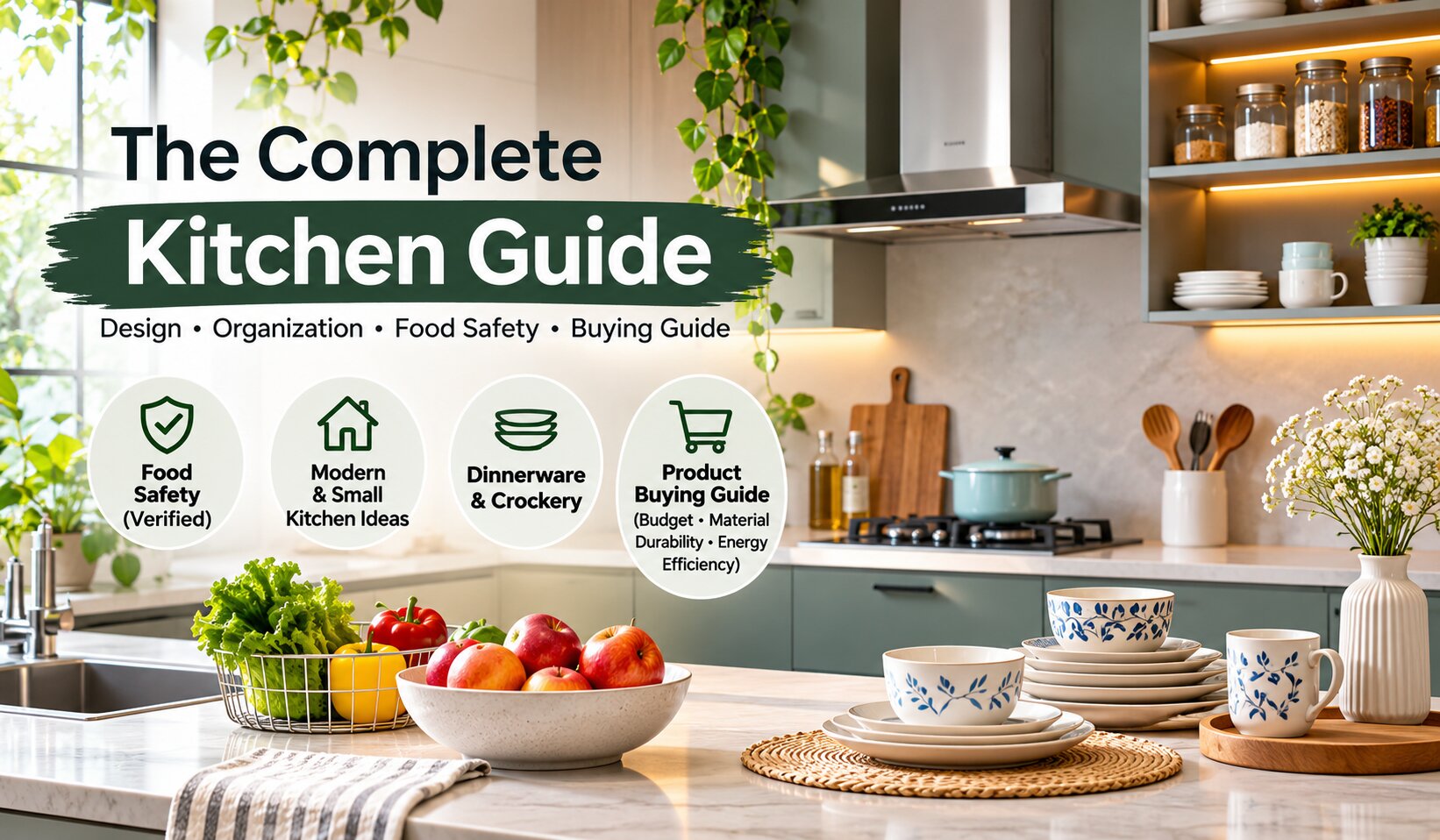
There is a particular kind of kitchen that looks wonderful in photographs and is miserable to cook in. The counters are bare, the open shelving holds six matching jars, and the one pan you actually need is buried under a stack of things you bought because a set seemed like good value.
Then there is the other kind of kitchen. It may not be big or new, but everything in it earns its place. The kettle is within arm's reach of the socket. The good knife lives where your hand finds it without thinking. Leftovers go into containers that stack properly and have lids that fit. People eat at a table where they are comfortable enough to stay for a second cup of tea.
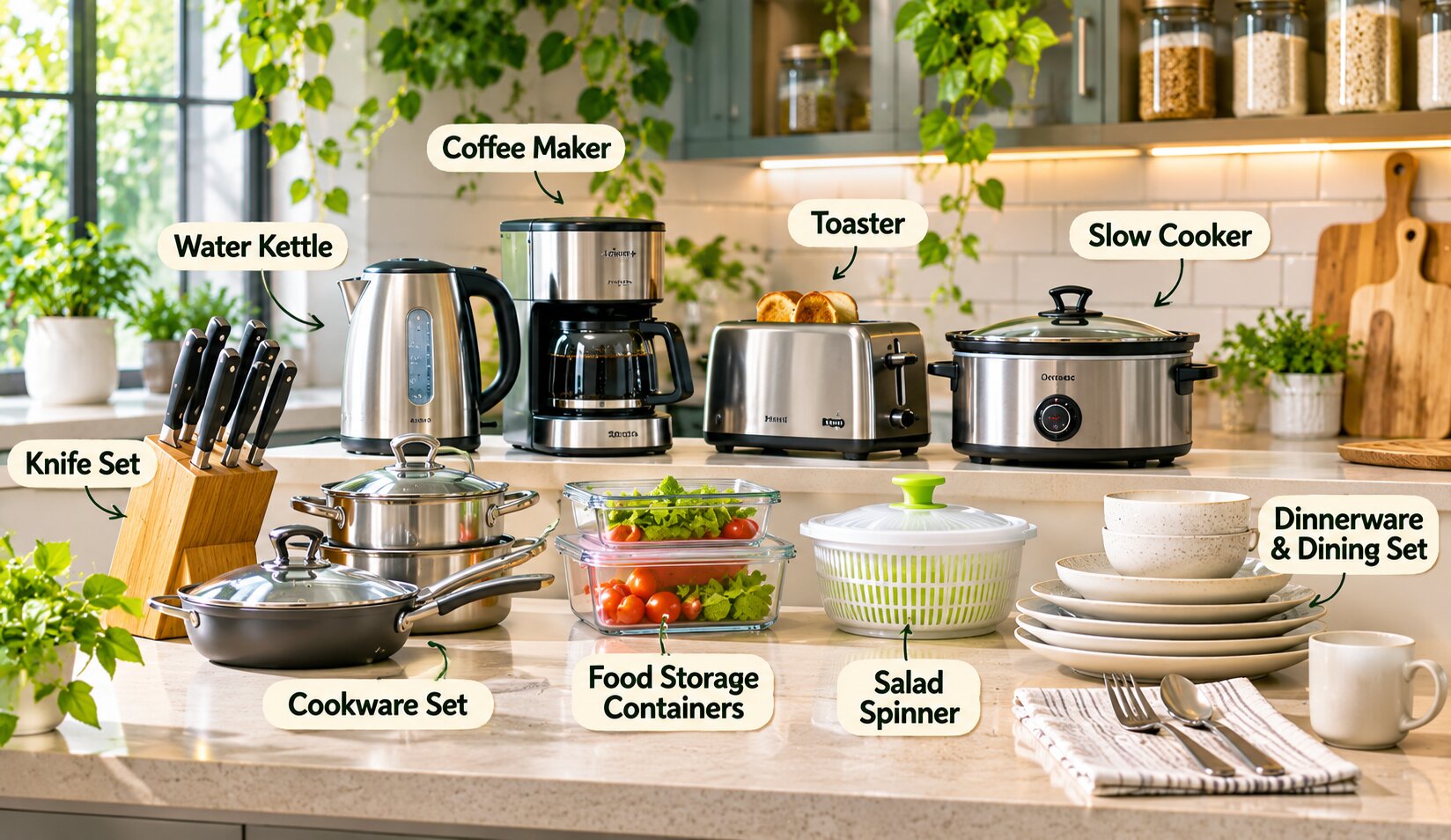
This guide is about building the second kind. It is written for home cooks in the US, UK, and Canada, where kitchens range from compact city galleys to open-plan family spaces. It covers the things most households really do buy and wonder about: the water kettle, cookware sets, knife sets, the salad spinner, food storage containers, flatware sets, slow cookers, toasters, rice cookers, dining sets, dinnerware, coffee makers, and the cleaners and habits that keep all of it working.
I'll tell you what each item is for, who should buy it, who can skip it, what to check before you pay, and how to care for it so it lasts. Where a food-safety point matters, I'll flag it and direct you to official guidance.
How to Think About a Modern Kitchen Before You Buy Anything
Most kitchen advice starts with a shopping list. I'd rather start with how you cook, because the "best" kitchen is the one that fits your habits.
Start With the Zones, Not the Gadgets
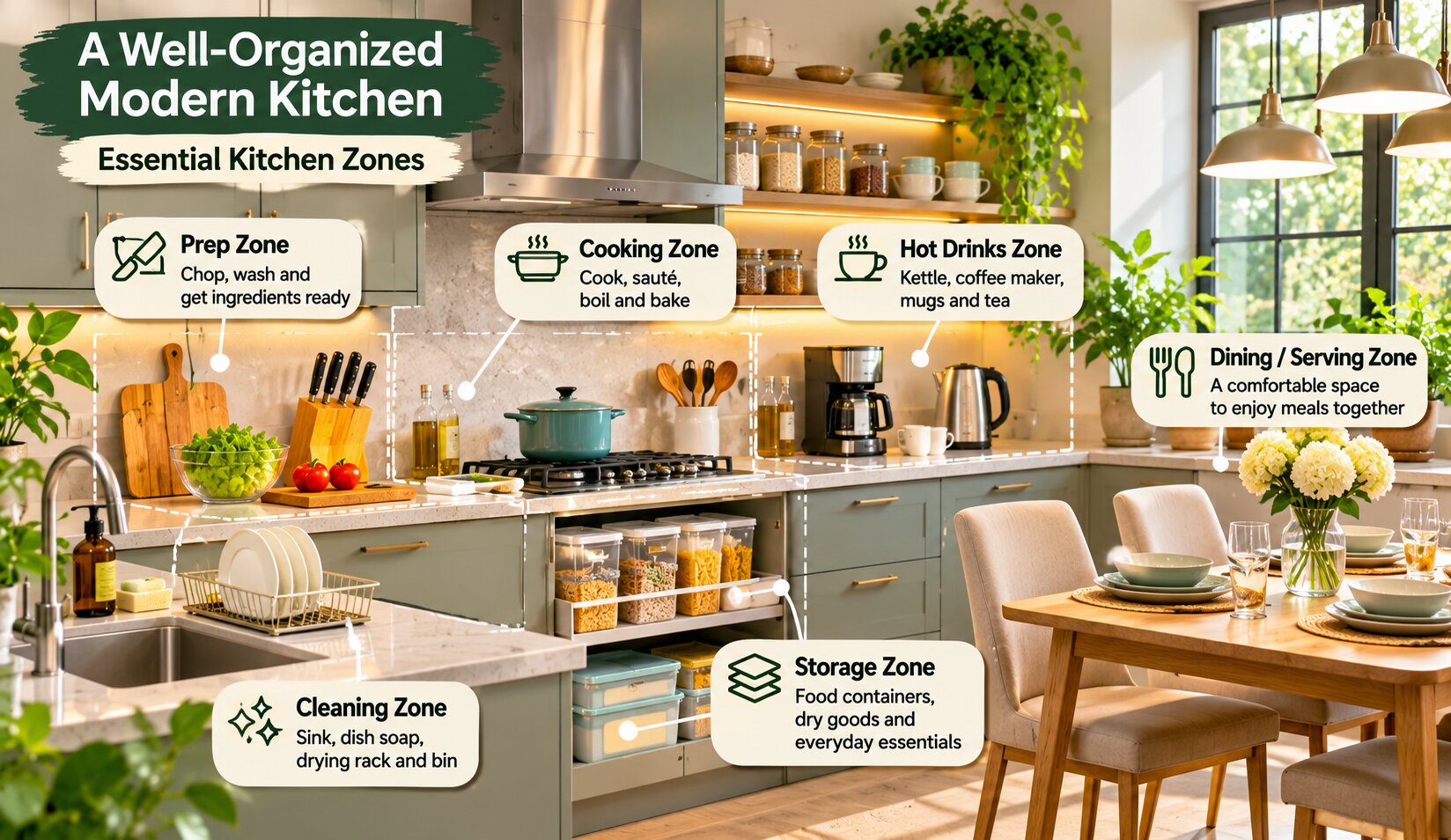
Professional kitchens are organized into stations, and a home kitchen works better when you borrow the idea in a small way:
- Prep zone: Knives, cutting boards, a bowl, a salad spinner, and a place to put the scraps. This should sit next to the longest stretch of clear counter you have.
- Cooking zone: Pans, a spatula, oils, salt, and a heat-proof trivet within reach of the hob or cooktop.
- Hot drinks zone: Kettle, coffee maker, mugs, tea, and sugar in one spot. This keeps the morning rush out of the cooking area.
- Cleaning zone: Sink, dish soap, brush, drying rack, cloths, and a bin nearby.
- Storage zone: Food containers, lids, and dry goods. This is where most kitchens quietly fall apart.
- Serving zone: Everyday plates, bowls, flatware, glasses, and serving dishes should be easy to reach from the dining area.
Once you see your kitchen this way, buying decisions get easier. You aren't asking, "Do I want a slow cooker?" You're asking, "Do I have a home for it, and will I use it more than twice a month?"
Modern Kitchen Design: What Makes a Kitchen Work Well?
A modern kitchen does not have to look like a showroom. It should be comfortable to use, easy to clean, well lit, and arranged around the way people prepare meals.
Start with the layout. The sink, refrigerator, and cooking area should be positioned so you can move between them without repeatedly crossing the room. This is sometimes called the kitchen work triangle. It is a useful planning principle, although it should not be treated as a rigid rule for every kitchen, particularly open-plan and single-wall layouts.
Think about the following design details:
Cabinet and drawer planning: Deep drawers are often easier to use than low cupboards because pans, lids, and food containers are visible without having to reach into the back. Use adjustable shelves for items of different heights.
Countertop space: Keep the main food-preparation area as clear as possible. A beautiful coffee machine or decorative appliance is less useful if it occupies the only space where you can comfortably chop vegetables.
Lighting: Combine general ceiling lighting with task lighting under cabinets or above preparation surfaces. A pendant light over the dining table can make the eating area feel separate without needing a wall.
Ventilation: A properly selected and installed extractor fan or range hood helps remove cooking moisture, smoke, and odours. Choose one suitable for the cooking appliance and the room, and maintain its filters according to the manufacturer's instructions.
Electrical planning: Position sockets where small appliances can be used safely without trailing cables across worktops or near water. Electrical installations should follow local building and electrical requirements.
Easy-clean surfaces: Smooth backsplashes, practical worktops, and handles that are easy to wipe down can save considerable cleaning time.
Modern Kitchen Colour and Material Ideas
A neutral base is easy to update. White, warm cream, soft grey, natural wood, and muted green can work well with different cabinet styles and countertop materials.
You do not need to use the same finish everywhere. A combination of light cabinets, darker handles, and a natural wood dining table can make a room feel less uniform.
For a small kitchen, lighter colours and reflective surfaces can help the room feel brighter. They do not physically create more space, however, so storage and layout still matter more.
Consider the following combinations:
- White cabinets with natural wood accents.
- Soft grey cabinets with brushed stainless steel handles.
- Cream cabinetry with warm stone-effect countertops.
- Muted sage green cabinets with light oak shelving.
- Dark lower cabinets with lighter upper cabinets.
Choose materials according to maintenance as well as appearance. Glossy surfaces may show fingerprints, while textured finishes can collect dust and grease.
Small Kitchen Ideas for Limited Spaces
A small kitchen needs more careful planning because every cupboard, appliance, and countertop has to earn its space.
Use vertical storage: Install shelves or wall-mounted racks where appropriate. Store frequently used spices, cups, or lightweight kitchen tools within easy reach.
Choose multi-purpose appliances: A multi-cooker may replace several individual appliances if you regularly use its functions. A compact toaster oven can also be useful when you do not have room for a separate oven and toaster.
Use drawer dividers: Separate cutlery, utensils, lids, and kitchen tools instead of allowing them to collect in one large drawer.
Choose stackable containers: Matching rectangular containers usually make better use of cupboard and refrigerator space than a collection of unrelated shapes.
Consider a folding or extendable dining table: This can provide everyday seating without permanently occupying the entire room.
Use cabinet-door organizers: These can hold lightweight items such as wraps, cleaning supplies, or small accessories, provided the door and hinges can safely support the added weight.
Keep counters selective: Leave out the kettle or coffee maker if you use them every day. Store occasional appliances elsewhere.
Use the space above cabinets carefully: If there is a suitable gap, baskets can hold lightweight items that are rarely needed. Avoid storing heavy objects where they could fall.
A small kitchen does not need more gadgets. It needs a sensible arrangement and enough clear space to prepare food comfortably.
Kitchen Organization: A Practical System That Lasts
Good organization should make everyday cooking easier, rather than creating another system that takes too much effort to maintain.
Try these simple habits:
- Keep frequently used pans and utensils near the cooking area.
- Store everyday plates and glasses near the dishwasher or sink.
- Keep knives in a dedicated block, sheath, or magnetic holder.
- Group food containers and lids together.
- Put older food at the front of the refrigerator so it is easier to use first.
- Label frozen meals with their contents and preparation date.
- Keep cleaning chemicals separate from food, cookware, and food-preparation surfaces.
- Review cupboards regularly and remove damaged or unused items.
An effective kitchen is one where you can find what you need without emptying three cupboards.
The "Buy Once" Question
A useful rule: spend more on things you touch every day and that cannot easily be replaced by something cheaper. That means a chef's knife, a main frying pan, and a kettle that doesn't leak or rattle.
Spend less on things you use occasionally, such as a salad spinner or a second set of serving bowls.
A cheap toaster that fails after two years and a mid-range one that lasts eight are not the same value, even if the second costs twice as much up front. Look for sensible warranties, which vary by category and manufacturer, and for brands that sell replacement parts such as lids, carafes, and crumb trays.
How Much Should You Spend on Kitchen Essentials?
A practical budget should cover the items you genuinely need before you spend money on specialist appliances.
- Budget: Basic cookware, a small knife collection, everyday plates, simple food containers, and a straightforward kettle.
- Mid-range: Better-quality stainless steel cookware, more comfortable knives, durable storage containers, and appliances with useful temperature or cooking settings.
- Premium: Fully clad cookware, specialist coffee machines, advanced rice cookers, high-quality dining furniture, and appliances with more precise controls.
A higher price does not automatically mean better performance. Compare construction, warranty, replacement-part availability, ease of cleaning, and energy use.
For most households, buying individual high-quality essentials over time is more sensible than buying a large premium set immediately.
Know Your Electrics
This one is rarely mentioned and it changes how appliances feel to use.
The US and Canada use approximately 120 volts, while the UK uses approximately 230 volts. That means a UK kettle can draw around 3,000 watts and boil a litre of water very quickly, while a typical North American kettle is limited to around 1,500 watts on a standard household circuit, so it takes noticeably longer for the same job.
Neither is wrong, but it's why UK readers often find US kettles slow and US readers are impressed by British ones.
Always check the voltage, wattage, plug type, and manufacturer's instructions before purchasing an appliance, especially if you are moving between countries. A plug adapter does not convert voltage.
Avoid overloading sockets and extension leads. If a circuit repeatedly trips, have the electrical installation checked rather than repeatedly resetting the breaker.
The Water Kettle: Small Appliance, Daily Habit
If you drink tea, instant coffee, pour-over coffee, or cook with a lot of boiled water (pasta, couscous, instant noodles, soup stock), a kettle quietly becomes the most-used appliance in the room.
Why a Kettle Beats the Stovetop
Heating water in an electric kettle is convenient and can be more energy-efficient than heating the same amount of water on a hob, particularly for small quantities. It also shuts off automatically on most modern models.
In the UK, a kettle is close to universal. In the US and Canada, it's common but not assumed, and many households still boil water in a pot.
If you make hot drinks more than once a day, a kettle will save time every single day.
What to Look For
- Capacity: 1.5 to 1.7 litres suits most families. A 1-litre model is plenty for one or two people and takes up less counter space.
- Auto shut-off and boil-dry protection: These are important safety features. Check that they are included.
- Variable temperature control: Worth paying for if you drink green tea, white tea, or pour-over coffee. As a rough guide, green tea is often brewed around 75–80°C (170–175°F), black tea and herbal infusions at a full boil, and pour-over coffee around 92–96°C (198–205°F).
- Material: Stainless steel, glass, or ceramic. Consider the quality of the interior and the parts that contact water.
- A wide opening and removable filter: These make cleaning easier.
- Gooseneck spout: Useful for pour-over coffee. Otherwise, it may be an unnecessary feature.
Budget, Durability and Energy Use
Basic kettles usually provide simple boiling functions. Mid-range models may offer temperature settings, better insulation, and improved controls. Premium models can include precise temperature adjustment and quieter operation.
Compare the wattage and capacity rather than assuming the most powerful kettle is automatically the best. Boiling only the amount of water you need is one of the easiest ways to avoid unnecessary energy use.
Who Can Skip It?
If you rarely boil water and already own a stovetop kettle you like, there's no need to switch.
How to Look After It
Limescale is the main enemy, especially in hard-water areas. Use a manufacturer-approved descaling method. White vinegar or citric acid may be suitable for some kettles, but check the manual first.
After descaling, rinse thoroughly and follow the manufacturer's instructions before making drinks again.
Don't leave water sitting in the kettle for days. Emptying it after use and refilling with fresh water helps maintain taste and reduce scale build-up.
Cookware Sets: Why a Big Set Is Often the Wrong Purchase
The 15-piece cookware set is one of the most heavily marketed items in any kitchen retailer. It looks impressive in the box. In reality, most home cooks use three or four pieces from it and the rest sits in a cupboard.
What Most Kitchens Actually Need
A small, well-chosen collection will cover nearly everything:
- One 10 to 12-inch (25–30 cm) frying pan with a good, heavy base.
- One non-stick pan for eggs, pancakes, and delicate fish.
- One saucepan (about 2 to 3 litres) with a lid.
- One large pot or Dutch oven (about 5 to 6 litres) for soups, stews, and pasta.
- One sauté pan with straight sides and a lid, if you cook for a family.
- Optionally, one cast iron skillet or carbon steel pan for searing.
If a set contains most of these in good materials, it can be good value. If it pads the count with tiny lids, steamers you will never use, and mismatched pieces, you are paying for packaging.
Materials, Plainly Explained
Stainless steel: Durable, oven-safe when the handles and construction allow it, non-reactive, and good for browning. It needs a little technique to avoid sticking. Tri-ply or fully clad construction can improve heat distribution.
Non-stick: Great for eggs and low-fat cooking, but the coating wears down. Don't use metal utensils, avoid very high heat, and replace the pan when the coating is visibly scratched or flaking. PTFE-coated cookware should be used according to the manufacturer's temperature and care instructions. Avoid overheating an empty non-stick pan. If you prefer to avoid PFAS, investigate the coating and its composition rather than relying on vague marketing terms.
Cast iron: Heavy, long-lasting, and excellent for searing and baking. It needs seasoning and a little care, but with proper maintenance it can last for generations. Enameled cast iron skips traditional seasoning and is ideal for braises and bread.
Carbon steel: Lighter than cast iron, heats quickly, and develops a natural seasoned surface over time. A favourite among keen home cooks.
Aluminum and copper: Excellent heat conductors, but usually found as a core layer within clad cookware or with a suitable lining.
Check Your Hob First
If you have an induction hob, your cookware must be magnetic. A simple test: if a fridge magnet sticks firmly to the base, it will generally work. Always check the manufacturer's induction compatibility information.
Gas and conventional electric hobs are more forgiving, but flat, stable bases still perform better.
Budget and Durability
A basic cookware collection can be built from individual pans. Mid-range stainless steel sets often provide a useful balance between durability and price. Premium fully clad cookware can be worth considering for frequent cooking.
Check the thickness, handle construction, lid fit, oven-safe temperature, and warranty. A set that includes replacement lids or individual pans can offer better long-term value.
Care Without the Drama
- Let hot pans cool before washing to avoid warping.
- For stuck-on food in stainless steel, simmer water with a spoonful of baking soda in the pan, then scrub gently.
- Dry cast iron right away, rub with a thin film of suitable oil, and store it somewhere dry.
- Even dishwasher-safe non-stick lasts longer if you wash it by hand.
Knife Sets: Buy the Right Three, Not the Block of Twelve
A knife block looks organized, but most of what's in it never gets used. A typical block set includes steak knives, a sharpening steel, and several oddly sized utility knives that overlap.
The Three Knives That Do Almost Everything
- An 8-inch (20 cm) chef's knife. This does most of the chopping, slicing, and dicing. If you only buy one good knife, buy this.
- A serrated bread knife. Useful for bread, tomatoes, and cakes.
- A paring knife. For peeling, hulling, and small precise tasks.
Add a utility knife or a santoku if you like, and kitchen shears if you cook a lot of poultry. That's enough for most homes.
German vs. Japanese Styles
German-style knives tend to be heavier, with a curved belly that suits a rocking motion, and they are generally forgiving.
Japanese-style knives are often lighter, thinner, and sharper out of the box, but the harder steel can chip if you twist or hit bone.
Neither is better. The right knife is the one that feels balanced in your hand, so if you can, hold it in a shop before buying.
Sharpening vs. Honing
This is one of the most misunderstood parts of knife care.
Honing realigns the cutting edge and is useful when the knife starts to fee