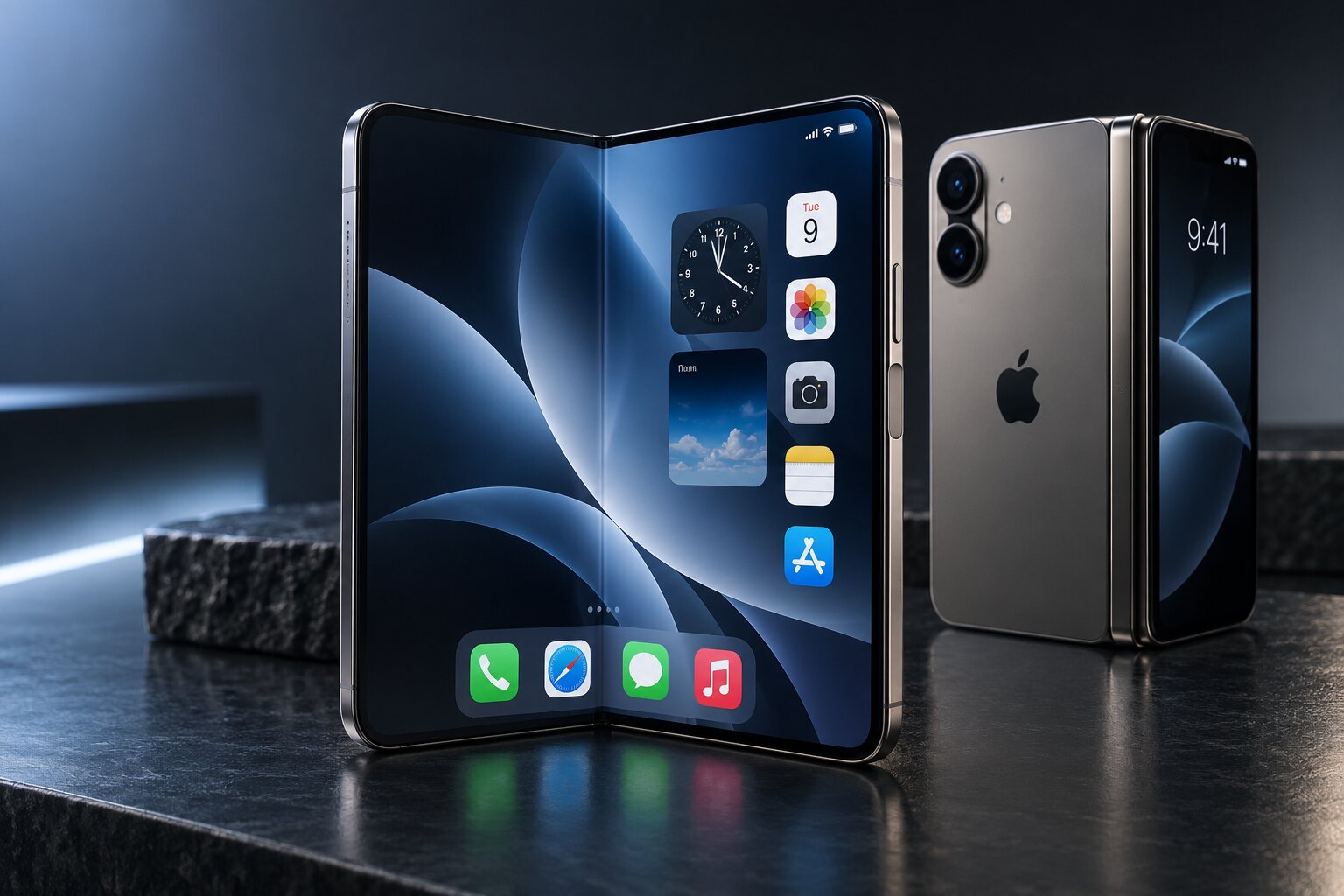
Apple has finally entered the foldable smartphone market, and it has done so with a device that looks less like an experiment and more like an attempt to redefine what a foldable iPhone should be.
At its September 9, 2026 event, Apple introduced the iPhone Duo, its first foldable iPhone. The device opens like a book, turning from a conventional smartphone with a 5.4-inch outer display into a much larger 7.6-inch device designed for multitasking, gaming, video and productivity.
Apple is positioning the Duo as the biggest change to the iPhone design since the original iPhone. The company has paired the foldable hardware with its new A20 Pro chip, iOS 27, Apple Intelligence and a redesigned software experience that changes depending on how the phone is being used.
Early hands-on impressions are also unusually positive. Tom’s Guide found the transition between phone and tablet modes particularly smooth and reported that the crease is visible but difficult to feel. At the same time, the publication noted that the Duo is heavier and thicker than Samsung’s latest Galaxy Z Fold 8 and costs more.
So what exactly is Apple offering for nearly $2,000? Here is everything you need to know.
First, It Is Officially Called iPhone Duo
There has been plenty of confusion around the name.
Apple has not officially called the device the “iPhone 18 Duo.” The official product name is simply iPhone Duo.
It launched alongside the iPhone 18 Pro and iPhone 18 Pro Max, both of which use the same A20 Pro processor. That makes the Duo part of Apple’s 2026 iPhone generation, but it is a separate product category rather than another conventional iPhone 18 model.
That distinction matters because the Duo is built around a completely different idea: one device that can function as a normal phone when closed and a larger tablet-like screen when opened.
A Phone That Opens Into a 7.6-Inch Display
The central feature of the iPhone Duo is its folding display.
When closed, the device has a 5.4-inch Super Retina XDR outer display. Apple says this screen provides about 90 percent of the screen area of the iPhone 18 Pro while remaining practical for one-handed use.
Open the Duo and the experience changes dramatically. The internal display measures 7.6 inches, making it the largest display ever placed inside an iPhone.
Both displays use the same aspect ratio, which Apple says allows content to transition between the outer and inner screens without the experience feeling completely different. Both also support ProMotion, Always-On display and up to 3,000 nits of peak outdoor brightness.
The inner screen also uses a nano-texture surface designed to reduce reflections and make the crease less noticeable.
And there is a notable detail here: the crease has not completely disappeared.
Tom’s Guide reported that the crease can still be seen, but the reviewer could barely feel it while using the phone. That distinction is important because Apple’s approach appears to focus less on pretending the fold does not exist and more on making it less distracting during everyday use.
The Hinge Is a Major Part of the Design
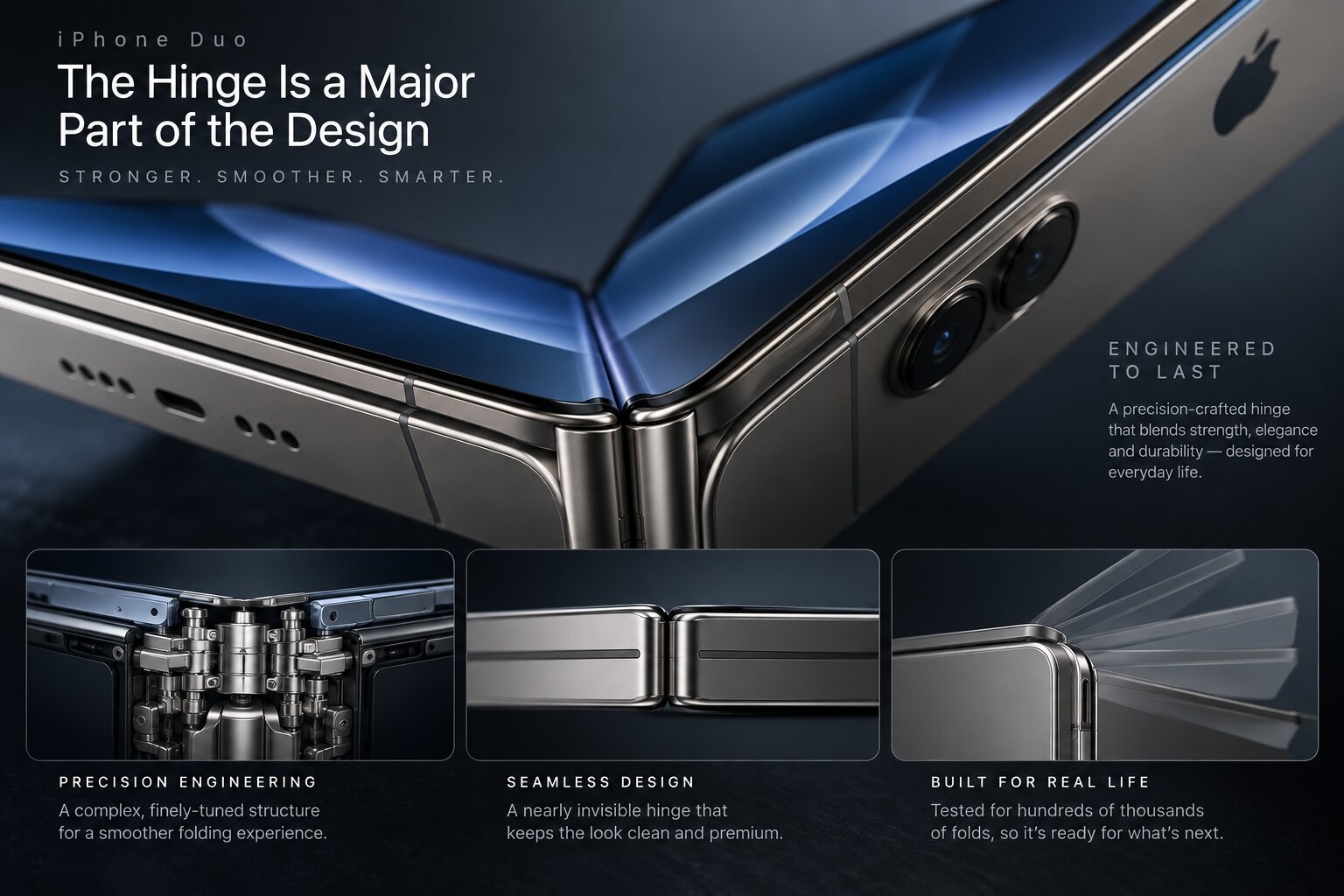
Apple has built the Duo around a precision hinge designed to keep the central portion of the display supported when the phone is opened.
The hinge contains more than 100 components and works with an integrated magnet system to provide controlled opening and closing.
The body uses Grade 5 titanium, while Ceramic Shield protects the rear and Ceramic Shield 2 is used on the outer display. Apple says the new front protection has three times the scratch resistance of the previous generation.
The inner display also receives a scratch-resistant coating and a nano-textured protective layer. Apple says the custom polymer used for this layer can be up to 40 percent stiffer than comparable materials used in the industry.
The Duo is also rated IP68 for water and dust resistance. Apple specifies testing to a maximum depth of six meters for up to 30 minutes under controlled laboratory conditions, although, as usual, water resistance is not considered permanent and liquid damage is not covered by warranty.
It Is Thin, But It Is Not the Thinnest Foldable
This is one area where Apple does not clearly dominate its competitors.
The Duo measures approximately 5.2mm when open and weighs 254 grams. Tom’s Guide notes that Samsung’s Galaxy Z Fold 8 is thinner at around 4.5mm and considerably lighter at about 201 grams.
That means Apple’s focus was not simply to make the thinnest foldable possible.
Instead, Apple has used the available internal space for a combination of batteries, thermal management, cameras and structural components. The result is a phone that feels substantial in the hand.
For users who prefer light smartphones, this will be one of the Duo’s biggest compromises.
A20 Pro Brings Serious Performance
Inside the Duo is Apple’s new A20 Pro, the same processor used in the iPhone 18 Pro models.
The chip is manufactured using a 2-nanometer process and includes a six-core CPU, seven-core GPU and a dual 16-core Neural Engine.
Apple says the CPU is up to 20 percent faster than the previous A19 Pro, while the GPU is up to 40 percent faster and more power efficient. The Neural Engine provides twice the compute power for on-device AI workloads, while unified memory bandwidth increases by 50 percent.
The Duo also gets a custom vapor-chamber thermal system.
This matters because a foldable phone with a large display creates a very different workload from a conventional smartphone. Gaming, multitasking and AI processing can keep the processor under sustained load for longer periods.
Apple says the Duo can deliver up to 35 percent better sustained performance than the iPhone 17 Pro.
Apple Pencil Support Is Coming
The large internal display is not only for watching movies.
Apple says the iPhone Duo will support Apple Pencil with USB-C later this year.
Users will be able to take notes, sketch and mark up documents on either display.
That makes the Duo more interesting as a productivity device. It also brings the phone closer to the space traditionally occupied by the iPad mini, although the Duo remains a smartphone first.
Dual 48MP Cameras, But No Dedicated Telephoto
The camera system is another area where the Duo takes a different approach from the iPhone 18 Pro.
- 48MP Fusion Main
- 48MP Fusion Ultra Wide
The main camera provides optical-quality 2x telephoto framing, but there is no separate dedicated telephoto camera.
That means the Duo does not offer the same camera hardware flexibility as the iPhone 18 Pro and Pro Max.
The 48MP main camera uses sensor-shift optical image stabilization and a computational photography pipeline designed to improve detail and low-light performance. The 48MP ultra-wide camera supports macro photography.
The folding design, however, gives the Duo some camera tricks that a normal iPhone cannot easily reproduce.
You can use the rear cameras for selfies while using the outer display as a preview. Another mode lets people being photographed see the live framing on the external screen.
There is also Smart Take, where on-device AI can analyze a scene and automatically capture an image when subjects are properly positioned.
A New Approach to FaceTime
Apple has placed a new FaceTime camera underneath the inner display.
When it is not being used, it remains hidden, leaving the large internal screen without a conventional camera cutout.
The Duo also introduces features designed specifically around its two-screen design, including the ability to use the outer screen during FaceTime and to prop the phone up for hands-free calls.
The result is a device that can effectively become its own stand for video calls and photography.
Touch ID Returns
One of the more unexpected decisions is Apple’s authentication system.
The Duo does not use Face ID.
Instead, Touch ID is integrated into the side button. Apple says this makes authentication consistent whether the phone is open or closed.
For longtime iPhone users, this is a significant change. Face ID has been Apple’s main biometric authentication system on premium iPhones for years.
The Duo also includes Camera Control and a new Siri Camera mode, allowing Siri to understand what the camera is seeing and respond to questions or take actions based on that visual context.
Battery Life Uses Two Batteries
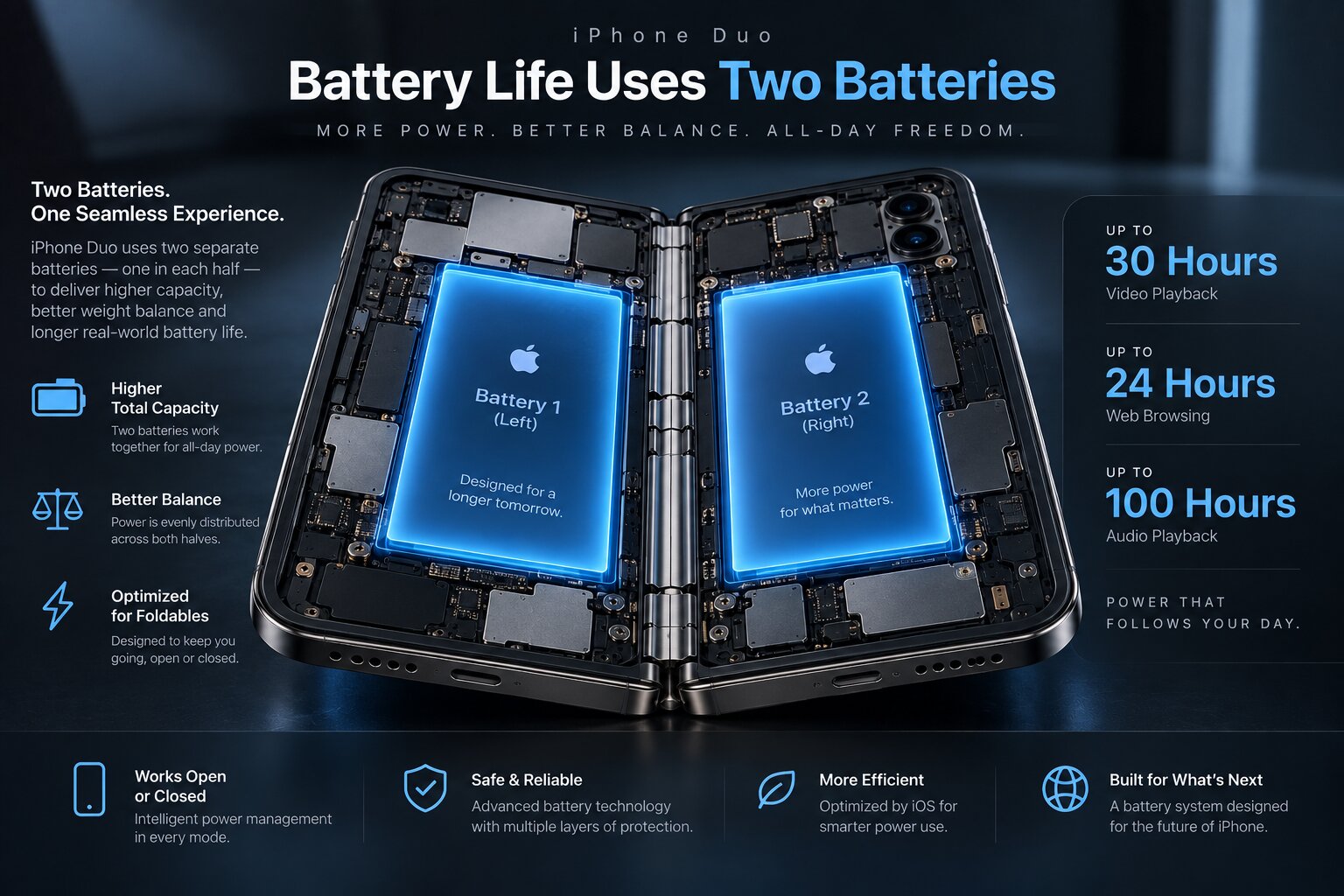
Foldable phones have a difficult battery challenge because the device needs to power a large internal display without sacrificing portability.
Apple’s solution is a dual-battery architecture, with one high-energy battery on each side of the phone.
Apple’s claimed battery figures:
• Up to 31 hours of video playback using the inner display.
• Up to 44 hours using the outer display.
• Up to 24 hours of typical usage when both displays are used equally.
Fast charging can take the device to 50 percent in around 20 minutes, while wireless charging can reach 50 percent in around 30 minutes using MagSafe or Qi2.
The device supports 35W wired charging and 25W wireless charging according to the published specifications reported by Tom’s Guide.
iPhone Duo Is eSIM-Only
There is no physical SIM card slot.
Apple has made the Duo eSIM-only worldwide, which gives the company more internal space for components and battery capacity.
Apple says eSIM is supported by more than 500 carriers worldwide, although availability and carrier support will still vary by country.
For some markets, this will be a bigger consideration than it is in the United States, where eSIM adoption is already widespread.
iOS 27 Is a Big Part of the Experience
The hardware alone is not what Apple believes will make the Duo successful.
iOS 27 has been adapted for the foldable form factor, with multitasking and app layouts designed around the larger screen.
Users can work with multiple apps and take advantage of the additional display space in ways that are difficult on a conventional iPhone.
Apple is also bringing its next generation of Apple Intelligence and Siri AI to the Duo.
Siri AI can use personal context from messages, emails and photos, understand what is on the screen and perform actions across supported apps. Apple says processing is handled on-device where possible, while cloud-based tasks use its Private Cloud Compute system.
The larger screen makes these AI interactions more practical because users have more space to see information, results and controls at the same time.
Storage Goes All the Way to 2TB
iPhone Duo Storage & Pricing
- 256GB $1,999
- 512GB $2,199
- 1TB $2,599
- 2TB $3,199
That makes the 2TB version one of the most expensive mainstream smartphones ever sold.
The entry-level model already costs $1,999, putting the Duo well above the starting price of the iPhone 18 Pro and into premium foldable territory.
Apple is offering the phone in Night Sky and Star White.
Release Date and Availability
Pre-orders: October 16, 2026
Retail availability: October 23, 2026
The iPhone Duo will not arrive alongside the iPhone 18 Pro models.
Apple says pre-orders begin on October 16, 2026, with retail availability starting October 23.
That later release is likely connected to the complexity of producing Apple’s first foldable device at scale.
Is the iPhone Duo Actually Better Than Other Foldables?
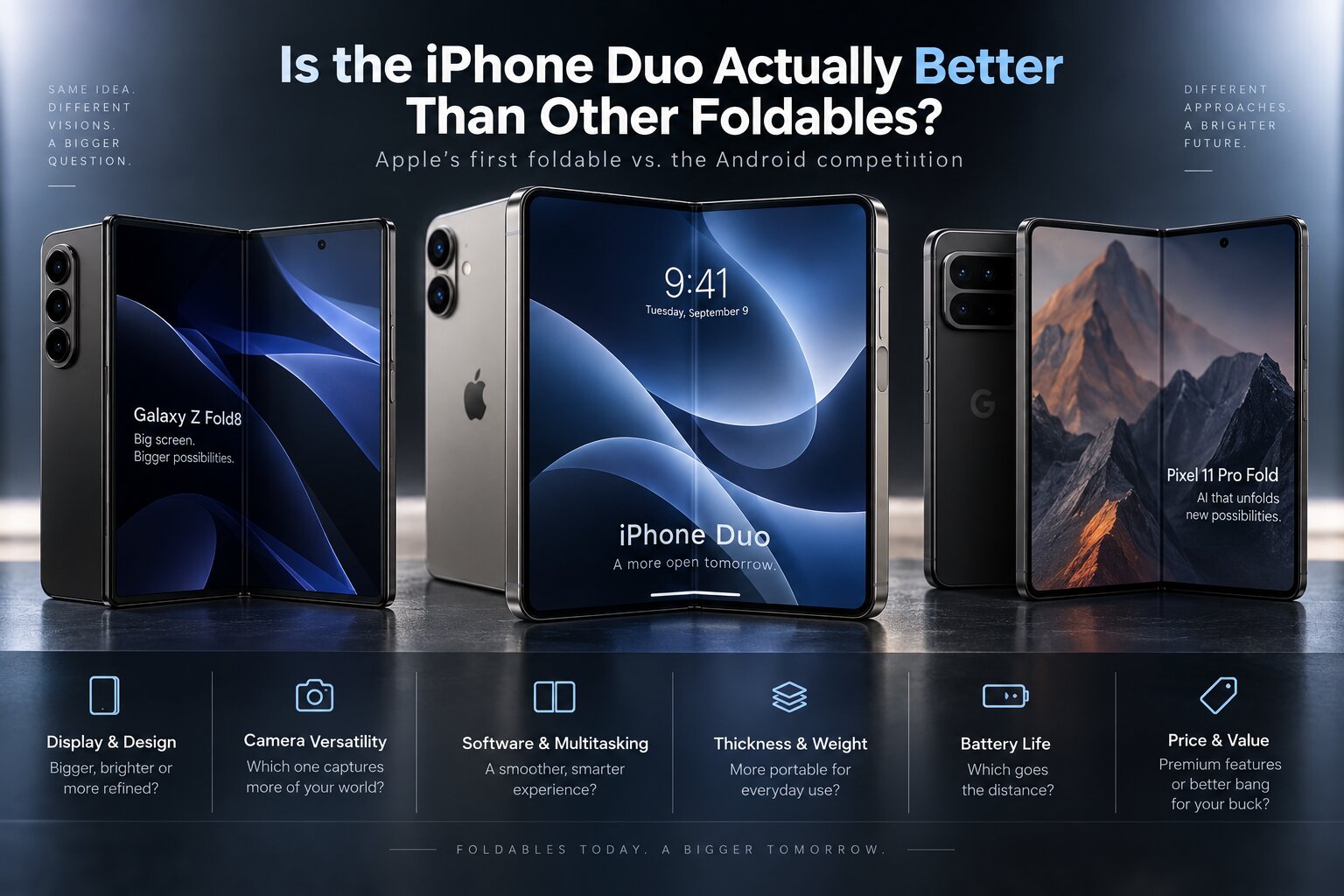
This is where the early hands-on feedback becomes interesting.
Apple has not produced the thinnest or lightest foldable. The Duo is also expensive and lacks a dedicated telephoto camera.
But Apple’s strength appears to be the combination of hardware and software.
Tom’s Guide’s hands-on experience suggests that the transition between the outer and inner screens feels polished, the crease is much less intrusive than expected, and the software responds naturally to the device’s position.
That is also the central challenge for Samsung, Google and other established foldable manufacturers. Apple is entering this market years after its competitors, so it does not have to be first. It has to convince iPhone users that the foldable format is finally mature enough to justify changing how they use their phones.
The Real Downsides
The iPhone Duo is not a perfect phone.
Weight: At 254 grams, the Duo is considerably heavier than a conventional iPhone.
Price: The $1,999 starting price will keep it out of reach for many buyers.
Camera: The camera system is less versatile than the iPhone 18 Pro because there is no dedicated telephoto lens.
Crease: Apple has reduced its visibility and feel, but it has not eliminated it completely.
There is also the normal first-generation question. The Duo is Apple’s first commercial foldable, so long-term durability, hinge reliability and how the inner display holds up after years of opening and closing cannot be judged from launch-day hands-on sessions alone.
The Bottom Line
The iPhone Duo is important because Apple has finally accepted that the conventional smartphone design has limits.
Instead of making the iPhone slightly faster, slightly thinner or adding another camera, Apple has changed the basic shape of the device.
Closed, the Duo works as a relatively compact 5.4-inch phone. Opened, it becomes a 7.6-inch workspace for video, gaming, multitasking, AI and eventually Apple Pencil input.
The early hands-on experience suggests Apple has paid particular attention to the small details that determine whether a foldable feels like a normal phone or like two devices awkwardly joined together. Tom’s Guide found the software polished and the crease difficult to feel, while acknowledging the Duo’s extra weight and higher price compared with Samsung’s latest foldable.
The bigger question is whether that refinement is worth $1,999.
For buyers who simply want the best conventional iPhone, the iPhone 18 Pro or Pro Max remains the more straightforward choice. But for someone who wants one device that can move between a phone and a tablet-sized workspace, the iPhone Duo is now Apple’s answer.
And that may be the most important part of this launch. Apple did not invent the foldable smartphone. Samsung, Huawei, Google, Honor and others have been building them for years.
What Apple has done is bring its own interpretation of the category to the iPhone ecosystem.
The iPhone Duo will begin shipping October 23. The real verdict will come after months of everyday use, when the novelty of opening a $2,000 iPhone has worn off and users have to decide whether the larger screen genuinely changes how they use it.