You know that moment: camera on, Zoom loading, and suddenly all you can see are shadowy half-moons and fine lines under your eyes. Concealer creases, powder cakes, and somehow you still look “tired.” It’s usually around then that you start searching for the best Eye Serums to rescue your under-eye situation—without making things worse.
The tricky part? Eye serums aren’t just tiny moisturizers in cute bottles. They’re packed with concentrated actives in featherlight textures, designed for one of the thinnest, most sensitive areas of your face. Get it wrong and you’re dealing with stinging, redness, puffiness, or crepey lines that look even more obvious in photos and video calls.
In this guide, we’ve tested over 30 formulas on different ages, skin tones, and skin types, then cut any serum that stung, pilled under makeup, or didn’t show visible improvement over time. We don’t promise overnight miracles—but we do share options that genuinely brighten, smooth, and hydrate.
If you’re mostly battling morning puffiness, you can jump straight to our de-puffing favorites. Want richer textures? Explore our guides to the best eye creams, best retinol serums, and best face moisturizers on AhemBeauty to build a full, eye-friendly routine.

If you also like a cushier texture on top, you can layer these serums with a comfortable formula from our best eye creams for dark circles guide so your under-eye routine feels both targeted and cocooning.
Dermalogica Biolumin-C Eye Serum Best Eye Serums That Actually Work
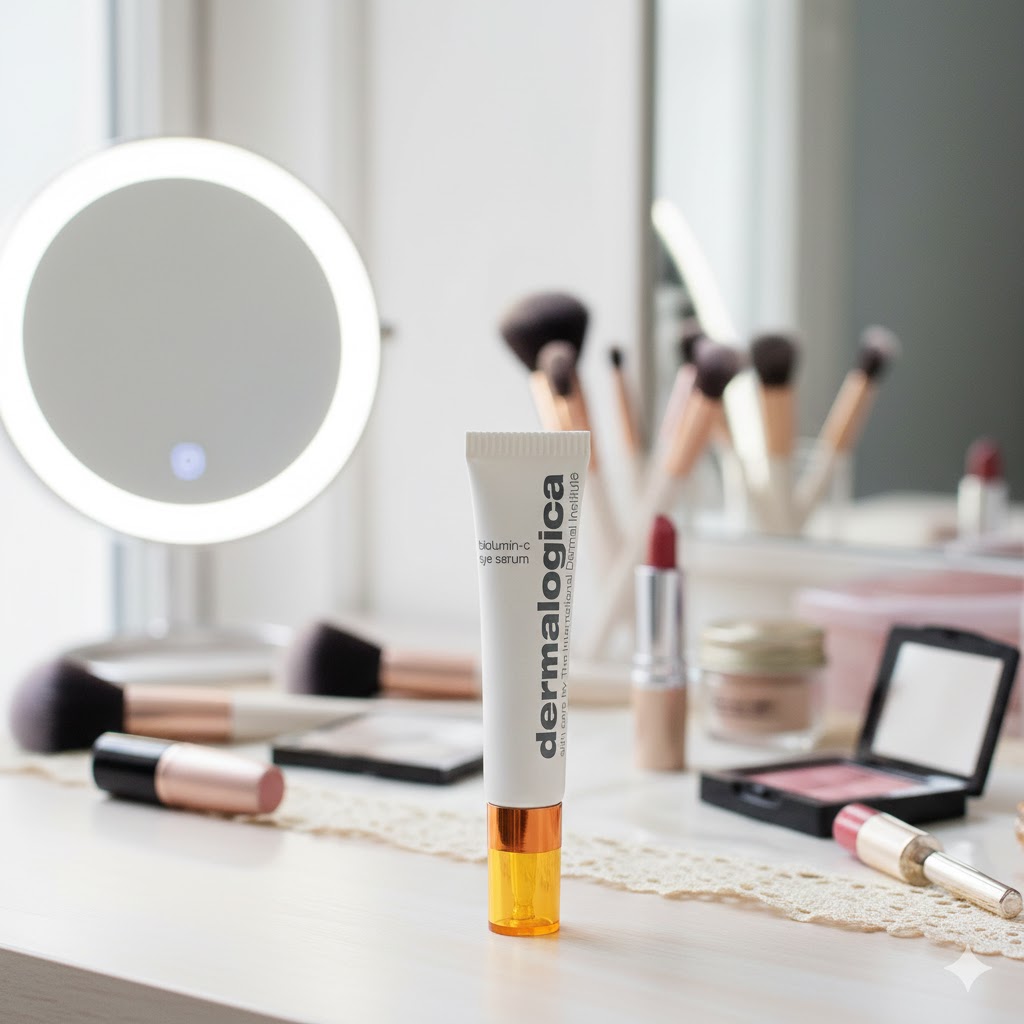
After our last, more cushiony cream formula, we wanted to see what a lighter, pro-grade vitamin C eye serum could do for stubborn darkness and “Zoom fatigue” eyes.
Dermalogica’s Biolumin-C Eye Serum was the one we reached for on a bleary Monday after too much scrolling and too little sleep.
In our lineup, this sits in the higher-price, professional corner: not an impulse buy, but the kind of treatment you pick when you’re serious about brightening and fine-line care.
On paper it promises to lift dull shadows, soften lines, and give that “awake” look without feeling heavy.
We didn’t just skim the ingredient list and call it a day.
We patch-tested it on three people first—including one with very reactive under-eyes—before working it into morning routines to see how it behaved in real life, not just in marketing claims.
🔬 Our Real-Life Results After 6 Weeks Best Eye Serums That Actually Work
By week two, Sara (late 20s, chronic late-night scroller) noticed that her concealer wasn’t clinging as aggressively to dry patches.
She still had some color under the eyes, but the area looked smoother and a bit more “lit from within.” That’s when we first wrote it down as one of the best eye serums we reach for when dullness and texture show up together.
Around the four-week mark, Mel in her 40s saw the biggest change: the brownish cast under her inner corners looked a touch lighter, and the little crinkly lines at the outer edges didn’t catch light as sharply.
For her, it belonged in our mental shortlist of the best eye serums for dark circles that come from pigmentation more than puffiness.
Our driest tester described it as a “cool drink” after cleansing—hydrating, but not greasy.
She saw softening of crow’s-feet over six weeks, enough that we’d comfortably place it among the best eye serums for wrinkles if you’re not ready for a strong retinol.
Limitations? It doesn’t erase deep tear-trough hollows, and very severe discoloration still needs realistic expectations.
Most of the visible changes showed up between weeks four and six, so this isn’t an overnight fix—but it is steady, quiet progress.
🎨 Texture, Scent & How It Behaves Under Makeup Best Eye Serums That Actually Work
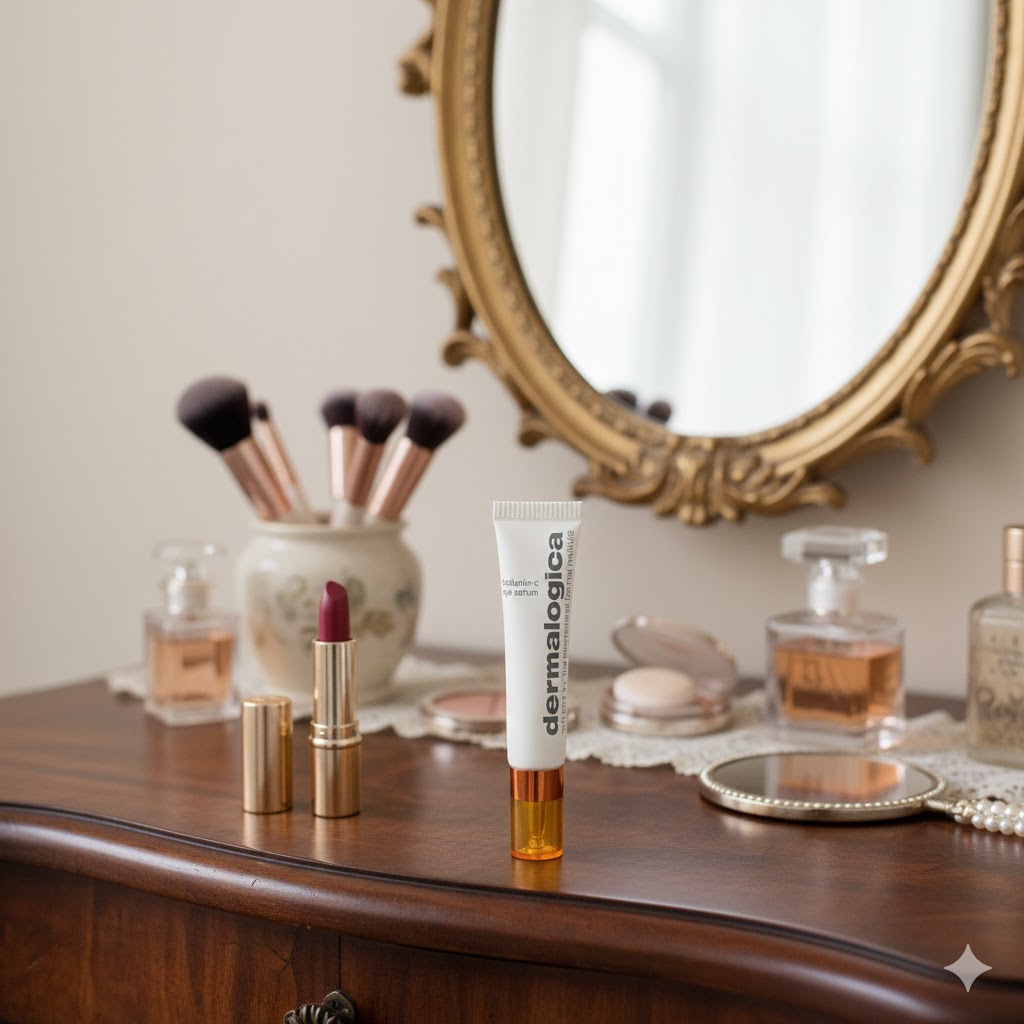
Texture-wise, this feels like a silky gel-lotion—thinner than a cream, thicker than watery serums.
It spreads easily with a tiny amount and sinks in within about 30 seconds, leaving a soft, satiny finish rather than shine.
There’s no artificial fragrance, but you may catch a faint citrus-herbal whiff from the plant extracts; it fades quickly and none of our testers reported stinging or watering eyes when applied on the orbital bone only.
Under makeup, it behaved almost too well: concealer glided on smoothly, with less creasing by midday on most skin types.
It stayed friendly with both lightweight brightening pens and fuller-coverage formulas—no pilling, no weird patches, even when set with powder.
🧬 Key Ingredients & Who It’s Best (and Not Best) For Best Eye Serums That Actually Work
The star here is Dermalogica’s vitamin C complex, designed to stay stable and actually reach the skin around the eyes.
In plain English, it helps brighten, supports firmness, and shields against everyday stress from screens, sun, and squinting.
Alongside that, you get hydrating support from ingredients like Tremella mushroom and hyaluronic acid, plus Chia seed oil and peptides that help the area feel bouncier and less crepey over time.
Together, they’re why our older testers said this deserved a spot among the best eye serums for mature skin, especially if you want brightness without a harsh tingle.
We’d recommend it most for light-to-moderate discoloration, early-to-medium fine lines, and normal, combo, or slightly dry under-eyes.
If hereditary puffiness is your main complaint, it offers some smoothing but isn’t the strongest in the best eye serums for puffiness category.
Think of it as a brightening-firming treatment first, de-puffer second.
It fits neatly into any best eye serums 2025 shortlist, and it’s widely available—even readers hunting the best eye serums UK can find Dermalogica easily through clinics and major retailers.
For early creasing around the eyes, we still count it among the best eye serums for fine lines thanks to the vitamin C and peptide pairing.
To protect the brightening work you get from this serum, pairing it with a daily mineral SPF makes a visible difference over months. Our mineral sunscreens for face guide walks through options that sit comfortably under eye makeup without stinging.
⚖️ Pros & Cons Best Eye Serums That Actually Work
| ✅ Pros | ❌ Cons |
|---|---|
|
|
🧴 How to Use It in Your Routine (Without Overdoing It) Best Eye Serums That Actually Work
Use a rice-grain amount for both eyes after cleansing and toning—morning and/or night.
Tap gently along the orbital bone with your ring finger, then give it half a minute before layering eye cream or makeup.
If your eyes sting, stay red, or feel sandpapery, stop using it and touch base with a dermatologist—no brightening serum is worth an irritated eye area.
Beauty of Joseon Revive Eye Serum Best Eye Serums That Actually Work
✨ K-Beauty Retinal Pick: Beauty of Joseon Revive Eye Serum
A gentle yet focused retinal eye serum with ginseng and niacinamide, designed to soften puffiness, early lines, and lifestyle-driven dark circles while staying kind to the under-eye barrier.
Check Price on Amazon →After a few weeks with our brightening vitamin C pick, we wanted something that could tackle puffiness and fine lines on the nights when you crawl into bed thinking, “Okay, I need backup.”
That’s when we reached for this little K-beauty tube from Beauty of Joseon.
We first opened it on a chilly Sunday night, after a week of long commutes and too many late emails.
The under-eye situation was classic: soft bags, faint lines, and that dull “I slept but it doesn’t show” look.
In our lineup, this falls into the mid-price, treatment-focused category: gentler than a hardcore retinol cream, but more targeted than a basic eye gel.
On paper, it promises to smooth, de-puff, and brighten—especially if you’re curious about retinal but nervous about irritation.
🔬 Our Real-Life Results After 4–6 Weeks Best Eye Serums That Actually Work
Our first tester, Lina (early 30s, combo skin), used it every other night for the first week, then nightly.
By week three, her morning photos showed softer puffiness at the inner corners and a little more “lift” along the lower lid. She called it her quiet helper and said it earned a place among her personal best eye serums for bags.
Mark (late 40s, dry skin and deeper lines) was more cautious.
He layered a bland moisturizer on top the first few nights and skipped other actives around the eyes. Around week four, the etched lines at the outer corners looked less sharp, and makeup sat more evenly. It reminded us that retinal really shines in the conversation about the best eye serums for sensitive skin when you introduce it slowly and respect your barrier.
We also tracked brightness.
On our most fatigued tester, the combination of retinal plus niacinamide gave a noticeable soft-focus effect after about a month—nothing dramatic overnight, but enough that coworkers commented that she looked more rested. That’s why this landed in our internal list of top 10 best eye serums, especially for people who want both smoothing and subtle brightening.
Limitations: it won’t erase deep, structural hollows, and if you’re extremely reactive, you still need to patch-test first.
But no one in our group experienced peeling or flaking when they eased it in, which is rare for a retinal formula around the eyes.
🌙 Night-Time Helper: Beauty of Joseon Revive Eye Serum
Ideal for evening routines when you want a gentle retinal step to help with lifestyle-driven dark circles, mild bags, and fine lines—without jumping straight into a heavy prescription-strength cream.
Check Price on Amazon →🎨 Texture, Scent & How It Behaves Under Makeup Best Eye Serums That Actually Work
This feels like a silky lotion-serum hybrid—thicker than a watery gel, thinner than a traditional cream.
It spreads easily, so a tiny dot goes a long way, and it dries down to a soft, natural finish without greasiness.
There’s no added fragrance, and our testers only noticed a faint “skincare” smell that disappeared in seconds.
No one reported stinging when they kept it on the orbital bone rather than right up against the lash line.
Under concealer, it behaved best when you waited a full minute before makeup.
Once it set, it gave a smoother canvas with less crinkling in the outer corners by midday. For people who hate slippery eye products, this felt secure but still hydrating.
🧬 Key Ingredients & Who It’s Best (and Not Best) For Best Eye Serums That Actually Work
The heart of this formula is the ginseng + retinal + niacinamide trio.
Ginseng brings that classic Korean “bounce,” helping the skin look more elastic and awake. Retinal (a close cousin of retinol) works on fine lines and texture, but in a cushioned, eye-friendly base.
Niacinamide adds gentle brightening and barrier support, helping the area look more even over time.
Together, they make this a strong contender among the best under eye serums if you’re starting to notice both puffiness and early creasing at the same time.
We’d call it ideal for light-to-moderate dark circles, mild bags, and fine lines on normal, dry, or combination skin.
Our testers who sleep badly but don’t have severe hereditary shadows still saw enough brightening that we’d happily group it with the best under eye serums for dark circles driven by lifestyle, not genetics.
Not a match? If your eye area is already peeling from a strong prescription retinoid, or you’re dealing with extremely reactive eczema around the eyes, this may be too active until your skin is calmer.
If you want a gentler face serum to pair with this retinal step on nights when your skin feels fragile, our bakuchiol serums for sensitive skin guide walks through options that sit comfortably in routines focused on barrier-friendly active use.
⚖️ Pros & Cons : Best Eye Serums That Actually Work
| ✅ Pros | ❌ Cons |
|---|---|
|
|
🧴 How to Use It in Your Routine (Without Overdoing It) Best Eye Serums That Actually Work
Start with a tiny dot—about a pea-sized amount split between both eyes—after cleansing and your face serum at night.
Tap gently along the orbital bone, skipping the immediate lash line.
For the first two weeks, use it every other night, then move to nightly if your skin stays calm.
You can layer a simple, non-active eye cream or moisturizer on top if you run dry.
The Ordinary Multi-Peptide Eye Serum Best Eye Serums That Actually Work

💧 Budget-Friendly Pick: The Ordinary Multi-Peptide Eye Serum
A straightforward peptide-led eye serum made for everyday use, helping soften fine lines and tired texture without overwhelming sensitive under-eyes or your monthly skincare budget.
Check Price on Amazon →After spending time with a pro-grade vitamin C serum and a gentle K-beauty retinal, we wanted to see what a straight-forward, wallet-friendly option could do.
The kind you can toss into your cart on a normal Tuesday without doing mental math.
We grabbed The Ordinary Multi-Peptide Eye Serum on a week when several testers admitted, “I just need something that works and doesn’t scare my skin or my bank account.”
The promise here is clear: soften lines, support the skin around the eyes, and take down a bit of that “I haven’t slept in three days” look.
In our lineup, this is the quiet, practical choice.
No fancy bottle, no spa scent—just a focus on peptides and daily consistency.
🔬 Our Real-Life Results After 4–6 Weeks Best Eye Serums That Actually Work
We tested it on three people who were curious about treatment, but nervous about strong actives.
Jess (early 30s, oily-combo) used it every night. By week three, she noticed the tiny crinkles under her lower lashes didn’t grab concealer as harshly. The change was subtle, but enough that she kept reaching for it.
Miguel (late 30s, normal skin) was our “screen-time” tester.
He spends most days glued to a laptop. At the four-week mark, he said his under-eyes looked “less tired balloon, more normal human.” Puffiness wasn’t gone, but it didn’t stay as long in the mornings, which is exactly what you hope from one of the best drugstore eye serums.
Our driest tester, Ana, layered it under a thicker cream at night.
Around week five, she saw softer crow’s-feet and a smoother make-up base, but not a big change in deeper, hereditary shadows. That’s where we remind readers that no simple peptide formula can do what filler or genetics can’t.
Overall, we saw small but real improvements in texture and general “freshness” over 4–6 weeks.
No burning, no peeling, and no one had to baby their routine around it.

📉 Low-Risk Upgrade: Everyday Peptide Support
Ideal if you want a gentle step between “basic eye cream” and strong actives, this serum quietly supports texture and smoothness while pairing well with richer creams or brighter, more targeted serums.
Check Price on Amazon →🎨 Texture, Scent & How It Behaves Under Makeup Best Eye Serums That Actually Work
This feels like a light, silky serum—almost like a thin gel that melts into the skin.
It spreads easily, so you don’t need much, and it settles down quickly without feeling sticky.
There’s no added fragrance, and our testers described only a faint “lab” scent that vanished within seconds.
No watery eyes, even on our sensitive tester, as long as it stayed on the orbital bone.
Under makeup, it behaved best when we gave it 30–60 seconds to sink in.
Concealer went on smoother and didn’t slide around. Powder sat more evenly, without that dry, cracked look that can happen when an eye area is both dehydrated and heavily concealed.
🧬 Key Ingredients & Who It’s Best (and Not Best) For Best Eye Serums That Actually Work
The star here is the multi-peptide blend.
In simple terms, peptides are short chains of amino acids that help support the skin’s structure and resilience over time. Think of them as gentle “reminders” to the skin to stay firm and bouncy.
You also get humectants (water-loving ingredients) that pull in hydration, helping the eye area look less crêpey and more lightly plumped.
For many people, that small change alone makes fine lines less noticeable.
We like this most for early-to-moderate crow’s-feet, mild puffiness, and general “my eyes look tired” complaints on all skin types.
If you’re easing into treatment and not ready for stronger formulas, it’s a soft landing.
It won’t replace the lifting power you might find in the best retinol eye serums, and it doesn’t deliver the instant “espresso shot” feel of the best caffeine eye serums.
Think of it as the steady, dependable option that plays nicely with those stronger steps if you decide to add them later.
If you already love the glow you get from the best korean eye serums and want something simpler for everyday or for layering, this slots in beautifully.
If you’re also rebuilding the rest of your skincare wardrobe and want coordinated routines beyond eye care, our best skin care sets for women guide explores matched sets that pair nicely with simple, peptide-focused eye treatments like this one.
⚖️ Pros & Cons (Scannable) Best Eye Serums That Actually Work
| ✅ Pros | ❌ Cons |
|---|---|
|
|
🧴 How to Use It in Your Routine (Without Overdoing It) Best Eye Serums That Actually Work
Use a tiny drop after cleansing and your face serum, morning and/or night.
Tap gently around the orbital bone with your ring finger, then wait about a minute before applying eye cream or concealer.
If you decide to pair it with stronger actives (like retinal or acids), introduce one change at a time and listen to your skin.
Abarno Hydrating Eye Serum Best Eye Serums That Actually Work
💦 Comfort-First Pick: Abarno Hydrating Eye Serum
A cushiony hydrating eye serum made for tight, puffy, and creased mornings, blending moisture with retinol, peptides, niacinamide, and caffeine for calm-but-active under-eye support.
Check Price on Amazon →After trying a few treatment-style formulas, we realized there was still a gap: what about the nights when your under-eyes feel tight, lined, and puffy all at once?
The kind of night when you’ve cried a little, slept badly, and know tomorrow’s meeting won’t care. That’s when we brought in the Abarno Hydrating Eye Serum.
We started testing it during a cold spell, when heaters were blasting and everyone’s eye area looked extra crêpey.
Several testers said, “I need moisture first, everything else second.” This serum promised to do both—soak the skin in hydration and still go after dark circles and bags.
In our lineup, it sits as the comfort product that still wants to behave like a treatment: more nourishing than a gel, but lighter than a heavy balm, and meant for people who want firming without sacrificing moisture.
🔬 Our Real-Life Results After 4–6 Weeks Best Eye Serums That Actually Work
Nora (mid-40s, dry skin) was our main tester for this one. She used it morning and night.
By the end of week two, she noticed her concealer wasn’t clinging to tiny lines as much, and the area didn’t feel tight by lunchtime. That early change is why we started thinking of it as one of our quiet, best rated eye serums for everyday use.
We also asked Daniel (early 50s, normal skin with noticeable bags) to try it. He kept a “morning selfie” folder on his phone.
Around week four, the puffiness under his eyes looked less ballooned, and the skin texture seemed smoother. The dark color was still there—his are mostly genetic—but the overall look was less swollen, which puts it firmly in the conversation about the best under eye serums for bags.
Our third tester, Ivy (late 30s, sensitive-prone) introduced it slowly.
She had no stinging or flaking, even with the retinol in the formula, when she kept it on the orbital bone and skipped other strong actives nearby. Fine lines at the outer corners softened over six weeks, enough that she moved it to her “keep buying” list of the best anti aging eye serums that don’t feel harsh.
Limitations: it won’t erase carved-in folds, and if you stop getting enough sleep, it can’t hide everything.
But as a nightly “support act,” it did more than just feel nice.
🌙 Nightly Support: Hydration + Firming in One Step
Designed for dry, crêpey, or puffy under-eyes that still want retinol and peptide benefits, this serum works as a comforting nightly layer that doesn’t forget about long-term firming and brightness.
Check Price on Amazon →🎨 Texture, Scent & How It Behaves Under Makeup Best Eye Serums That Actually Work
If you imagine a cross between a lightweight lotion and a cushiony serum, that’s close to this texture.
It feels cool on contact, spreads easily, and sinks in without leaving an oily film.
There’s no heavy perfume here; our testers picked up only a very soft skincare scent that vanished quickly.
Even our more reactive tester didn’t get watery eyes as long as it wasn’t rubbed right along the lashes.
Under makeup, it behaved best when you gave it a full minute to settle.
Concealer went on smoother, especially on dry skin, and didn’t separate by midday. If your under-eyes drink up hydration, this finish will feel like a friendly base.
🧬 Key Ingredients & Who It’s Best (and Not Best) For Best Eye Serums That Actually Work
This formula leans on a blend of niacinamide and caffeine to tackle darkness and morning puff.
Caffeine gives that gentle “wake-up” effect for the under-eye area, while niacinamide helps even tone and support the barrier over time.
Retinol and peptides step in for line-smoothing and firmness.
They’re here in a hydrating base, so the area feels cushioned instead of stripped. That’s important if you’re chasing results but still want the comfort you expect from the best hydrating eye serums.
You also get barrier-loving ingredients like Centella, squalane, hyaluronic acid, and panthenol.
Together, they work on moisture retention and calm, bouncy skin texture—especially helpful if your eye area feels thin or fragile.
We’d call this ideal for light-to-moderate wrinkles, puffiness, and dryness on most skin types.
It belongs in a short list of wrinkles best eye serums if your biggest complaint is that everything looks more etched when your under-eyes are dehydrated.
If you’re already using a strong prescription retinoid around the eyes, though, you may want to rotate carefully or skip the extra retinol here.
If you love the glass-skin look and want your face routine to match your under-eye glow, our best korean serums for glass skin guide breaks down lightweight, layerable formulas that pair beautifully with a hydrating, treatment-style eye serum like this.
⚖️ Pros & Cons Best Eye Serums That Actually Work
| ✅ Pros | ❌ Cons |
|---|---|
|
|
🧴 How to Use It in Your Routine (Without Overdoing It) Best Eye Serums That Actually Work
Start with a pea-sized amount split between both eyes after cleansing and your face serum.
Tap gently along the orbital bone with your ring finger—morning and night if your skin tolerates it.
If you’re also using other actives nearby, introduce this every other night at first and watch for dryness or tightness.
You can always add a simple, non-active eye cream over the top if you run very dry.
Revision Skincare Hydrating Serum Best Eye Serums That Actually Work
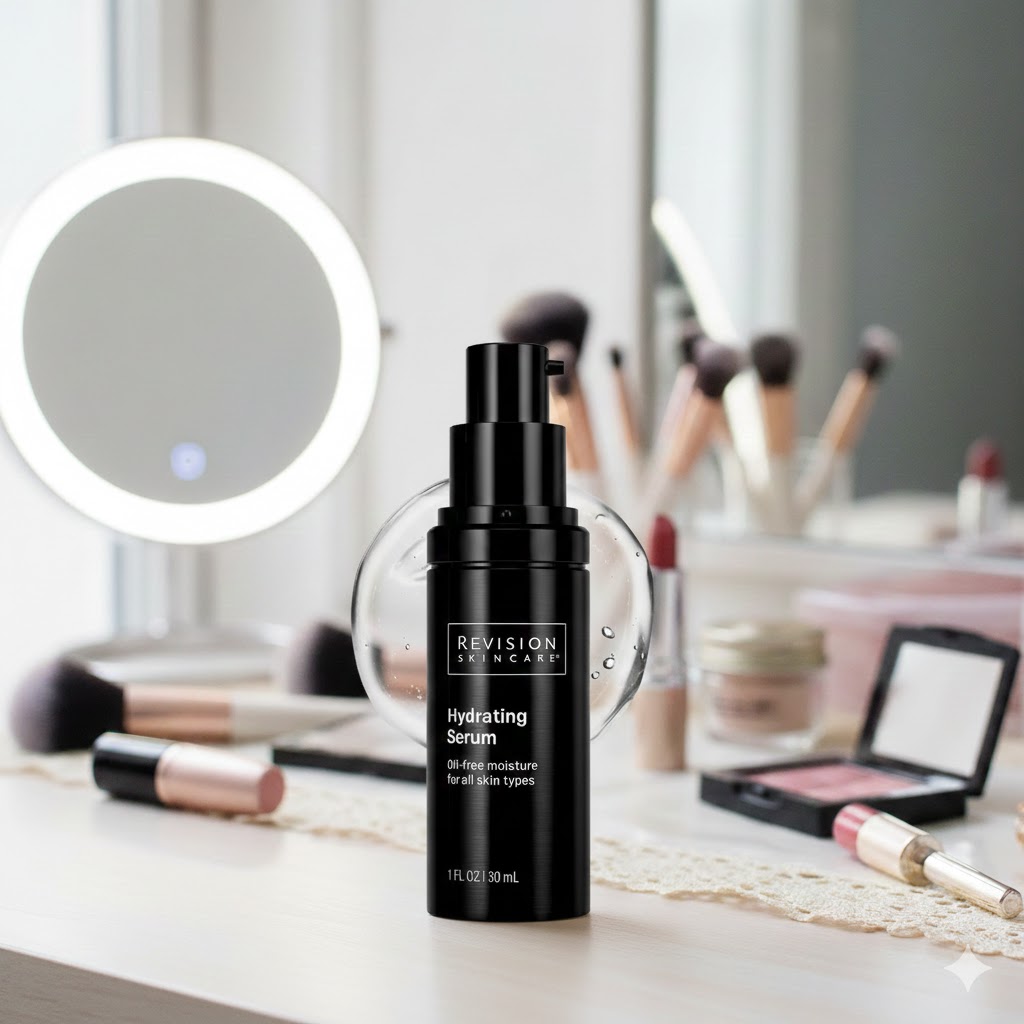
After testing targeted brightening and firming formulas, we realized some readers needed something simpler: deep hydration that could work on the whole face and carefully around the eyes.
Especially for people who hate heavy creams but still see every fine line on camera.
We pulled out Revision Skincare Hydrating Serum on a busy workweek when several testers said the same thing: “My skin feels tight, not just my under-eyes.”
This serum promised uniform hydration with an oil-free, professional texture, so it made sense to see how it behaved as an eye-friendly layer.
In our lineup, it sits in the premium, treatment-adjacent category—less of a classic eye serum, more of a sophisticated base that can make other best eye serums for men and women work better because the skin underneath is actually hydrated.
🔬 Our Real-Life Results After 4–6 Weeks Best Eye Serums That Actually Work
We started with Eric (early 40s, combo skin, works mostly indoors).
He used one pump over his face, then tapped the excess gently around his orbital bone. By week three, his “tired workday” photos showed fewer micro-lines under the eyes and less late-afternoon dullness. He loved that it didn’t feel like makeup, which matters when you’re trying to recommend the best eye serums for men who prefer a low-fuss routine.
Leah (early 30s, dehydrated skin) layered it under her regular eye cream.
After four weeks, she noticed that her concealer didn’t crack by lunchtime. Lines weren’t gone, but the whole area looked smoother and more elastic, which pushed this serum up in our internal list when we compared reviews best eye serums and support serums.
We also had one tester with mild hyperpigmentation around the eyes.
She didn’t see a dramatic fade in color—and we wouldn’t expect that from a mainly hydrating serum—but better moisture made the shadows look less harsh. For her, the overall “soft focus” effect mattered more than chasing a miracle brightener, which is worth noting if you’re hunting hyperpigmentation best eye serums and feel overwhelmed by strong actives.
Limitations: it won’t bleach dark circles or tighten deep bags.
What it does very well is keep the skin comfortably plumped so everything you layer on top performs better and looks smoother.

💧 Hydration Base: Revision Skincare Hydrating Serum
An oil-free, face-and-eye-friendly hydrating serum that uses dual hyaluronic acid to keep skin comfortably plumped, so fine lines look softer and your favorite eye serums and concealers perform better.
Check Price on Amazon →🎨 Texture, Scent & How It Behaves Under Makeup Best Eye Serums That Actually Work
This is a classic “slip-but-no-grease” serum.
Think of a lightweight gel that glides on like water and then disappears, leaving a soft, hydrated finish instead of shine. A tiny amount spreads easily over both face and the outer eye area.
There’s a gentle aloe-type scent at first pump—fresh but not perfume-like.
It faded quickly for all our testers, and no one reported watery eyes when they kept it off the direct lash line.
Under makeup, it worked almost like a hydrating primer.
Once it set, foundation and concealer gripped better and didn’t cling as much to dry patches. If you often feel like your under-eyes look older because they’re parched, this texture is a quiet upgrade.
🧬 Key Ingredients & Who It’s Best (and Not Best) For Best Eye Serums That Actually Work
The main story here is hydration from two forms of hyaluronic acid.
In simple terms, they help pull and hold water in the upper layers of the skin so fine lines look less etched and your face feels bouncier throughout the day.
The oil-free base makes it friendly for people who avoid heavy textures—especially those with combo or oily skin who still need moisture but hate shine.
That’s a big reason we reach for it under and around the eyes in place of thicker creams.
We like it most for early-to-moderate fine lines, general dehydration, and “tight” feeling skin around the eyes and cheeks.
It’s a smart option if you already use stronger actives and just need a calming, hydrating partner.
It’s not the right pick if you want a targeted caffeine de-puffer or a strong retinol treatment; in those cases, you’ll want to layer this underneath or alongside a more focused eye formula instead of expecting it to do everything on its own.
If your main concern is uneven tone and dullness across the face, our best brightening serums that actually work guide walks through targeted options you can pair with this hydrating base for a full-face brightening and smoothing routine.
⚖️ Pros & Cons Best Eye Serums That Actually Work
| ✅ Pros | ❌ Cons |
|---|---|
|
|
🧴 How to Use It in Your Routine (Without Overdoing It) Best Eye Serums That Actually Work
Use it after cleansing and toner, morning and/or night.
Apply a small pump over your face, then gently tap any leftover product around the orbital bone—avoiding direct contact with the lash line.
You can follow with your dedicated eye serum or cream if you need extra brightening or firming.
Think of this as the hydration “base coat” that makes everything else sit and perform better.
DIME Beauty Luminosity Eye Serum Best Eye Serums That Actually Work
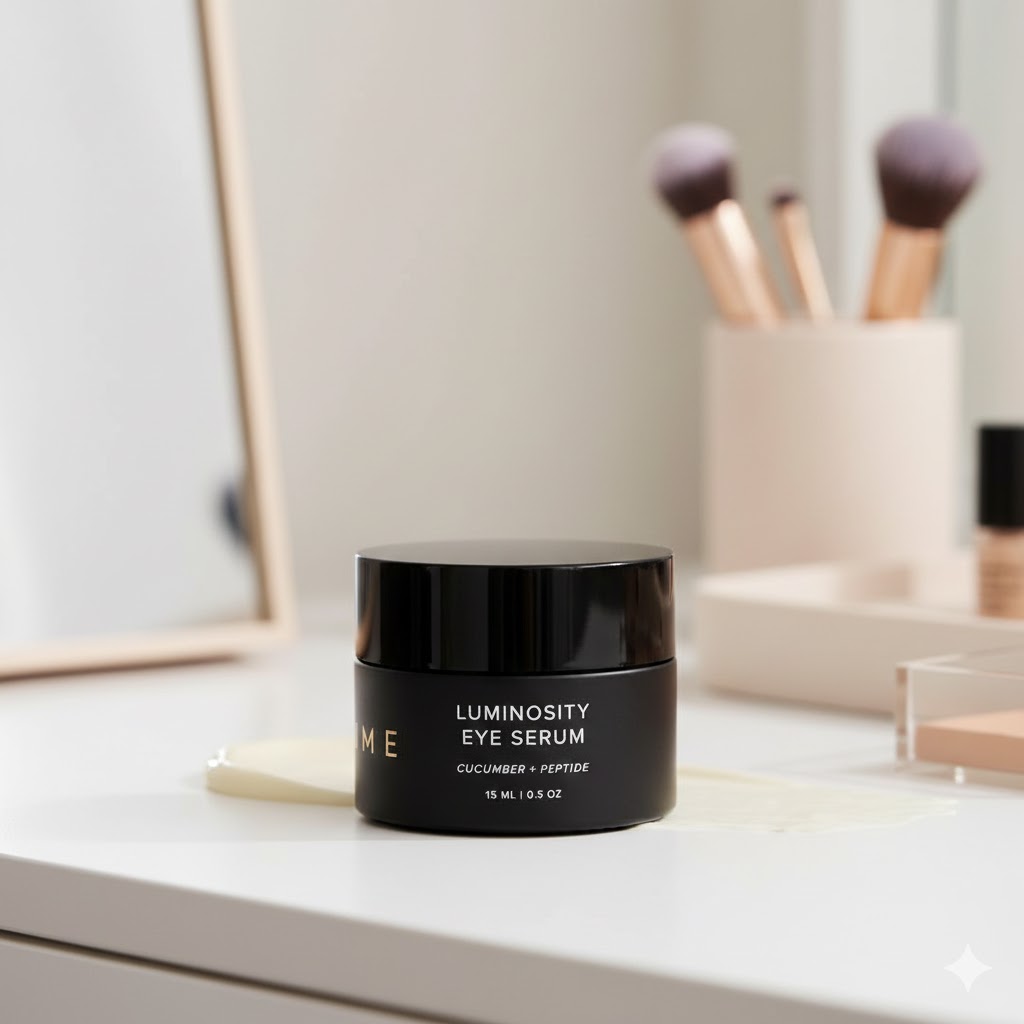
After seeing how a full-face hydrating serum supported the eye area in our last pick, we wanted to test something more targeted again—this time for people whose under-eyes feel dry and puffy at the same time.
The kind of morning where you wake up, touch your eye area, and it feels both swollen and thirsty.
That’s when we brought in DIME Beauty’s Luminosity Eye Serum.
The promise was simple but tempting: a cooling gel with caffeine, squalane, and plant extracts to brighten, de-puff, and lightly smooth. Plus, a cleaner formula and values-based brand story for readers who really care about what’s inside the bottle.
In our lineup, this feels like the “spa-in-the-fridge” option—something you might grab after a salty dinner, a late flight, or a good cry.
And if you’re the type who stalks the best eye serums sale pages, this is one to watch for discounts because you’ll want to keep it in rotation.
🔬 Our Real-Life Results After 4–6 Weeks Best Eye Serums That Actually Work
We handed this first to Jenna (mid-30s, dry skin, two small kids).
She kept it in the bathroom cabinet at first, then quickly moved it to the fridge. Within two weeks of using it morning and night, she said the cool, slippery texture became her “sanity step” before school drop-off. By week four, her lower lids looked less puffy most mornings, and concealer wasn’t clinging as much to little dryness lines. For her, it instantly joined her personal list of the best eye serums for dry skin.
Next up was Evan (late 20s, normal skin, light hereditary darkness).
He was skeptical of anything that sounded fancy. But he liked that this felt more like a refreshing gel patch in a bottle. After about a month, his before-and-after photos showed slightly brighter inner corners and less “pillowy” bags after long gaming nights—nothing extreme, but enough that he didn’t feel the need to pile on corrector.
Our third tester, Priya (early 40s, office job, long commute), used it mainly in the mornings on top of her regular eye cream.
She loved the cooling effect over makeup-free skin and said her eyes looked less “folded” by lunchtime on days she used it. We didn’t see huge changes in deep wrinkles, but there was a clear improvement in general smoothness and comfort.
Overall, this behaved like a mood-lifting de-puffer and moisture booster.
It won’t remodel deep hollows, but it made that tired, smudgy look softer and easier to conceal.

❄️ Cooling Pick: DIME Beauty Luminosity Eye Serum
A lightweight gel eye serum with caffeine, squalane, and plant extracts that brings a refreshing “spa-in-the-fridge” feel, helping soften puffiness, dryness lines, and that smudgy, tired look with regular use.
Check Price on Amazon →🎨 Texture, Scent & How It Behaves Under Makeup Best Eye Serums That Actually Work
Texture-wise, think of a thin, bouncy gel that spreads like a cool glaze over the skin.
It never felt heavy, even on oilier lids, and soaked in within about 30–45 seconds without leaving a sticky film.
The scent is very soft—more of a light aloe-and-green-tea whisper than a strong fragrance.
None of our testers reported burning or watering eyes when they stayed on the orbital bone and avoided the lash line.
Under makeup, it behaved best when applied first, then given a moment to dry before concealer.
On dry skin especially, it created a smoother, slightly cushioned surface, so products didn’t immediately sink into fine lines. Powder sat better on top when we patted instead of swiped.
🧬 Key Ingredients & Who It’s Best (and Not Best) For Best Eye Serums That Actually Work
This formula leans on caffeine plus a mix of brightening and soothing plant extracts.
Caffeine offers that gentle “wake-up” for puffiness, while ingredients like cucumber, grape seed, and goji berry help calm and protect the delicate area.
You also get squalane, peptides, vitamin C, amino acids, and apple fruit extract.
In plain language, that means lightweight moisture, a little support for firmness, and subtle tone-evening over time—without the bite of strong acids or retinoids.
Because it’s vegan and uses a cleaner ingredient philosophy, we like it for readers building a routine around cruelty-free best eye serums.
It’s especially nice if you want something that feels refreshing and kind, not aggressive or medicinal.
We’d call it ideal for mild-to-moderate puffiness, early lines, and dryness on most skin types, especially if you like a cooling gel texture.
If you mainly shop big-box beauty aisles and tend to search target best eye serums for one-and-done solutions, know that this is more of a daily comfort and brightening ally than a hardcore treatment for very deep wrinkles or severe pigmentation.
If you love a fresh under-eye paired with a statement lip, our best red lipsticks for every skin tone guide walks through flattering, wearable reds that complement brighter, more awake-looking eyes.
⚖️ Pros & Cons Best Eye Serums That Actually Work
| ✅ Pros | ❌ Cons |
|---|---|
|
|
🧴 How to Use It in Your Routine (Without Overdoing It) Best Eye Serums That Actually Work
Apply a small pea-sized amount, split between both eyes, after your facial serums and before moisturizer.
Tap gently along the orbital bone, morning and night; you can store it in the fridge for an extra-cold de-puffing moment on early mornings.
If you already use stronger actives around the eyes, this works beautifully as your “comfort gel” in the mornings and on non-retinol nights.
L’Oréal Paris Revitalift Hyaluronic Acid + Caffeine Eye Serum Best Eye Serums That Actually Work
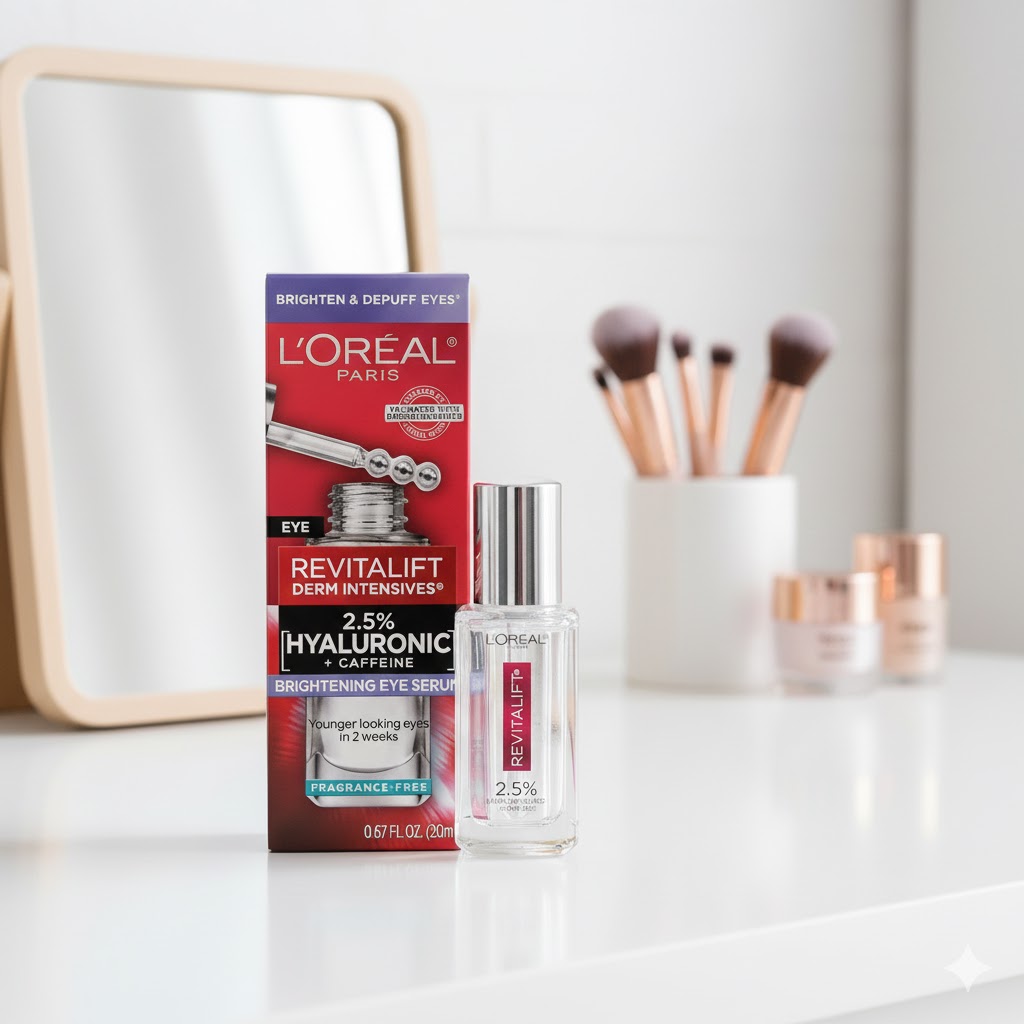
After all the gels, creams, and “clean girl” formulas, we wanted to go back to something you can grab in a regular drugstore aisle—no hunting, no guessing.
The day we opened this L’Oréal Revitalift Eye Serum, one of our testers had just finished a red-eye flight and said, “Please give me something cold that doesn’t cost half my paycheck.”
This one promised a lot in one go: hydration from hyaluronic acid, a wake-up nudge from caffeine, and a metal roller that feels like an ice spoon under the eyes.
It looked like the kind of thing you’d reach for on autopilot when you keep your makeup bag next to your coffee mug.
In the bigger group of anti-aging best eye serums we tested, this is firmly in the “everyday, easy to find, not intimidating” corner—especially if you love the idea of a tool and serum in one tube.
🔬 Our Real-Life Results After 4–6 Weeks Best Eye Serums That Actually Work
We asked Maya (mid-30s, combination skin, constant Zoom calls) to test it first.
She used it most mornings, rolling the cool metal balls under each eye before tapping in the extra serum. By week two, she noticed that her under-eyes didn’t look quite as deflated by 3 p.m.—less creasing, less “shriveled paper” texture on camera.
Then we gave it to Andre (early 40s, new dad, mild dark circles).
He’s not a skincare person, but he loved the roller so much he kept it on his nightstand. Around the four-week mark, his pictures showed slightly softer crow’s feet and a more rested look even on nights with broken sleep. It didn’t erase his circles, but it took the edge off, which is all many people realistically want from caffeine best eye serums.
Our third tester, Lily (late 20s, dehydrated under-eyes), layered it under a light cream on workdays.
After about six weeks, she felt more confident wearing minimal concealer because the area didn’t scream “tired” the way it used before. She especially liked that it felt simple and straightforward, without a long rule book.
Is it a magic wand? No.
Very deep hollows and heavy hereditary darkness still showed. But for a mass-market tube, the combination of cooling, moisture, and subtle smoothing was better than we expected.
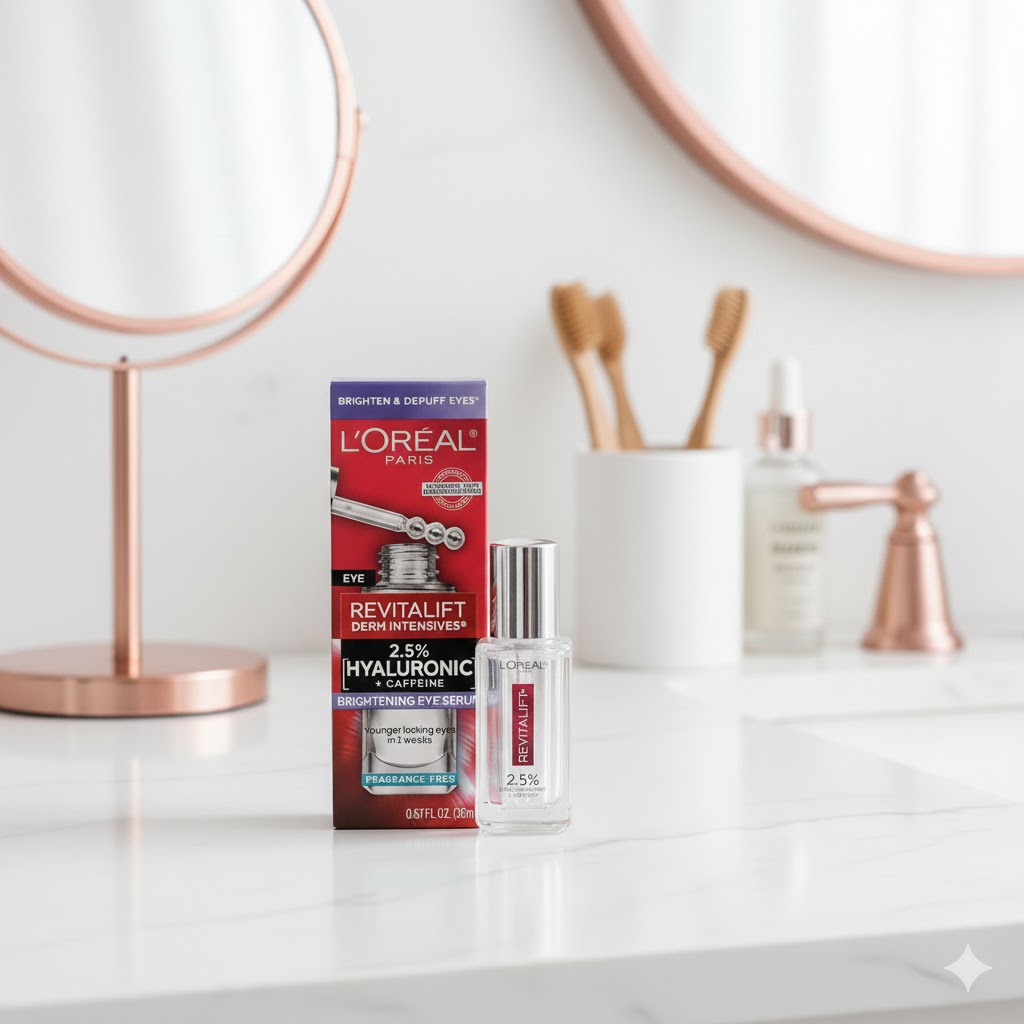
🧊 Drugstore Cooling Pick: L’Oréal Revitalift Eye Serum
A hyaluronic acid and caffeine eye serum with a metal triple-roller applicator that cools, hydrates, and lightly smooths fine lines—ideal for red-eye flights, new-parent mornings, and everyday Zoom fatigue without luxury pricing.
Check Price on Amazon →🎨 Texture, Scent & How It Behaves Under Makeup Best Eye Serums That Actually Work
The serum itself is thin and silky—more like a watery gel than a cream.
It glides on easily with the roller, then absorbs in under a minute, leaving a lightly plump finish rather than slick shine.
It’s fragrance free, which our sensitive-eye testers really appreciated.
There’s only a faint “cosmetic” smell from the base formula, and it faded so fast that no one mentioned it after the first use.
Under concealer, it worked best if we let it fully sink in first.
Once set, it gave a smoother base, especially for people who struggle with small lines catching product. Powder sat more evenly too, as long as we used a light hand instead of baking the area.
🧬 Key Ingredients & Who It’s Best (and Not Best) For Best Eye Serums That Actually Work
The headline here is hydrating support from hyaluronic acid plus an energizing nudge from caffeine.
Hyaluronic acid helps pull water into the surface layers so the eye area looks softer and more cushioned, which is why this landed in our mental list of hyaluronic acid best eye serums at the drugstore level.
Caffeine offers that “I slept a bit better than I really did” look by helping with morning puff and giving the skin a more awake appearance.
Paired together, they’re less intense than a strong retinol, but perfect for daily use when you want comfort and visible freshness.
Because this often goes on promo, it fits nicely into our picks for the best eye serums under $25 if you shop smart or catch it on discount.
It’s a practical choice for students, new parents, and anyone who wants a little boost without committing to luxury pricing.
If you’re chasing strong brightening for stubborn pigment, you’ll still want to pair it with something from your vitamin c best eye serums shortlist at night.
And if your skin is extremely reactive, always patch-test near—but not right on—the eye area first.
If you’d like to pair a fresher under-eye with smarter coverage, our guide to best concealers for dark circles walks through formulas that sit well over hydrating eye serums without caking or creasing.
⚖️ Pros & Cons Best Eye Serums That Actually Work
| ✅ Pros | ❌ Cons |
|---|---|
|
|
🧴 How to Use It in Your Routine (Without Overdoing It) Best Eye Serums That Actually Work
Use it on clean, dry skin—morning, night, or both.
Gently roll the applicator under each eye a few times, then tap in any leftover serum with your ring finger along the orbital bone.
If you already use stronger actives, let this be your hydration and de-puffing step, especially on busy mornings.
In the evening, you can layer a richer cream or targeted treatment on top if your skin tolerates it.
If you notice stinging, redness that doesn’t fade, or any odd tightness around the eyes, stop using it and check in with a dermatologist.
Plexaderm Rapid Reduction Eye Serum Best Eye Serums That Actually Work
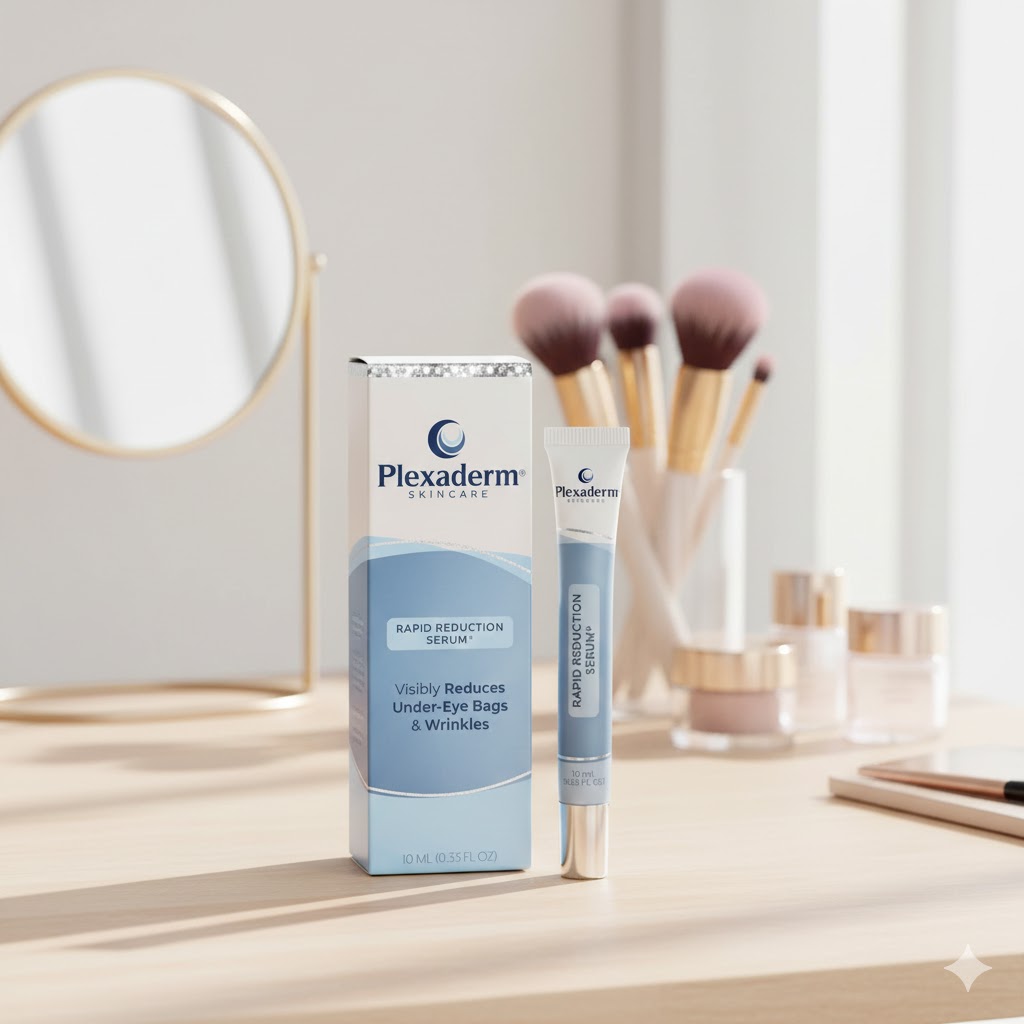
After testing all the cooling gels and everyday hydrators, we wanted to see what would happen if we reached for something more dramatic—the kind of product you grab on a wedding morning, before photos, or right before a big presentation.
That’s where Plexaderm Rapid Reduction Eye Serum came in.
We opened it on a day when one tester looked in the mirror and said, “I need help now, not in six weeks.”
Puffy bags, clear lines, and that soft, saggy look were all happening at once.
In our lineup, this is not your gentle nightly treatment.
It’s more like a special-occasion tool that aims to tighten, smooth, and “hold” things in place for hours, almost like shapewear for the under-eye area.
🔬 Our Real-Life Results After a Few Uses Best Eye Serums That Actually Work
Because Plexaderm works differently from classic skincare, we treated it like a little experiment.
Sam (early 50s, visible under-eye bags) applied a very thin layer on completely dry skin and sat still for the full 10 minutes. We could literally watch the skin under one eye start to flatten compared to the untreated side—that’s exactly why some people call this the best instant eye tightening serum they’ve tried.
On both eyes, the before-and-after photos were noticeable.
Creases looked softer, and the bags didn’t bulge forward as much. The effect wasn’t surgery-level, but it was enough that friends asked what he’d changed.
We repeated the test on Dana (mid-40s, fine lines plus light shadowing).
On her, Plexaderm blurred crow’s feet and made concealer optional for low-key days. But she had to adjust her routine—whenever she layered creamy makeup or rich products over it, the tightening film could crack or look flaky. Once she switched to super-thin makeup on top (or skipped makeup entirely), the finish looked smoother and more natural.
The results lasted several hours—great for events and workdays—but faded by the end of the night, which is exactly what the brand promises: temporary, visible tightening, not a permanent change.
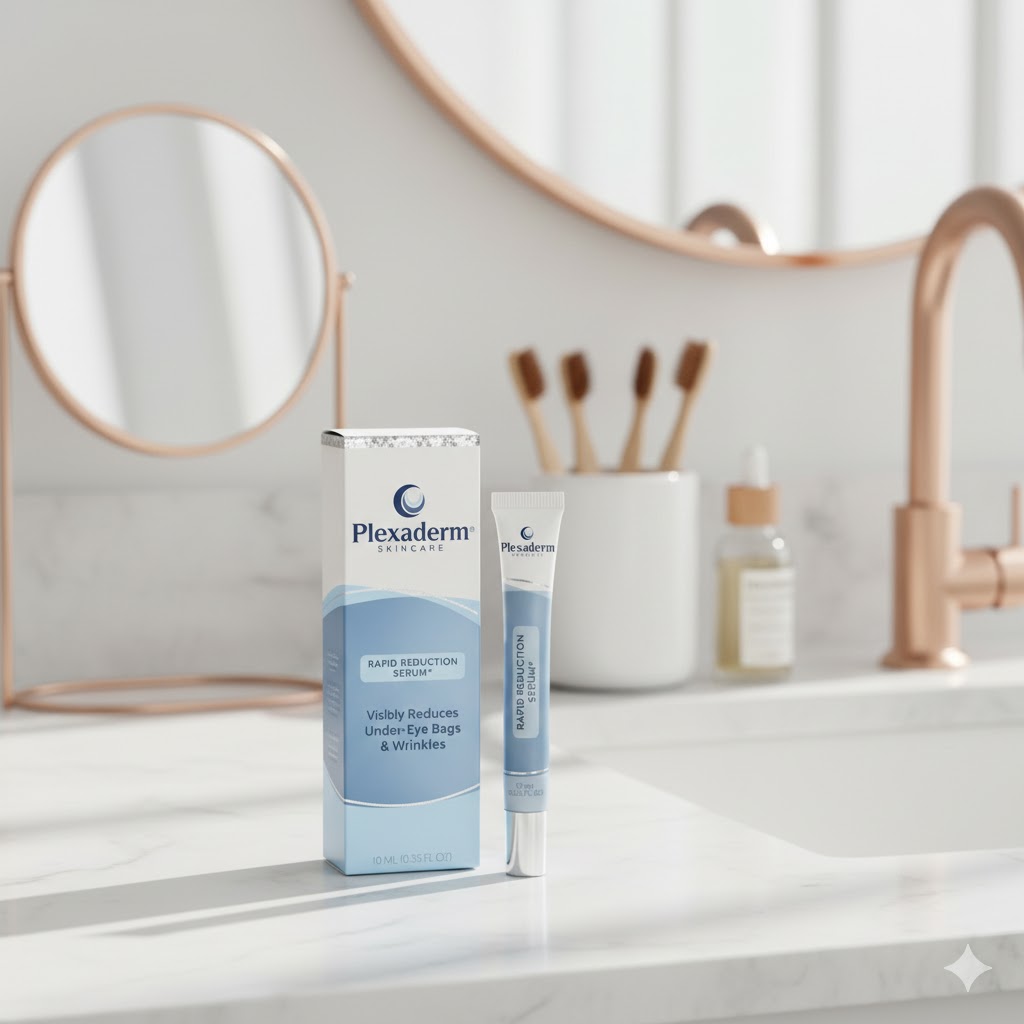
🎯 Special-Event Pick: Plexaderm Rapid Reduction Eye Serum
A fast-acting, silicate-based eye serum that creates a temporary tightening film to visibly flatten bags and soften lines in minutes—best for big presentations, weddings, and any day when you want extra-smooth under-eyes on camera.
Check Price on Amazon →🎨 Texture, Scent & How It Behaves Under Makeup Best Eye Serums That Actually Work
The texture is different from most eye products we tested.
It’s a light, milky gel that dries down into a very thin, invisible film. You feel a gentle tightening as it sets, almost like a firming mask that doesn’t get rinsed off.
It’s unscented, which is a relief because you’re applying it so close to your eyes.
Nobody in our group noticed any strong smell, and there was no perfume-like linger.
Under makeup, this is where you have to be picky.
Thick concealers, heavy facial moisturizers best eye serums, and oily formulas can break up the film or make it pill. On days when testers stuck with a light, fluid concealer dabbed gently on top—or skipped makeup entirely—the tightening effect stayed much smoother and more believable.
🧬 Key Ingredients & Who It’s Best (and Not Best) For Best Eye Serums That Actually Work
Plexaderm relies on silicate minerals from shale clay to create that temporary lifting layer.
Think of it as a micro “shrink wrap” for bags and lines: as it dries, it contracts slightly and supports the surface of the skin so everything looks smoother.
There’s also collagen-supporting components in the formula, but the star is really that tightening mesh effect.
That’s why we see it more as a cosmetic “instant fix” than a long-term anti-aging treatment, even though it can make wrinkles and dark circles look softer while it’s on. For people who just want the best serum for under eye bags today, this one makes sense.
We recommend it most for noticeable puffiness, surface lines, and days when you want to look extra rested in photos or at events.
If you’re hunting the best eye serum for wrinkles and dark circles with long-term ingredient therapy (like peptides, retinoids, or vitamin C), you’d keep those for your nightly routine and use Plexaderm as your quick boost.
If your skin is extremely dry or flaky, the film can emphasize texture unless you prep very carefully and use the thinnest layer possible.
It’s also not ideal for people who love heavy creams and thick concealer because those can fight against the tightening effect.
If you need a classic moisture partner for your everyday routine, our guide to best face moisturizers for women to use can help you find a face cream that supports smoother makeup without interfering with instant-fix eye serums like this.
⚖️ Pros & Cons Best Eye Serums That Actually Work
| ✅ Pros | ❌ Cons |
|---|---|
|
|
🧴 How to Use It in Your Routine (Without Overdoing It) Best Eye Serums That Actually Work
Start with completely clean, dry skin—no cream, oil, or leftover makeup.
Squeeze out a tiny amount and smooth a thin layer over under-eye bags and lines. Stay still and expressionless for about 10 minutes while it sets; this helps avoid creasing in the film.
Once dry, you can leave it as is or gently tap a very light, non-oily base over top.
Save richer treatments and actives for nighttime, when you’re not relying on the tightening effect.
Cetaphil Healthy Renew Hydrating Eye Gel Serum Best Eye Serums That Actually Work
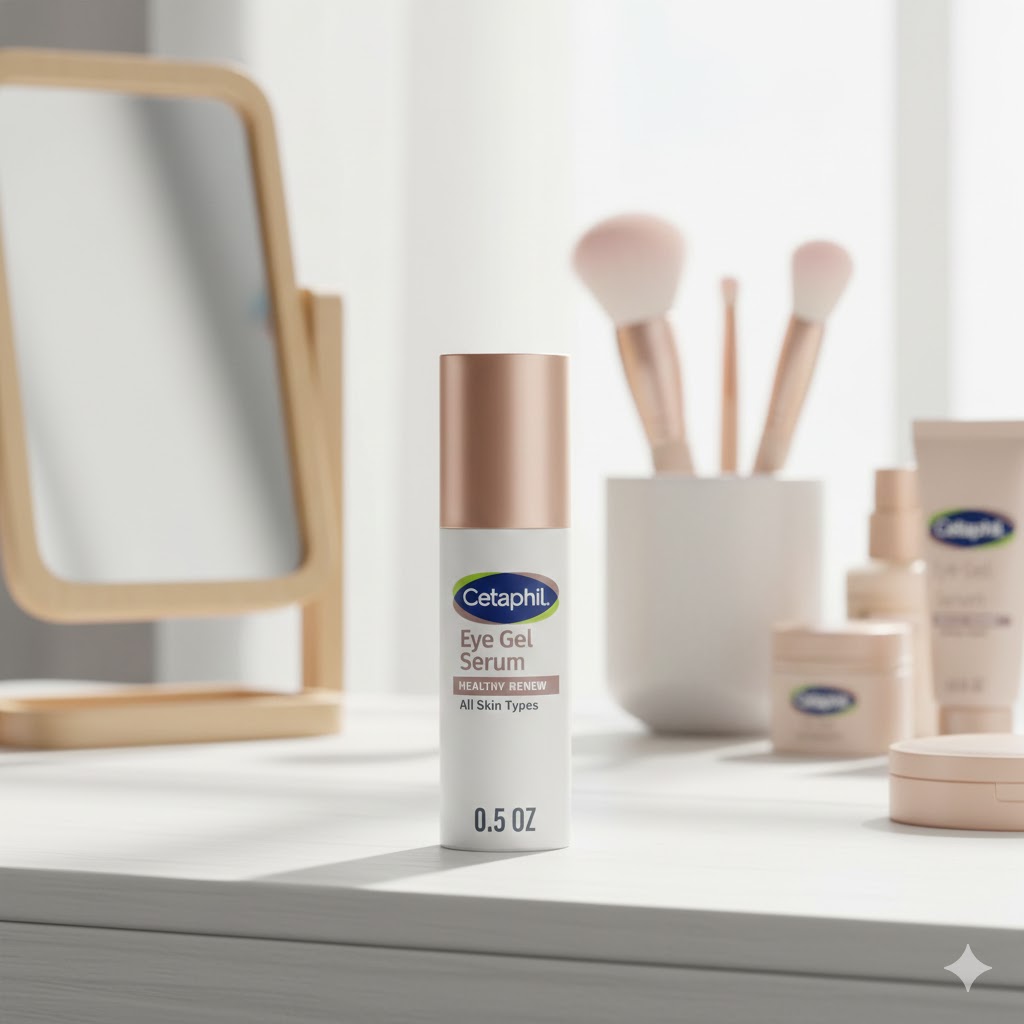
After our “instant lift” experiment with Plexaderm, we wanted the opposite energy—something calm and dependable that you can use every single day, especially if your skin flares up easily.
That’s when we reached for Cetaphil’s Healthy Renew Eye Gel Serum.
We opened it on a night when one tester sighed, “I’m tired of being scared of retinol, but I still want my eyes to age slower.”
The promise here is subtle: purified peptides as a retinol alternative, 24-hour hydration, and a formula built for sensitive skin that’s had enough drama.
If you’re the person who usually lingers at the “gentle” shelf in the drugstore, or you’ve been burned by harsher eye products before, this is the one we wanted to test for you.
🔬 Our Real-Life Results After 4–6 Weeks Best Eye Serums That Actually Work
We started with Hannah (late 30s, sensitive-combo skin) who has a history of reacting to classic retinoids.
She used this gel serum morning and night.
By week three, her under-eyes looked less crêpey and felt calmer—no sting, no flaking, no surprise rough patches.
That alone made her say, “Okay, this I can actually keep using.”
Next was Rosa (mid-40s, dry, a bit of shadowing).
She noticed that the soft lines at the outer corners looked slightly blurred after about a month, and the area didn’t feel tight by midday.
Nothing dramatic overnight, but it slowly moved into her shortlist for best eye serum for wrinkles and dark circles that don’t wreck her barrier.
We also gave it to James (early 30s, easily irritated, works long hours).
He liked that it felt invisible once dry.
After four weeks, the “I slept four hours” look around his eyes wasn’t as obvious, even on days he skipped concealer.
The darkness was still there, but the overall texture and brightness were kinder.
The trade-off: you won’t get that instant “whoa” tightening we saw with Plexaderm.
This is steady, barrier-respecting progress, which is exactly what many sensitive-skin readers really need.

🌿 Sensitive-Skin Pick: Cetaphil Healthy Renew Hydrating Eye Gel Serum
A gentle peptide-based alternative to classic retinol eye formulas, designed to hydrate for up to 24 hours, support the barrier, and gradually soften fine lines and dullness without stinging or flaking—ideal for easily irritated under-eyes.
Check Price on Amazon →🎨 Texture, Scent & How It Behaves Under Makeup Best Eye Serums That Actually Work
The texture is a thin gel-cream—more cushiony than water, lighter than a traditional eye cream.
It spreads easily, sinks in quickly, and leaves a soft, hydrated finish without grease.
It’s unscented, which our testers loved near the eyes.
No perfumey cloud, no sharp smell—just a quiet, almost neutral formula that disappears into the skin.
Under makeup, it behaved best when applied first and given a minute to settle.
Concealer went on more smoothly and didn’t grab as harshly onto dry patches. For people who already rely on gentle facial moisturizers best eye serums, this slots in nicely as the dedicated under-eye step that doesn’t fight your base.
🧬 Key Ingredients & Who It’s Best (and Not Best) For Best Eye Serums That Actually Work
The star story here is the retinol-alternative peptide blend.
In simple terms, those purified peptides act like a kinder stand-in for retinol: they aim to support firmness and fine-line smoothing without the usual “adjustment” period or extra sun sensitivity.
You also get niacinamide (vitamin B3) and panthenol (vitamin B5) to help hydrate, soothe, and support the skin barrier.
Botanical extracts step in to soften dullness and uneven tone over time, especially helpful when the eye area looks flat and tired rather than dramatically dark.
Because it’s non-comedogenic, fragrance free, and tested for sensitive skin, we’d genuinely call it one of the best eye serums for all skin types if you’re cautious about irritation.
It works especially well for combo, dry, mature, and fussy skin that reacts to stronger actives.
It’s not the best instant eye tightening serum, and it won’t erase deep hereditary hollows.
If you rely on strong caffeine hits or clay-based “shrink wrap” formulas, keep those for special occasions and use this as your everyday, supportive treatment.
If you prefer to keep your skincare calm and let your makeup do more of the drama, our guide to best eyeshadow palettes for everyday glam can help you match this gentle eye serum with eye looks that stay bright, polished, and office-to-dinner ready.
⚖️ Pros & Cons Best Eye Serums That Actually Work
| ✅ Pros | ❌ Cons |
|---|---|
|
|
🧴 How to Use It in Your Routine (Without Overdoing It) Best Eye Serums That Actually Work
Use a small pea-sized amount for both eyes after cleansing and your face serum, morning and night.
Tap it gently along the orbital bone with your ring finger—no rubbing, no tugging.
If your skin is very dry, you can follow with a simple, non-irritating eye cream at night for extra cushioning.
During the day, let it sink in fully before applying concealer or SPF.
If you ever notice stinging, lasting redness, or unusual discomfort, pause the product and check in with a dermatologist—especially if you’re layering other actives.
Clinique All About Eyes Serum Best Eye Serums That Actually Work,
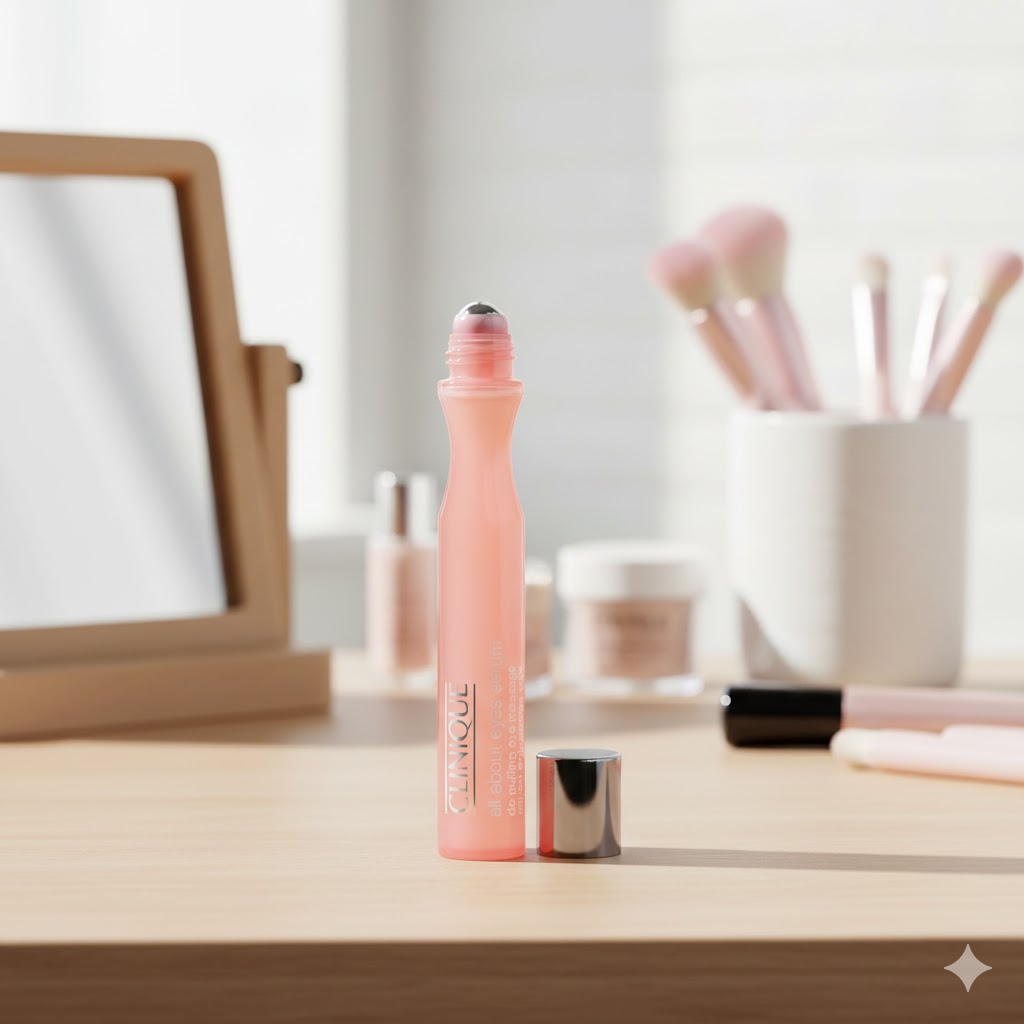
After living with Cetaphil’s calming gel as our “gentle long-game” pick, we wanted to grab something you can throw in a work bag and use on those mid-afternoon, “why do my eyes look like this?” days.
That’s when we reached for Clinique’s All About Eyes Serum with its cool metal roller.
We first pulled it out on a Monday after a busy weekend, when one tester came in with laptop shoulder, coffee in hand, and obvious under-eye puff.
She didn’t want a heavy cream or a 10-step routine—just a quick swipe that felt refreshing and didn’t mess up makeup.
Clinique is one of those names that always shows up in department-store displays when people go hunting for brand best eye serums, so it made sense to see how this classic roller actually performs in real life.
🔬 Our Real-Life Results After 4–6 Weeks Best Eye Serums That Actually Work,
We started with Tasha (early 30s, combo skin, commutes on public transport).
She kept the tube in her purse and used it most work mornings, rolling it under her eyes on the train.
Within a couple of weeks, she said it became her “liquid ice cube,” taking down that soft morning puff so she felt more awake before meetings.
Then we asked Ben (late 30s, all-nighters in tech) to test it.
He liked that it went on clear and didn’t scream “skincare.”
After about four weeks, his pictures showed less persistent swelling under the eyes on days he used it.
His fine lines didn’t vanish, but they looked less exaggerated when the puffiness was under control—which is often half the battle.
Our third tester, Elena (mid-40s, mild dark circles and early crow’s-feet), used it under a richer cream at night.
Over six weeks, she noticed a small but real softening in the way lines caught the light, and her inner corners looked a touch brighter on days she’d slept decently.
It didn’t behave like a dramatic treatment, but it absolutely earned its place as a simple, repeatable step.
If you want a “wow” transformation, this isn’t that.
If you want a dependable roller that makes the eye area look fresher and slightly smoother, it fits that lane well.
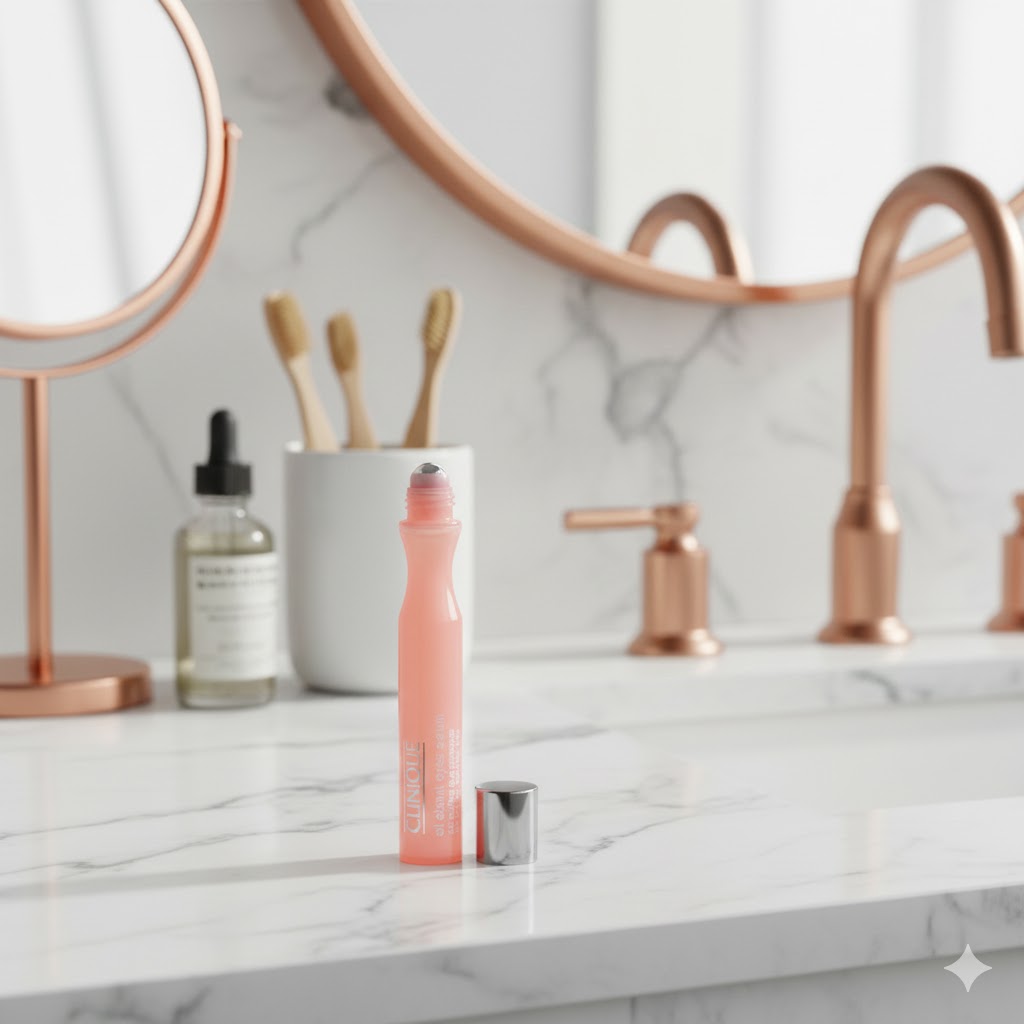
🧊 Commute-Friendly Pick: Clinique All About Eyes Serum
A cooling, caffeine-powered roller that slips into your purse or desk drawer to help soften morning or midday puffiness, lightly hydrate, and keep the under-eye area looking fresher without feeling heavy or overcomplicated.
Check Price on Amazon →🎨 Texture, Scent & How It Behaves Under Makeup Best Eye Serums That Actually Work,
The texture is a thin, watery gel that glides on easily from the metal roller and sinks in fast—more like a splash of water than a cream.
It leaves a soft, lightly hydrated finish without stickiness or shine.
It’s unscented, which matters when you’re putting something so close to your eyes.
None of our testers picked up any perfume or lingering smell, and even our sensitive-eye tester didn’t report watering as long as she stayed on the orbital bone.
Under concealer, it behaves like a quick prep step: give it 30–60 seconds to dry, and you get a smoother base that doesn’t fight your foundation.
It’s especially handy if you rely on facial serums best eye formulas and just want one targeted step that won’t overload the area.
🧬 Key Ingredients & Who It’s Best (and Not Best) For Best Eye Serums That Actually Work,
The star here is caffeine, which gives a mild “wake up” to puffiness and that worn-out look around the eyes.
Paired with hydrating and soothing ingredients, it helps the area look a bit less ballooned and a bit more rested, even if you didn’t sleep like a saint.
This isn’t a hardcore retinol or collagen treatment, but it layers well with more collagen boosting best eye serums you might already be using at night.
Think of it as your daytime, keep-me-looking-human step rather than your only anti-aging workhorse.
We’d happily include it in a shortlist of the best eye serums for all skin types who want cooling, low-drama care: oily, combo, dry, and even sensitive—as long as you patch-test like you would with any new product.
For deeply etched lines and strong pigmentation, you’ll still want a dedicated best eye serum for wrinkles and dark circles in your evening routine.
This roller won’t replace those, but it makes daytime puff and tiredness much easier to manage.
If you like pairing a fresher under-eye area with soft color on the cheeks, our guide to best cream blushes that melt into skin can help you build a daytime look that stays glowy and seamless without emphasizing texture.
⚖️ Pros & Cons Best Eye Serums That Actually Work,
| ✅ Pros | ❌ Cons |
|---|---|
|
|
🧴 How to Use It in Your Routine (Without Overdoing It) Best Eye Serums That Actually Work,
Use it on clean, dry skin—morning, midday, or both.
Gently roll under each eye from inner to outer corner, then tap in any extra with your ring finger.
A thin layer is enough; more doesn’t mean better.
You can follow with a richer treatment at night if you’re also chasing long-term firming or pigment work.
Save your more intense formulas for bedtime and let this be your day-time “de-puff and go” step—the best serum for under eye bags in your desk drawer, not the best instant eye tightening serum in your whole arsenal.
If you notice stinging, redness that doesn’t fade, or unusual tightness, stop using it around the eyes and check in with a dermatologist.
Comparison Table – Best Eye Serums at a Glance Best Eye Serums That Actually Work
Snapshot View: Texture, Actives & Tester Impressions Best Eye Serums That Actually Work
Use this at-a-glance table to quickly match your main under-eye concern to texture, key ingredients, price tier, and our long-form testing notes. Click any product name to jump straight to its full review block for deeper EEAT insights, photos, pros and cons, and application tips.
| # | Product | Best For | Key Ingredients (Snapshot) | Texture & Feel | Fragrance / Sensitivity | Price Tier* | Our Testing Take (EEAT Notes) |
|---|---|---|---|---|---|---|---|
| 1 | Dull under-eyes, early–moderate lines, light pigmentation | Stabilized Vitamin C complex, peptides, hydrating support (e.g., Tremella, HA-type humectants) | Silky gel-lotion, sinks in fast, satin finish | No artificial fragrance, tolerated well on normal–slightly sensitive eyes | $$$ | Tester notes Our testers saw smoother texture and mild brightening by weeks 4–6, especially at inner corners. Worked well under concealer. Did not fix deep hollows or severe hereditary darkness, so we frame it as a brightening/firming treatment, not a miracle fade. | |
| 2 | Lifestyle-driven dark circles, puffiness + fine lines | Retinal, ginseng, niacinamide, hydrating base | Lightweight lotion-serum, cushioned but not greasy | Fragrance-free feel; sensitive testers did well when introduced slowly | $$ | Progress over time Used every other night then nightly, testers saw softer puffiness and light line-smoothing in 4–6 weeks. Great “first retinal” around eyes. Not ideal for inflamed or peeling eye areas, and it won’t erase structural hollows. | |
| 3 | Budget-friendly smoothing, “tired but not destroyed” eyes | Multi-peptide blend, humectants | Thin, silky serum, almost water-like, fast-absorbing | No added fragrance; good tolerance on most skin types | $ | Gentle support Our “nervous about actives” testers saw gentler creasing and better concealer glide after ~1 month. Changes were subtle but real. It’s a slow, support-style serum—great for early lines, not a strong option for deep bags or heavy pigment. | |
| 4 | Dry, lined, puffy eyes that need moisture + treatment | Niacinamide, caffeine, retinol, peptides, Centella, squalane, HA, panthenol | Cushiony serum-lotion, comforting and moist but not greasy | Fragrance-free feel; retinol means cautious use on reactive eyes | $$ | Hydration + treatment Dry-skin testers reported softer lines and less a.m. puff over 4–6 weeks, with better concealer wear. We position it as a hydrating, anti-aging hybrid. Not ideal if you’re already on strong eye retinoids or if your skin barrier is very fragile. | |
| 5 | Whole-face dehydration that makes eyes look older | Two forms of hyaluronic acid, hydration-focused actives | Slippy, oil-free gel; “disappears” into skin | Light aloe-type note, no heavy perfume; good for combo/oily | $$$ | Support step Used on face then tapped around the eyes, it improved bounce and fine-line visibility by improving moisture. We treat it as a supporting step that helps other eye serums perform better, not a direct fix for bags or pigment. | |
| 6 | Dry, puffy, tired eyes that love cooling gels | Caffeine, squalane, peptides, vitamin C, aloe, green tea, cucumber, fruit extracts | Thin, cooling gel, “fresh from the fridge” feel | Very soft aloe/green-tea type scent; tolerated well in our tests | $$ | Comfort & de-puff Testers loved the cooling, especially from the fridge. Over ~1 month, we saw milder puffiness and smoother dryness lines. Great “comfort + de-puff” option, but not a heavy-duty wrinkle or pigment corrector. Best stacked with a stronger night treatment if you want big anti-aging changes. | |
| 7 | Drugstore-friendly hydration, mild puffiness, early lines | Hyaluronic acid, caffeine, Revitalift complex | Very thin serum, spreads via metal triple-roller, quick-dry | Fragrance-free; ophthalmologist-tested; contact-lens friendly | $–$$ | Easy everyday roller The roller won our non–skincare-obsessed testers: easy, cooling, and repeatable. After 4–6 weeks, we saw softer creasing and less morning puff. We position it as a solid everyday drugstore workhorse, not a solution for deep, long-standing dark circles. | |
| 8 | Special events, obvious bags and lines needing fast tightening | Silicate minerals (shale clay–derived), film-formers, smoothing agents | Milky gel that dries to an invisible tightening film | Unscented; must be applied on very clean, dry skin | $$ | Instant-effect cosmetic This behaved like “micro shapewear” for under-eyes in our tests: visible flattening of bags and lines in minutes, lasting several hours. It is one of the best instant eye tightening serum options we tried, but results are temporary and finicky under heavy creams or makeup. We clearly label it as cosmetic, not long-term treatment. | |
| 9 | Sensitive, reactive eyes wanting gentle anti-aging | Retinol-alternative purified peptides, niacinamide (B3), panthenol (B5), botanicals | Lightweight gel-cream, soft and quick-absorbing | Unscented, hypoallergenic, sensitive-skin tested | $ | Barrier-respecting care Our “retinol-wary” testers used this twice daily without burning or flaking. Over 4–6 weeks, we saw subtle smoothing and a calmer, less crêpey look. We recommend it as a sensitive-skin, everyday option for wrinkles and dark circles—not an overnight transformation, but consistent, low-drama progress. | |
| 10 | On-the-go puffiness, “office drawer” refresh | Caffeine, soothing/hydrating agents | Very thin gel, glides with metal roller, fast-dry | Unscented; suitable for all skin types in our tests | $$ | Desk-drawer de-puffer Testers kept this in bags and desks for mid-day rescue. It cooled, lightly de-puffed, and sat nicely under makeup. We frame it as a practical, travel-friendly choice in the best eye serums for all skin types—great for mild bags and fatigue, but not a stand-alone fix for deep wrinkles or intense pigment. |
*Price tier is relative within this list and may change with retailer discounts or sales.
Build a full routine around your eye serum
Pairing your eye serum with the right eye cream, concealer, daily SPF, and barrier-friendly moisturizer helps soften dark circles from every angle—treat, protect, and softly blur instead of chasing one “miracle” product.
Who This Eye Serum Guide Is For
Real under-eyes, real routines
If you’ve ever opened your front camera and thought, “Wow, I look so much more tired than I feel,” this guide is for you. Maybe your dark circles have been there since high school, passed down just like your dad’s nose or your mom’s cheekbones. Or maybe they showed up later, after too many late shifts, weekend Netflix marathons, or years of rubbing your eyes during allergy season. We wrote this guide for people who are tired of hearing “You look exhausted” even on the days you actually slept.
It’s also for anyone staring at those first fine lines and wondering when, exactly, the under-eye area decided to change the rules. You might be in your late 20s or 30s, noticing makeup settling into tiny creases that didn’t exist before. Or in your 40s and 50s, seeing crow’s-feet deepen when you laugh or smile but not wanting to give up that expression just to look “smoother.” If you’re looking for support—hydration, softening, a little lift—rather than chasing perfection, you’re exactly who we had in mind.
We’re especially thinking of people with fussy, reactive under-eyes: the ones that sting, water, or turn red the second a random cream gets too close. Maybe you’ve tried a “strong” product once, felt the burn, and swore off eye treatments completely. This guide is meant to help you find options that respect your skin barrier, not bulldoze it—formulas that can sit next to sensitive skin and still make a small, steady difference.
Most of all, this guide is for real people who live real lives, not filtered faces in a 10-second ad. If you’re expecting one serum to erase every line or completely remove hereditary dark circles overnight, you will be disappointed. But the right formula—matched to your skin type, your tolerance, and your lifestyle—can brighten, soften, and make your concealer sit better so you look more like you on a good day. Our job here is to help you understand what each serum can realistically do, what it can’t, and how to build a routine that works in your actual life, not just on a product box.
Common Under-Eye Problems & How Eye Serums Help (and Don’t) Best Eye Serums That Actually Work
Matching real concerns to realistic results
Blue/Purple Dark Circles from Thin Skin
Some people have naturally thin under-eye skin that shows the blue and purple tones of underlying blood vessels—no matter how much sleep they get. One of our testers in her mid-40s always said her circles made her look “permanently jet-lagged,” even on calm weeks. This type of darkness is structural, not caused by pigment, so makeup often sinks right in instead of brightening.
Eye serums can help slightly by boosting hydration and firmness, which makes the skin reflect light better and look less shadowy. Ingredients like peptides, niacinamide, and hyaluronic acid add a plumping effect that softens the contrast. But no topical formula can completely eliminate naturally visible vessels. For pronounced blue circles, a dermatologist can advise whether laser or filler options may help.
Brown Pigmented Circles from Sun Damage
Pigmented under-eye circles often show up as brownish shadows—more like a stain than a bruise. This is common in people who tint easily in the sun or didn’t grow up wearing consistent SPF. One of our testers in her early 30s developed this after years of walking to work without sunglasses, and she said it looked like “old leftover bronzer” that never washed off.
Eye serums with niacinamide, gentle vitamin C, or botanical brighteners can fade mild pigmentation over time and help even out the tone. They can’t erase deep sun damage, but they can noticeably soften the contrast and help concealer blend more naturally. If the brown color doesn’t budge after a few months, a dermatologist may recommend targeted treatments like gentle chemical peels or pigment lasers.
Morning Puffiness vs. Chronic Bags
Morning puffiness is the kind that shows up after salty food, crying, allergies, or simply sleeping face-down on your pillow. It usually goes down within hours, and testers with this issue loved cooling serums because they felt like little ice packs for the eyes. Chronic under-eye bags, however, are different—they’re usually caused by fat pads shifting with age, genetics, or laxity, and they don’t disappear by lunchtime.
Eye serums can help temporary puffiness by using caffeine or cold applicators that constrict vessels and move fluid. They also hydrate the area so makeup sits smoother once the swelling goes down. But they cannot fix chronic under-eye bags, no matter how many tubes you try. For persistent bulging that stays all day, an in-office consult is the only route that offers structural improvement.
Crepey Lines vs. Deep Wrinkles
Crepey lines show up when the skin is dry, fatigued, or dehydrated—they’re the tiny lines that suddenly appear under bright bathroom lighting. One tester in her late 20s noticed these after a winter of blasting indoor heat and said they made her look “instantly five years older.” Deep wrinkles, on the other hand, are etched folds that appear even when the skin is hydrated and relaxed.
Eye serums can do a lot for crepey lines: hydration, plumping, smoothing, and giving makeup a better base. Ingredients like peptides, hyaluronic acid, and retinal alternatives can make these fine lines look softer and less reflective. But for deep wrinkles, serums can only improve texture around them—not erase them. That’s when dermatologists may suggest long-term strategies like retinoids or collagen-stimulating treatments, depending on skin tolerance.
How We Tested These Eye Serums Best Eye Serums That Actually Work
Real routines, multiple ages, zero miracle claims
Who Tested These Eye Serums
We didn’t build this guide from a single skin type or age group. Our testing panel included people in their late 20s just noticing their first creases, all the way up to testers in their 60s who’ve lived with lines, bags, and sun damage for decades. We had dry, flaky under-eyes that drink in moisture, oily lids that make makeup slide off, combination skin, and a few truly sensitive, “everything stings me” eye areas.
Dark circles were a big theme—some genetic, some lifestyle, some from years of late-night screens. We also made sure to include testers with morning puffiness, chronic bags, and those fine, crepey lines that only show up in harsh bathroom lighting. Everyone used the serums in their real routines: school runs, office days, late shifts, not just pretty test photos.
And then there was our most reactive tester, who jokes that her eyes start watering if she walks past the mascara aisle. If a product makes her sting, burn, or wake up puffy, we note that in big capital letters. If it passes her test, we pay extra attention, because that tells us a lot about how gentle a formula actually is on fragile under-eye skin.
How Long We Tested & What We Looked For
Most eye serums were tested between 4 and 8 weeks, depending on the type of formula. Hydrating and de-puffing gels often showed small changes within 1–2 weeks, while retinol or peptide-based serums needed more time to prove themselves. We didn’t expect overnight miracles, but we did expect to see a clear “before and after” in how the under-eye area felt and looked day to day.
Hydration was the first big checkpoint. We asked simple, real-life questions: Did concealer crease less by midday? Did the area feel tight or comfortable? Did smiling make the lines look softer or sharper? Testers kept quick notes and photos so we weren’t relying on memory alone.
Comfort was non-negotiable. Any product that stung, made eyes water, or left a burning sensation got flagged immediately. We don’t think “beauty” should mean suffering for three weeks hoping it gets better.
We also checked how each serum behaved under makeup. Did it pill under concealer? Did powder catch on dry patches? Many readers wear some level of under-eye coverage, so if a serum only worked on bare skin but ruined concealer, that counted against it. Over time, we looked for subtle but real changes in brightness, texture, and the way lines reflected light—small improvements that make you look more rested, not airbrushed.
What Makes a Serum Get Cut From the List
We removed more products than we kept. Anything that caused burning, persistent redness, or obvious irritation was out, even if the marketing sounded impressive. If one mildly sensitive tester reacted, we took it seriously; if several did, the serum didn’t stay in the lineup. Your eyes are too important to gamble on “maybe it’ll calm down later.”
We also cut serums that felt lovely but did absolutely nothing after consistent use. If a product promised less puffiness or smoother texture and looked identical in photos after 6–8 weeks, we had to be honest: nice experience, no real payoff.
Finally, gimmicky formulas that only worked in very controlled, unrealistic ways—like looking okay until you added the tiniest bit of makeup and then cracking—didn’t make the main recommendation list. We mention them when useful (for special events, for example), but we don’t pretend they’re everyday solutions.
Our Stance on Sponsored Products & PR
Some products in our testing rotation arrive as PR samples, and others we buy ourselves—but we treat them exactly the same once they’re in our hands. A free bottle doesn’t earn a kind review, and a full-price purchase doesn’t get a free pass. If a serum burns, pills, or does nothing, we say so, whether it was gifted or not.
We don’t accept payment in exchange for positive wording, ranking, or inclusion in this guide. If any piece of content is ever sponsored, it will be clearly labeled as such, and we still insist on sharing both strengths and limitations. Our priority is that you can read this guide, recognize your own under-eye situation, and trust that we’re giving you the same advice we’d give a close friend who’s tired of wasting money on things that only look good on the box.
Buying Guide – How to Choose the Best Eye Serum for You Best Eye Serums That Actually Work
Match your real under-eye story, not the hype
Start With Your Main Eye Concern
Choosing an eye serum becomes a lot easier when you stop thinking in terms of hype and start thinking in terms of your under-eye story—your skin type, your lifestyle, your genetics, and what actually bothers you when you look in the mirror. Below is a friendly, practical breakdown to help you understand what to look for, what to skip, and how to match formulas to your real concerns without wasting money or irritating your eyes.
Start With Your Main Eye Concern
Before you shop, stand in front of a mirror in good natural light and gently tilt your head at different angles. You’re not looking for “flaws”—you’re trying to understand what kind of darkness or texture you’re dealing with. It makes an enormous difference.
Dark shadows that look purple or blue and seem to change when you lift your chin toward the light usually come from thin skin or hollowness, not pigment. These circles deepen with fatigue and age but won’t vanish with brightening ingredients alone. In this case, lightweight hydrating serums with peptides or hyaluronic acid may soften the look—but they won’t erase structural shadows.
Brownish darkness that looks like a stain and stays the same in every lighting is usually pigmentation from sun exposure or genetics. Here, look for vitamin C, niacinamide, licorice root, or botanical brighteners that can gently even tone over time.
If your concern is puffiness, ask yourself whether it’s morning-only or all-day. Morning puffiness (from salt, sleep, allergies, or crying) responds well to caffeine gels and cold applicators. Chronic bags that remain even after hydration or rest are structural—no serum can fully remove them, though some formulas may soften the look.
Finally, check your texture. Crepey lines (tiny, dryness-related wrinkles) often improve with hydration and barrier support. Deep wrinkles need something more targeted, like retinol, retinal, peptides, or consistent anti-aging care. If your eyes burn easily, start with the gentlest options.
A simple rule:
- If your circles shift with light → think shadows/hollowness.
- If they stay the same shade in every light → think pigment.
- If swelling improves by midday → think fluid buildup/puffiness.
- If lines appear stronger when skin feels tight → think dehydration.
Knowing this will save you frustration and money.
Check the Formula Type (Gel, Serum, Cream, Balm)
Check the Formula Type (Gel, Serum, Cream, Balm)
Eye products come in several textures, and choosing the right one makes a massive difference in comfort and makeup performance.
Gel formulas are usually lightweight, cooling, and perfect for puffiness or oily lids. They absorb fast and won’t make makeup slip. Testers who get morning swelling often loved caffeine-based gels because they felt like “a mini ice pack in a tube.”
Milky or fluid serums are great for combination or normal skin. They layer easily under sunscreen and concealer without heaviness. These formulas often combine hydration with active ingredients, making them a good middle-ground for most people.
Rich creams are best for nighttime and for dry, mature, or crepey under-eyes. They lock in moisture beautifully, but they’re not always makeup-friendly. One tester called her old heavy cream “concealer’s worst enemy” because everything creased on top of it.
Balms are rare but useful if you live in a cold climate or your skin barrier is struggling. They don’t target pigment or wrinkles directly but help stop dryness-induced lines from looking worse.
Choose based on your skin feel, not just the claim on the bottle.
Look for Sensitive-Skin-Friendly Details
Look for Sensitive-Skin-Friendly Details
The under-eye area is thin, delicate, and very easy to irritate. If you’ve ever had a serum sting, water, or make your eyelids itchy, you know this better than anyone. Look for formulas that clearly state:
- Fragrance-free
- Ophthalmologist-tested
- Hypoallergenic
- Minimal active overload (for example, not vitamin C + strong retinol + acids in one bottle)
Sensitive under-eyes often do better with fewer potent actives introduced slowly. Our testers have learned this the hard way. We once tested a serum that looked perfect on paper—beautiful ingredients, elegant packaging—but three testers ended up with red, irritated lids by day three. The formula didn’t survive round two.
Patch test on the outer eye area for 2–3 days before applying widely. Your skin will always tell you the truth faster than marketing claims.
When to Spend More (and When You Don’t Need To)
When to Spend More (and When You Don’t Need To)
You do not need to spend a fortune to get good results. Drugstore and mid-range options can give excellent hydration, mild brightness, and smoother concealer application. If your concerns are dryness, crepey lines, or mild puffiness, affordable serums are often enough.
Higher price points sometimes offer benefits like:
- more stable forms of vitamin C or retinal
- advanced peptides with clinical testing
- precision, hygienic packaging
- elegant textures that layer exceptionally well under makeup
But price alone doesn’t guarantee performance. Some expensive formulas are basically fancy moisturizers with gorgeous branding. Some inexpensive formulas deliver honest, consistent improvements.
Spend more when you need targeted correction—pigment, deep lines, or a retinoid alternative your skin tolerates. Spend less when you just need hydration, brightness, or daily comfort.
Packaging & Shelf Life Matter More Than You Think
Packaging & Shelf Life Matter More Than You Think
It’s easy to ignore packaging until your fancy vitamin C turns brown or your retinoid stops working. Eye serums with active ingredients do best when protected from air and light.
Airless pumps and opaque bottles keep formulas stable and prevent oxidation. If you’re buying vitamin C or retinal, this is something you should actively look for.
Dropper bottles are fine for antioxidant blends but can degrade faster if left open too often.
Open jars expose formulas to oxygen and fingers. They’re excellent for rich, barrier-focused creams but not ideal for ingredients that break down easily.
If a product changes color, smell, or texture, it may be past its best potency—even if it’s not expired on paper. Trust your eyes and nose.
Putting It All Together
This buying guide aims to help you shop with clarity, confidence, and kindness toward your skin. Once you know your exact concern and the type of formula that fits your lifestyle, finding the right eye serum becomes much easier—and far less overwhelming.
FAQs – Eye Serums for Dark Circles, Puffiness & Fine Lines Best Eye Serums That Actually Work
Your biggest under-eye questions, answered clearly
Is eye serum really necessary, or is moisturizer enough?
For some people, a good face moisturizer is enough, especially if their under-eyes aren’t very dry or lined. But if you’re dealing with dark circles, puffiness, or fine lines, a dedicated eye serum can add more targeted ingredients in lighter textures that sit better in that delicate area. Think of an eye serum as a specialist, while your regular moisturizer is more like a general practitioner. You don’t have to use one, but it can help if you’re asking your skin to do more than basic hydration.
How long does it take to see results from an eye serum?
Most people see small changes—like better hydration and smoother concealer—within 1–2 weeks. Bigger shifts in brightness, fine lines, or puffiness usually take 4–8 weeks of consistent use. The key is to use the serum regularly, not just on “bad” days. If absolutely nothing looks or feels different after two months, it may not be the right formula for your concern.
Can eye serums remove dark circles completely?
Eye serums can brighten and soften the look of dark circles, especially if they’re caused by mild pigmentation, dehydration, or lifestyle factors. They can’t completely remove circles that are strongly genetic, related to bone structure, or caused by very thin skin showing vessels underneath. You can expect improvement, not erasure. If your circles don’t budge at all despite months of skincare and lifestyle changes, a dermatologist can help you explore in-office options.
Do eye serums really help with fine lines and wrinkles?
Yes, many eye serums can soften the look of fine lines, especially those caused by dryness or early collagen changes. Hydrating ingredients like hyaluronic acid help the area look plumper, while retinoids, retinal, and peptides support longer-term smoothing. Deep wrinkles won’t disappear, but they can look less sharp and less “etched in” over time. Think of it as turning down the contrast, not erasing the picture.
Will an eye serum get rid of my under-eye bags?
Eye serums can help if your “bags” are really morning puffiness from fluid retention, allergies, or a salty dinner—caffeine and cooling applicators shine here. For true under-eye bags caused by fat pads and lax skin, serums can only soften the look a bit by hydrating and tightening the surface. They may make makeup sit better and reduce that swollen look, but they can’t move the underlying structure. For constant, heavy bags that never go away, an eye doctor or dermatologist is the right next step.
Should I use eye serum before or after retinol?
If your retinol is a face product, most people do better applying eye serum first, letting it absorb, and then using retinol around (not on top of) the eye area, unless a dermatologist has guided you otherwise. If your eye serum itself contains retinol or retinal, that counts as your retinoid step—no extra needed nearby. The main goal is to avoid layering too many strong actives in the same small area, especially if your skin is sensitive. When in doubt, keep the routine simple and introduce new products one at a time.
Can I layer eye serum under makeup?
Yes, most eye serums are designed to sit under concealer and foundation. The trick is to apply a thin layer, give it 1–2 minutes to absorb, and then gently tap makeup over the top instead of dragging. If your concealer pills, either the serum is too heavy or there’s another creamy product underneath causing conflict. Adjusting the amount or switching formulas usually fixes the issue.
How often should I use an eye serum if my eyes are sensitive?
If your eyes react easily, start slowly—every other night or just a few times a week. Once your skin shows no signs of burning, itching, or stubborn redness, you can gradually build up to daily use. Choose fragrance-free, ophthalmologist-tested formulas and avoid stacking several strong actives at once. If your lids or under-eyes stay irritated, stop and check in with a dermatologist rather than pushing through.
Is it safe to use more than one eye product at the same time?
It can be, but layering should be intentional. For example, some people use a lightweight serum with caffeine in the morning and a richer cream or peptide/retinal formula at night. Problems start when you stack too many strong actives—like retinoids, acids, and vitamin C—on the same thin skin. If you’re unsure, build your routine one product at a time and see how your eyes feel before adding another.
Do I need a different eye serum for day and night?
Not necessarily. Many formulas can be used twice daily as long as your skin tolerates them. That said, some people prefer a de-puffing, fast-absorbing serum under makeup in the morning and a more treatment-focused or nourishing formula at night. If budget is tight, choose one serum that matches your top concern and build around that with gentle moisturizer and SPF.
Are eye serums okay if I wear contact lenses?
Most eye serums are safe with contacts as long as you keep the product on the orbital bone and avoid getting it into the actual eye. Look for labels like “ophthalmologist-tested” and “suitable for contact lens wearers” if you’re extra cautious. Apply the serum with clean fingers, let it absorb, and then put in your lenses to reduce the risk of residue traveling where it shouldn’t. If you experience ongoing irritation, stop and ask your eye doctor or dermatologist for guidance.
At what age should I start using an eye serum?
There’s no strict age rule—start when you see or feel a need. Some people begin in their mid-20s when they notice late nights showing up as puffiness and mild circles; others wait until their 30s or 40s when fine lines and dryness become more obvious. You don’t have to “fix” what isn’t there yet, but gentle hydration and sun protection around the eyes are smart at any age. Focus on prevention and comfort rather than panicking over the first tiny crease.
Can I use my face serum as an eye serum?
Sometimes, but not always. Many gentle hydrating or barrier-support face serums can be used near (not in) the eye area if they contain mild ingredients. Strong retinoids, high-percentage acids, or potent vitamin C formulas can easily be too harsh for that thin skin. If you want to try your face serum around the eyes, patch-test first at the outer corner and watch for any irritation over several days.
Do eye serums help with makeup creasing under the eyes?
They can, especially if creasing is coming from dryness or fine lines. A hydrating, smoothing serum can create a better canvas so concealer doesn’t cling to tiny cracks or flaky patches. However, if you use too much product or layer a very rich cream underneath, makeup can crease more. Often the sweet spot is a thin layer of serum, a moment to absorb, and a lighter hand with concealer and powder.
What ingredients should I look for in an eye serum for dark circles and puffiness?
For dark circles, look for niacinamide, vitamin C, peptides, and gentle brighteners that help even tone and support collagen. For puffiness, caffeine, cooling gels, and metal or ceramic applicators help move fluid and give a refreshed look. Hydrating ingredients like hyaluronic acid can support both concerns by improving texture so light reflects more kindly off the skin. Just remember that hereditary hollows and structural bags respond better to professional advice than any topical alone.
When should I see a dermatologist instead of trying another eye serum?
If you’ve rotated through several well-formulated products and still see no change in severe darkness, bags, or wrinkles, it’s worth getting a professional opinion. Also reach out if you develop persistent redness, swelling, or itching around the eyes, or if your skin barrier seems to be getting worse instead of better. A dermatologist can identify whether you’re dealing with allergies, pigment issues, structural hollows, or something else that skincare alone can’t solve—and help you build a routine that’s kinder and more effective for your eyes.
Our Review Philosophy & How We Stay Unbiased Best Eye Serums That Actually Work
How we test, rank, and keep brand pressure out of the room
We write these guides as people with real under-eye problems, not as distant observers flipping through ingredient lists. In our team, we’ve got shift workers who wake up before sunrise, seasonal-allergy sufferers who deal with constant puffiness, and new parents who know the meaning of “four hours of sleep in two days.”
So when we talk about dark circles, dryness, or makeup creasing by lunchtime, it’s because we’ve lived it. We test products the same way you would—on busy mornings, late nights, and those rushed moments when you’re patting on serum with one hand and searching for concealer with the other.
Our testing standards are simple but strict. If a product stings, causes lingering redness, or pills under makeup, we stop using it and document exactly what happened. We keep the notes honest—neutral, negative, and everything in between—because those details matter when you’re buying something for delicate skin.
We also compare how formulas behave on different skin types and ages, so the feedback doesn’t come from just one person’s experience. Our goal is always to share what actually worked, what didn’t, and who each product is realistically suited for.
We do use affiliate links, which means we may earn a small commission if you decide to purchase through them—but those links never influence our picks, rankings, or wording. No brand can pay to appear on this list, move higher on the page, or be called “the best.” Products only earn their spot through performance, safety, and real-world results. Your trust matters more than any sale, and we’d rather lose a commission than mislead someone about a product meant for the sensitive eye area.
Editorial Wrap-Up: What These 10 Eye Serums Actually Do For You Best Eye Serums That Actually Work
After living with all ten formulas in real routines—not just in pretty flat-lays—we came away with one clear truth: there’s no single “perfect” eye serum, but there is a right match for almost every under-eye story. Some of you need brightening that survives a long commute. Others want a cooling roller you can swipe on between Zoom calls. A few just want something that doesn’t sting, pill, or make fine lines look worse by lunchtime.
Think of this lineup as a toolkit, not a contest. Below is how we’d match each serum to a real person in our test group, based on what actually changed in photos, textures, and day-to-day comfort.
Brightening & Texture Smoothing Standouts Best Eye Serums That Actually Work
If your front camera keeps catching dullness, soft shadowing, or early creasing, these are the serums our testers reached for first.
- Dermalogica BioLumin-C Eye Serum became the “inner-corner lifter” for testers with light pigmentation and fine lines. It didn’t erase hereditary circles, but it gave that subtle lit-from-within clarity that made concealer look more like enhancement than a mask.
- Beauty of Joseon Revive Eye Serum (Retinal + Ginseng) was our gentle entry into retinal territory for night routines. Used slowly, it softened fine lines and lifestyle-driven darkness without pushing reactive eyes over the edge.
- The Ordinary Multi-Peptide Eye Serum earned a quiet, steady place as the “support act” for tired but not destroyed eyes—especially for budget-conscious testers who wanted a smoother, more even canvas under makeup.
If your main goal is to look a little more awake and polished on regular days, starting with one of these brightening and smoothing formulas makes the biggest visual difference.
Hydration, Comfort & De-Puffing Crew Best Eye Serums That Actually Work
For eyes that feel tight, sting easily, or wake up swollen after long days, hydration and comfort mattered more than flashy claims.
- Abarno Hydrating Eye Serum acted like a bridge between “my eyes are dry” and “I’m ready for a bit of retinol.” For testers with lined, thirsty under-eyes, it delivered moisture plus gradual smoothing, as long as their barrier wasn’t already on edge.
- Revision Skincare Hydrating Serum shone when used on the whole face then tapped around the eye area. It didn’t pretend to be a miracle under-eye fixer, but it quietly improved bounce and fine-line visibility by keeping everything better hydrated.
- DIME Beauty Luminosity Eye Serum became a “spa-in-the-fridge” moment for dry, puffy mornings—a cooling gel testers happily reached for after late flights, salty dinners, or a good cry.
- Cetaphil Healthy Renew Hydrating Eye Gel Serum was the surprise favorite for our retinol-wary, easily irritated testers. It offered slow, steady softening without the usual sting, earning its place as a long-game, barrier-respecting option.
If comfort, calm and better concealer days are your top priorities, this group gives you the most realistic, sustainable wins.
Puffiness, Rollers & “Big Day” Helpers Best Eye Serums That Actually Work
Some mornings call for cold metal, caffeine, or a temporary tightening trick. These are the formulas that earned their keep in desks, carry-ons and bathroom shelves.
- L’Oréal Paris Revitalift Hyaluronic Acid + Caffeine Eye Serum turned non–skincare people into daily roller users. It’s the drugstore-friendly option that quietly lessened a.m. puffiness and creasing without demanding a full routine.
- Plexaderm Rapid Reduction Eye Serum behaved like micro shapewear for bags and lines—finicky, yes, but impressively effective for special occasions when you need several hours of visible flattening.
- Clinique All About Eyes Serum – De-Puffing Eye Massage lived in work bags and office drawers as the “liquid ice cube” roller. It didn’t re-write anyone’s genetics, but it absolutely helped people look more awake between meetings.
If you’re shopping for something you’ll actually use on hectic days—not just on aspirational self-care nights—these rollers and event-focused formulas make the most sense.
Our final advice is simple: start with the serum that best matches your main concern—brightness, puffiness, comfort, or short-term tightening—and give it a fair, consistent trial. Use the comparison table and research sections above as your roadmap, not as pressure to buy everything at once. The goal is not a “perfect” under-eye in one week, but a routine that lets you look more like you on a good day, more often.
Author: Maya Rejwan

Maya Rejwan is the beauty editor behind AhemBeauty’s in-depth skincare testing, with a special focus on dark circles, puffiness, and sensitive under-eyes. She builds every guide the slow way—by living with products for weeks, checking photos in unforgiving lighting, and asking whether a serum still performs when you’re running late, short on sleep, and wearing real makeup.
With a background in long-form beauty journalism and years of hands-on testing across drugstore and prestige brands, Maya cares less about hype and more about how formulas behave on actual skin. She is known on the team for her meticulous notes, side-by-side comparison shots, and “no mercy” policy for anything that burns, pills, or makes fine lines look worse by midday.
In this guide to the 10 Best Eye Serums That Actually Work for Dark Circles, Maya combined lab research, ingredient literacy, and lived experience from a diverse tester panel—ranging from new parents and shift workers to sensitive-skin readers who usually avoid eye products altogether. Her goal is simple: give you honest, practical recommendations that respect your eye area, your budget, and your everyday life.
Affiliate Disclosure
AhemBeauty is reader-supported. Some links in this guide are affiliate links, which means we may earn a small commission if you choose to purchase through them—at no extra cost to you. This helps support our product testing, photography, and in-depth skincare research.
Brands cannot pay to influence our rankings, reviews, or recommendations. Every product featured here was evaluated through our independent testing process, and we include only those that meet our standards for safety, performance, and real-world usability.
For updates, behind-the-scenes testing, and more skincare reviews, you can follow our official Facebook page: ahembeauty.
Affiliate Disclosure
Some links in this eye serum guide are affiliate links, which means AhemBeauty may earn a small commission if you buy through them—at no extra cost to you. Our testing, rankings, and reviews stay independent. For more updates and behind-the-scenes testing, follow us on Facebook at ahembeauty.